
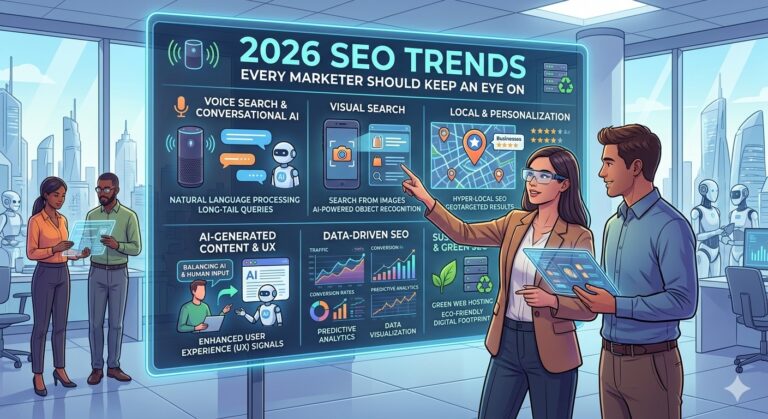
As search engines refine their algorithms and consumers alter how they do online searches, search engine optimization, or SEO, keeps changing. What was effective in SEO a few years ago might not be as effective now.
Marketers will need to adjust to new technology, more intelligent algorithms, and shifting consumer behavior in 2026. Companies who keep up with the most recent SEO trends are more likely to retain a strong online presence, draw in organic visitors, and rank better in searches.
Marketers are increasingly using AI-powered tools to:
AI-assisted SEO strategies help businesses make smarter decisions and improve content performance.
In the past, SEO strategies focused heavily on inserting keywords into content. Today, search engines prioritize search intent, which refers to the reason behind a user’s search query.
There are several types of search intent, including:
Content that directly answers user questions and provides useful information is more likely to rank higher in search results.
Content quality continues to be one of the most important ranking factors. Search engines prioritize content that provides value, accuracy, and clarity.
High-performing content typically includes:
Marketers who consistently produce valuable content will maintain a strong SEO advantage.
Voice search is becoming more common as people use smartphones and smart assistants to find information online.
Voice searches tend to be more conversational and often include longer phrases.
To optimize for voice search, marketers should:
Voice search optimization can help capture additional search traffic.
Mobile browsing now dominates internet usage. As a result, search engines prioritize websites that perform well on mobile devices.
A mobile-friendly website should include:
Businesses that ignore mobile optimization risk losing both rankings and potential customers.
User experience is now a major ranking factor. Search engines analyze how users interact with websites and reward pages that provide smooth experiences.
Important factors include:
Optimizing these elements improves both search rankings and visitor satisfaction.
Video content is becoming increasingly important in search results. Many users prefer watching videos rather than reading long articles.
Marketers can improve SEO by:
Video content can increase engagement and expand search opportunities.
Search engines now evaluate topic authority rather than just individual keywords. Websites that publish multiple related articles around a specific topic are more likely to rank well.
A common strategy involves creating:
This structure helps search engines understand the expertise of a website in a particular field.
Successful SEO strategies in 2026 rely heavily on data and analytics. Marketers must track performance and continuously optimize their content.
Important metrics include:
Data insights allow marketers to refine strategies and improve long-term results.
Search engines are becoming better at detecting low-quality, misleading, or spammy content. Authenticity and trustworthiness are now critical factors for ranking success.
Businesses should focus on:
Trustworthy content helps build credibility with both search engines and audiences.
To remain competitive in the evolving SEO landscape, marketers should:
Staying proactive is essential for long-term success.
SEO in 2026 is more sophisticated than ever before. Artificial intelligence, user experience, search intent, and high-quality content are shaping the future of search engine optimization.
Marketers who stay informed about emerging SEO trends and adopt modern strategies will be better positioned to attract organic traffic and grow their online presence.
By focusing on value-driven content, data insights, and user-focused optimization, businesses can build sustainable SEO strategies that succeed in an increasingly competitive digital world.
To deliver innovative, scalable, AI, and human-centered technology solutions that empower businesses to thrive in a digital-first economy
1129 Northern Blvd., Suite 404, Manhasset, New York 11030
Privacy Policy | Team of Use | Cache © 2026 All rights reserved