
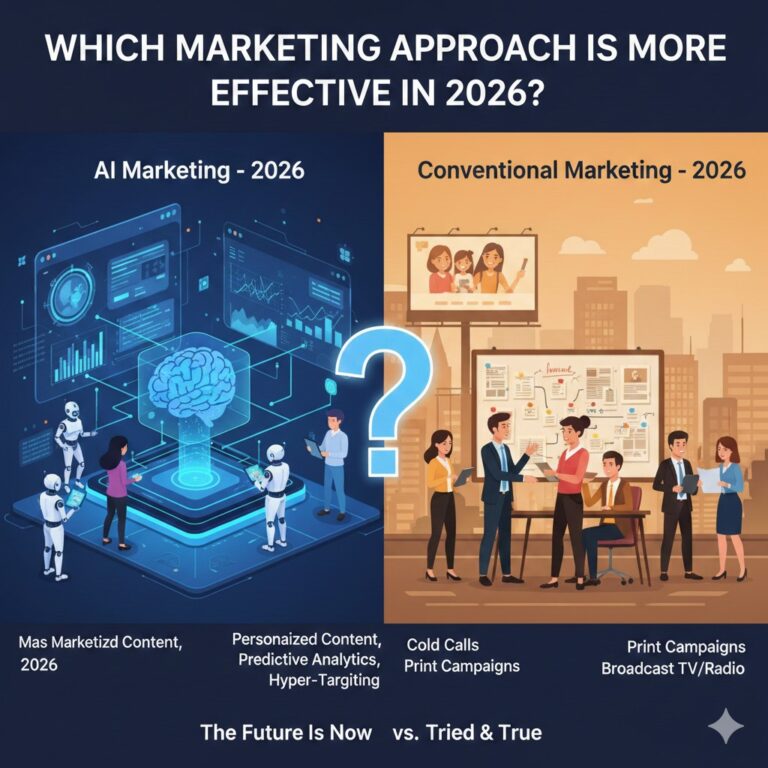
The last ten years have seen a significant change in marketing. Data-driven, AI-powered digital strategies have replaced practices that once mostly depended on print advertisements, cold calls, and human research. As 2026 draws nearer, companies are posing a crucial query:
Which is more effective, AI or traditional marketing?
There is more to the solution than just one or the other. Making better marketing choices requires an understanding of how both strategies function in the current competitive environment.
Traditional marketing refers to conventional methods such as:
These methods dominated for decades and built many successful brands. Traditional marketing focuses heavily on broad audience reach and brand awareness.
Strengths of Traditional Marketing
Limitations of Traditional Marketing in 2026
In 2026, these limitations make it harder for businesses—especially small and medium-sized ones—to compete efficiently.
AI marketing uses artificial intelligence technologies to automate, optimize, and personalize marketing efforts. It includes:
AI allows marketers to analyze massive amounts of data in seconds and make real-time adjustments.
AI processes customer behavior, trends, and engagement metrics instantly. Instead of guessing what works, businesses rely on real-time insights.
Traditional marketing relies heavily on assumptions and delayed feedback.
Winner in 2026: AI Marketing
Consumers expect personalized experiences. AI enables:
Traditional marketing typically delivers one message to a broad audience.
Winner in 2026: AI Marketing
AI reduces manual labor, optimizes ad spending, and automates repetitive tasks. This makes it highly cost-effective, especially for small businesses.
Traditional marketing often requires large upfront investments with uncertain returns.
Winner in 2026: AI Marketing
AI-powered campaigns adjust in real time. If an ad underperforms, algorithms optimize it immediately.
Traditional campaigns—like print ads or billboards—cannot be changed once launched.
Winner in 2026: AI Marketing
Traditional marketing still has one advantage: physical presence and emotional familiarity. Local events, print materials, and in-person promotions can create strong community trust.
AI marketing, while powerful, sometimes lacks that tangible connection if not executed thoughtfully.
Winner in 2026: Traditional Marketing (for local brand trust)
Absolutely.
The smartest businesses in 2026 use a hybrid marketing strategy:
For example:
The combination maximizes both efficiency and emotional connection.
If we compare scalability, cost-efficiency, personalization, and measurable ROI, AI marketing clearly outperforms traditional marketing in 2026.
However, traditional marketing still plays a role in industries that rely on local relationships, community presence, and physical interaction.
Final Verdict:
AI technology continues to evolve, becoming more accessible to small businesses and entrepreneurs. Automation, predictive analytics, and AI-driven personalization will only grow stronger.
Traditional marketing will not disappear—but it will become more selective and strategically integrated into digital campaigns.
Businesses that adapt to AI while maintaining authentic human connections will lead the market.
In the debate of AI vs Traditional Marketing in 2026, AI clearly provides the edge in efficiency, personalization, scalability, and measurable results. However, traditional marketing still holds value for trust-building and local engagement.
The key is not choosing one over the other—but understanding how to combine both effectively.
Marketing success in 2026 belongs to those who embrace innovation while preserving meaningful customer relationships.
To deliver innovative, scalable, AI, and human-centered technology solutions that empower businesses to thrive in a digital-first economy
1129 Northern Blvd., Suite 404, Manhasset, New York 11030
Privacy Policy | Team of Use | Cache © 2026 All rights reserved