
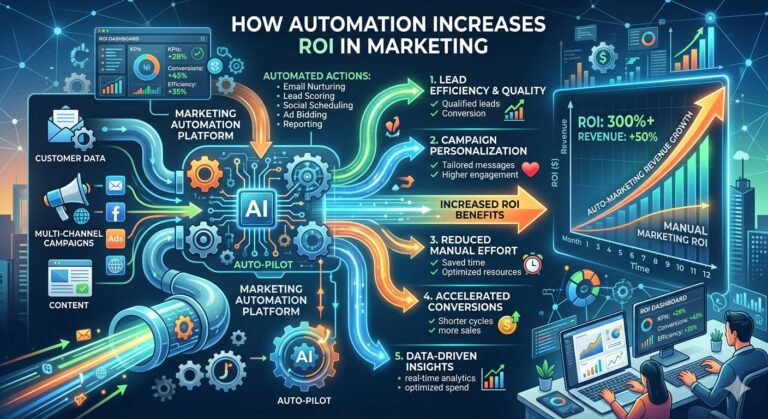
Return on Investment (ROI), which is the ratio of revenue to marketing expenses, is frequently used to gauge the performance of marketing initiatives. Improving marketing ROI can be difficult for many companies because of ineffective workflows, manual procedures, and subpar targeting.
In 2026, marketing automation has emerged as a potent tool for companies looking to optimize their marketing effectiveness while keeping expenses under check. Marketers can provide targeted campaigns, streamline operations, and make data-driven decisions that greatly increase ROI by utilizing AI-driven platforms and smart automation solutions.
The use of technology to automate marketing campaigns, workflows, and tasks is known as marketing automation. Automation tools manage operations using pre-established rules and data insights rather than carrying out each step by hand.
Common automated marketing activities include:
By automating these tasks, businesses can increase efficiency and achieve better marketing results.
One of the primary ways automation improves marketing ROI is by reducing operational expenses. Manual marketing processes often require large teams and significant time investment.
Automation allows businesses to:
When marketing teams spend less time on routine activities, they can focus on strategic initiatives that drive growth and profitability.
Generating leads is only the first step in the marketing funnel. Converting those leads into customers requires consistent engagement and personalized communication.
Marketing automation improves lead nurturing by:
This ensures that leads receive the right information at the right time, increasing the likelihood of conversion.
Poor audience targeting can waste marketing budgets and reduce campaign effectiveness. Automation tools use data analysis and AI to identify the most relevant audiences for marketing campaigns.
Benefits include:
Improved targeting leads to higher conversion rates and better marketing ROI.
Traditional marketing campaigns often rely on manual monitoring and adjustments. Automation tools can optimize campaigns in real time by analyzing performance data and making automatic improvements.
Automated systems can:
These adjustments ensure marketing resources are used efficiently.
Customers today expect personalized experiences from brands. Automation enables businesses to deliver personalized marketing at scale.
Examples include:
Personalized marketing improves customer engagement and increases conversion rates, ultimately boosting ROI.
Understanding marketing performance is essential for improving ROI. Automation tools provide real-time analytics that help marketers evaluate campaign success.
Key insights may include:
With accurate data, marketers can make informed decisions and continuously refine their strategies.
Automation helps align marketing and sales teams by creating a seamless lead management system.
Automation tools can:
This streamlined process reduces friction and improves the efficiency of the sales funnel.
Beyond immediate improvements in ROI, automation provides several long-term advantages:
As businesses grow, automation ensures that marketing operations remain efficient and sustainable.
To maximize ROI with automation, businesses should follow these best practices:
A balanced approach ensures automation enhances rather than replaces human expertise.
As artificial intelligence continues to evolve, marketing automation will become even more sophisticated. Advanced systems will provide predictive insights, deeper personalization, and smarter campaign optimization.
Businesses that adopt automation early will gain a competitive advantage by achieving higher efficiency and stronger marketing performance.
Marketing automation is transforming how businesses approach digital marketing. By reducing operational costs, improving targeting, optimizing campaigns, and delivering personalized customer experiences, automation significantly improves marketing ROI.
In today’s competitive digital landscape, automation is no longer optional—it is a strategic necessity. Businesses that leverage automation effectively will be able to scale their marketing efforts, maximize efficiency, and achieve sustainable growth.
To deliver innovative, scalable, AI, and human-centered technology solutions that empower businesses to thrive in a digital-first economy
1129 Northern Blvd., Suite 404, Manhasset, New York 11030
Privacy Policy | Team of Use | Cache © 2026 All rights reserved