
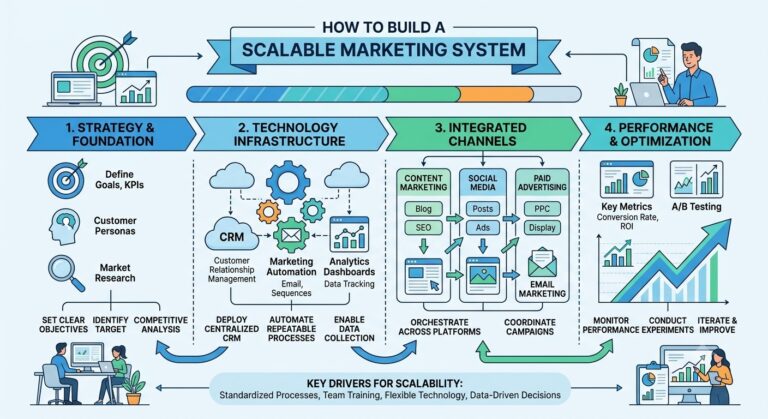
Growing a business requires more than simply running marketing campaigns. Many companies struggle to achieve consistent growth because their marketing processes depend too much on manual work, individual efforts, and disconnected strategies.
A successful business needs a scalable marketing system—a structured approach that allows marketing activities to grow without creating unnecessary complexity or increasing costs.
In 2026, businesses are using AI marketing tools, automation, and data-driven strategies to build smarter marketing systems that generate leads, improve customer engagement, and support long-term growth.
This article explains how to build a scalable marketing system and how modern businesses can create efficient processes that grow with them.
A scalable marketing system is a set of strategies, processes, and tools designed to support business growth without requiring the same increase in time, effort, or resources.
Instead of creating every campaign manually, scalable marketing uses:
A scalable system helps businesses attract customers consistently while maintaining efficiency.
Many businesses reach a point where their existing marketing process cannot handle growth.
Common challenges include:
A scalable marketing strategy helps businesses overcome these challenges by creating organized and repeatable processes.
The foundation of a scalable marketing system starts with clear goals.
Before creating campaigns, businesses should define:
Clear objectives help teams choose the right strategies and measure success effectively.
A scalable marketing system requires a deep understanding of customers.
Businesses should identify:
Audience insights help create more personalized campaigns and improve customer experiences.
Content is one of the most powerful growth tools for modern businesses.
A scalable content system includes:
Instead of creating random content, businesses should develop a consistent publishing process.
Using AI content creation tools can help marketers:
Automation is essential for scaling marketing operations.
Marketing automation tools help businesses manage repetitive tasks such as:
Automation allows teams to focus on strategy while technology handles routine processes.
Search Engine Optimization is a long-term strategy for attracting organic traffic.
A scalable SEO system includes:
AI-powered SEO tools make it easier to:
A scalable marketing system should consistently attract and convert potential customers.
Lead generation strategies include:
A strong lead generation system ensures businesses have a steady flow of potential customers.
Artificial Intelligence is transforming how businesses manage marketing.
AI helps companies:
By using AI marketing automation, businesses can make faster and more accurate decisions.
Not every visitor becomes a customer immediately.
A scalable marketing system includes customer nurturing through:
Nurturing builds trust and increases the chance of conversion.
A scalable system requires continuous measurement.
Businesses should monitor:
Analytics help identify what works and where improvements are needed.
Successful marketing should not depend on one person.
Businesses should document processes such as:
Repeatable systems make it easier to train teams and expand operations.
Increased Efficiency
Automation reduces manual work and improves productivity.
Lower Marketing Costs
Businesses can achieve more without constantly increasing expenses.
Consistent Growth
Repeatable strategies create predictable marketing results.
Better Customer Experience
Personalized communication improves relationships and loyalty.
Easier Business Expansion
Scalable systems support growth into new markets and audiences.
When building a scalable marketing system, businesses should avoid:
A strong system requires planning, testing, and continuous improvement.
The future of marketing will continue moving toward automation, personalization, and artificial intelligence.
Businesses will increasingly use:
Companies that build scalable marketing systems today will be better prepared for future growth.
Building a scalable marketing system allows businesses to grow faster without increasing complexity. By combining strategic planning, automation, AI-powered tools, SEO, and data-driven decision-making, companies can create marketing processes that support long-term success.
In 2026, the most successful businesses are not only focused on getting more customers—they are building smart systems that continuously attract, engage, and convert audiences.
To deliver innovative, scalable, AI, and human-centered technology solutions that empower businesses to thrive in a digital-first economy
1129 Northern Blvd., Suite 404, Manhasset, New York 11030
Privacy Policy | Team of Use | Cache © 2026 All rights reserved