
Artificial intelligence (AI) is no longer a futuristic concept—it is now a major force behind how businesses interact with customers. From AI-powered chatbots to personalized recommendations, consumers are experiencing faster, smarter, and more convenient services than ever before.
As AI becomes deeply integrated into websites, mobile apps, e-commerce platforms, and customer support systems, customer expectations are evolving rapidly. Businesses that fail to meet these new expectations risk losing customers to competitors that offer more intelligent and responsive experiences.
In this article, we will explore how AI is changing customer expectations, what modern consumers now demand, and how businesses can adapt to remain competitive in 2026 and beyond.
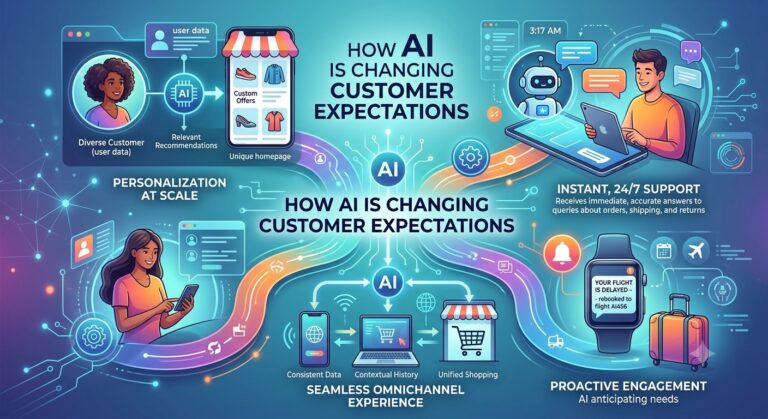
AI enables companies to analyze large amounts of customer data in real time and respond with highly relevant interactions. Instead of offering the same experience to every user, businesses can now provide personalized journeys tailored to individual preferences.
Examples include:
These technologies are reshaping what customers consider “normal” service.
One of the biggest changes AI has created is the expectation of immediate assistance.
In the past, customers were often willing to wait hours—or even days—for a response. Today, AI-powered chat systems can answer questions within seconds.
Always-on
Businesses using AI support tools can meet these expectations more effectively than companies relying solely on traditional customer service channels.
AI has made personalized experiences incredibly common. Customers now expect businesses to understand their interests, browsing history, and purchasing behavior.
Common AI personalization features include:
When a company delivers generic, one-size-fits-all messaging, customers often perceive the experience as outdated.
AI can identify patterns and anticipate customer needs before they are explicitly expressed.
For example:
This proactive approach creates a smoother customer experience and raises expectations for other brands.
Customers interact with businesses through multiple channels:
AI helps unify these interactions by maintaining context across platforms. Customers increasingly expect businesses to “remember” previous conversations and preferences, regardless of where the interaction occurs.
Repeating information multiple times is now seen as a poor customer experience.
Modern consumers often prefer solving simple problems themselves rather than contacting support.
AI-powered self-service tools include:
When these tools provide accurate answers quickly, customer satisfaction increases significantly.
As AI systems become more advanced, customers expect responses to be both fast and correct.
Poorly trained AI that provides inaccurate information can damage trust. Businesses must ensure that AI systems are continuously updated and monitored for quality.
Customers are increasingly comparing AI experiences across brands, and a weak implementation stands out immediately.
Although AI is automated, customers still expect interactions to feel helpful, respectful, and human-centered.
Successful AI systems use:
The goal is not to replace human connection entirely but to make routine interactions faster and more pleasant.
To meet evolving customer expectations, businesses should focus on the following strategies:
Key actions to stay competitive
2026 ready
Companies that successfully adapt can achieve:
Higher customer satisfaction
Increased loyalty
Better retention rates
Higher conversion rates
More repeat purchases
Stronger brand reputation
Despite its advantages, AI also introduces challenges:
Challenge | Impact |
Data privacy concerns | Customers expect secure handling of personal information. |
Over-automation | Too much automation can feel impersonal. |
AI bias | Inaccurate or unfair responses can harm trust. |
Integration complexity | Connecting AI across multiple systems requires planning. |
Employee training | Teams must learn how to work effectively with AI tools. |
By 2026 and beyond, AI-driven experiences will continue to become more sophisticated. Customers will likely expect:
Businesses that embrace these changes early will be better positioned to build long-term customer relationships.
How AI is changing customer expectations can be summarized in one sentence: customers now expect experiences that are faster, smarter, more personalized, and available whenever they need them.
AI has transformed what consumers consider acceptable service. Instant responses, tailored recommendations, predictive support, and seamless interactions are becoming the new standard rather than a competitive advantage.
For businesses, the opportunity is clear. By implementing AI thoughtfully and combining automation with human empathy, companies can exceed modern customer expectations, improve satisfaction, and create stronger loyalty in an increasingly digital marketplace.
In the AI era, customer expectations are not just evolving—they are being redefined.
To deliver innovative, scalable, AI, and human-centered technology solutions that empower businesses to thrive in a digital-first economy
1129 Northern Blvd., Suite 404, Manhasset, New York 11030
Privacy Policy | Team of Use | Cache © 2026 All rights reserved