
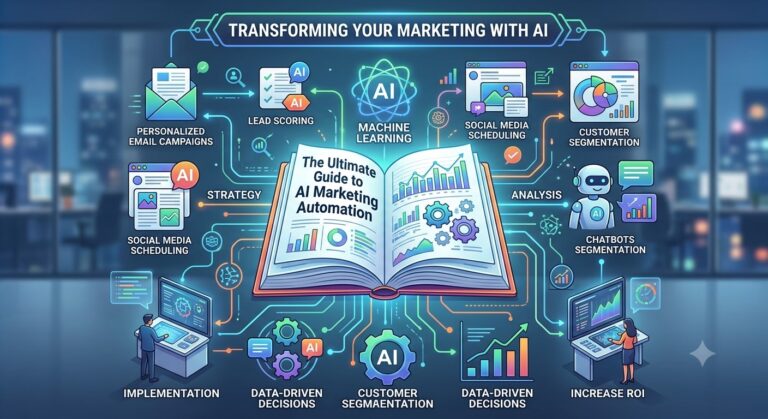
Artificial intelligence is transforming the way businesses attract, engage, and convert customers. What once required large marketing teams and countless hours of manual work can now be handled through AI marketing automation. From personalized email campaigns to predictive customer insights, AI-powered tools help businesses improve efficiency, reduce costs, and generate better results.
In this ultimate guide to AI marketing automation, you’ll learn what AI marketing automation is, how it works, its benefits, the best use cases, and how to implement it successfully in your business.
AI marketing automation combines artificial intelligence technologies with marketing automation platforms to streamline and optimize marketing activities. Instead of simply scheduling tasks, AI systems analyze data, learn from customer behavior, and make intelligent decisions automatically.
Examples include:
AI marketing automation typically follows four key steps:
The system gathers data from websites, CRM platforms, email campaigns, social media, and customer interactions.
Machine learning algorithms identify patterns, trends, and customer preferences.
The platform automatically sends emails, adjusts ad bids, publishes content, or triggers follow-up messages.
AI learns from campaign performance and improves future decisions over time.
Saves Time
Repetitive tasks such as scheduling posts, sending emails, and updating customer records are automated.
Reduces Costs
Businesses can accomplish more with smaller teams and fewer manual processes.
Improves Targeting
AI identifies the right audience and delivers the most relevant message.
Increases ROI
Optimized campaigns typically generate higher conversion rates and lower acquisition costs.
Enhances Customer Experience
Personalized interactions make customers feel understood and valued.
Email Marketing Automation
AI can automatically:
AI Chatbots and Customer Support
Modern chatbots can answer questions, qualify leads, schedule appointments, and guide users through the sales funnel.
Social Media Automation
AI tools can:
Lead Scoring and Qualification
AI evaluates leads based on behavior, demographics, and engagement history.
AI Content Creation
AI assists with:
AI predicts which products customers are most likely to buy and displays relevant recommendations in real time.
Top Strategies
Clean, organized data is essential for accurate AI predictions.
Focus on measurable objectives such as lead generation, conversion rates, customer retention, or revenue growth.
Create workflows for awareness, consideration, purchase, and retention.
Identify customers who are likely to buy, churn, or upgrade.
AI improves when it has performance data to learn from.
How to Implement AI Marketing Automation
Step-by-Step Implementation
Identify repetitive tasks and bottlenecks.
Look for CRM integration, analytics, and automation features.
Remove duplicates and outdated information.
Set triggers for emails, notifications, and follow-ups.
Test before scaling.
Review performance metrics regularly.
Expand workflows across additional channels.
Avoid These Pitfalls
Over the next few years, AI marketing automation is expected to become even more sophisticated.
Emerging trends include:
Businesses that adopt AI automation early will have a significant advantage in customer acquisition and retention.
AI marketing automation is no longer a luxury reserved for large enterprises. It has become an essential tool for businesses that want to scale efficiently, improve customer experiences, and increase marketing ROI.
By combining artificial intelligence with automated workflows, companies can deliver personalized marketing at scale, respond to customer needs faster, and make smarter data-driven decisions.
Whether you’re a startup, a small business, or an established brand, implementing AI marketing automation can help you save time, reduce costs, and unlock new growth opportunities in an increasingly competitive digital landscape.
To deliver innovative, scalable, AI, and human-centered technology solutions that empower businesses to thrive in a digital-first economy
1129 Northern Blvd., Suite 404, Manhasset, New York 11030
Privacy Policy | Team of Use | Cache © 2026 All rights reserved