
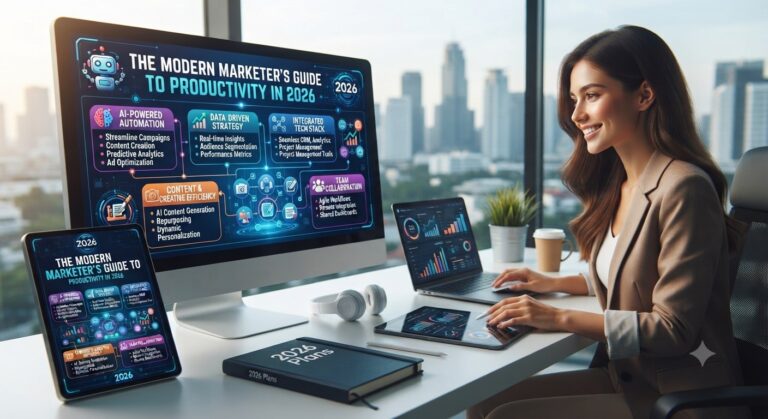
Marketing in 2026 is faster, more data-driven, and more competitive than ever before. Today’s marketers are expected to create engaging content, manage multiple digital channels, analyze campaign performance, interact with customers, and adapt to changing trends—all while delivering measurable results. Fortunately, advances in artificial intelligence (AI), automation, and cloud-based collaboration have made it easier to work smarter rather than harder.
This Modern Marketer’s Guide to Productivity in 2026 explores proven strategies, tools, and workflows that help marketing professionals save time, increase efficiency, and maximize their return on investment (ROI). Whether you’re a solo entrepreneur, a small business owner, or part of a large marketing team, these productivity techniques can help you stay ahead in an increasingly digital world.
Marketing is no longer about completing isolated tasks. It involves managing an interconnected ecosystem of content, social media, email campaigns, SEO, paid advertising, analytics, and customer engagement. Without effective productivity strategies, marketers can quickly become overwhelmed.
Improving productivity offers several key benefits:
The marketers who embrace productivity-focused technologies are often better equipped to respond to market changes and customer expectations.
Even with modern technology, marketers continue to face common obstacles.
Content Overload
Producing blogs, videos, newsletters, social media posts, and advertising content requires significant time and coordination.
Multi-Platform Campaign Management
Managing campaigns across multiple platforms can become difficult without centralized workflows.
Data Analysis
Collecting analytics is easy, but turning data into actionable insights remains a challenge.
Constant Algorithm Updates
Search engines and social media platforms regularly update their algorithms, requiring marketers to adapt their strategies.
Limited Resources
Many small businesses operate with lean marketing teams, making efficiency essential.
Automation eliminates many routine activities that consume valuable time.
Tasks suitable for automation include:
Automating these processes allows marketers to focus on campaign planning and customer engagement instead of repetitive administration.
Artificial intelligence has become a valuable assistant rather than a replacement for marketers.
AI can help generate:
Human editing remains essential, but AI significantly reduces the time required to create high-quality content.
Using separate tools for every task often creates inefficiencies.
Modern marketers benefit from centralized platforms that combine:
A unified workflow reduces communication gaps and keeps projects organized.
Not every marketing task contributes equally to business growth.
Focus your time on activities that directly influence key performance indicators (KPIs), such as:
| Marketing Activity | Business Impact |
| SEO content creation | Long-term organic traffic |
| Email marketing | Customer retention |
| Conversion optimization | Higher sales |
| Paid advertising optimization | Better ROI |
| Customer experience improvements | Brand loyalty |
Concentrating on high-impact initiatives produces better results with fewer resources.
Waiting until the end of the month to review campaign performance is no longer effective.
Modern analytics platforms provide instant insights into:
Real-time reporting enables marketers to make immediate improvements instead of reacting after opportunities have passed.
A structured routine helps reduce distractions and improve consistency.
Morning
Midday
Afternoon
End of Day
A repeatable workflow minimizes decision fatigue and helps maintain momentum.
Modern marketers often rely on a combination of specialized tools to improve efficiency.
AI Writing Assistants
Generate ideas, outlines, and first drafts for content marketing.
Marketing Automation Platforms
Automate customer journeys, email campaigns, and lead nurturing.
SEO Platforms
Identify keyword opportunities, optimize content, and monitor search rankings.
Project Management Software
Track deadlines, assign tasks, and improve collaboration across teams.
Analytics Dashboards
Monitor marketing performance and identify areas for optimization.
Selecting tools that integrate well with one another creates a smoother workflow and reduces manual effort.
Many marketers unintentionally reduce their efficiency by making avoidable mistakes.
Avoid these common pitfalls:
Reducing distractions and simplifying processes often produces greater gains than adding more software.
Marketing productivity will continue to evolve as AI becomes more advanced.
Emerging trends include:
Businesses that adopt these innovations early will likely enjoy greater efficiency and stronger competitive positioning.
The demands placed on marketers continue to grow, but so do the tools available to meet those challenges. By combining artificial intelligence, automation, centralized workflows, and real-time analytics, marketers can accomplish more without increasing workload.
The Modern Marketer’s Guide to Productivity in 2026 emphasizes that productivity is no longer about working longer hours—it’s about working smarter. Businesses that embrace AI-assisted marketing, automate repetitive processes, and focus on high-impact activities will be better positioned to increase efficiency, improve customer engagement, and achieve sustainable growth in the years ahead.
To deliver innovative, scalable, AI, and human-centered technology solutions that empower businesses to thrive in a digital-first economy
1129 Northern Blvd., Suite 404, Manhasset, New York 11030
Privacy Policy | Team of Use | Cache © 2026 All rights reserved