
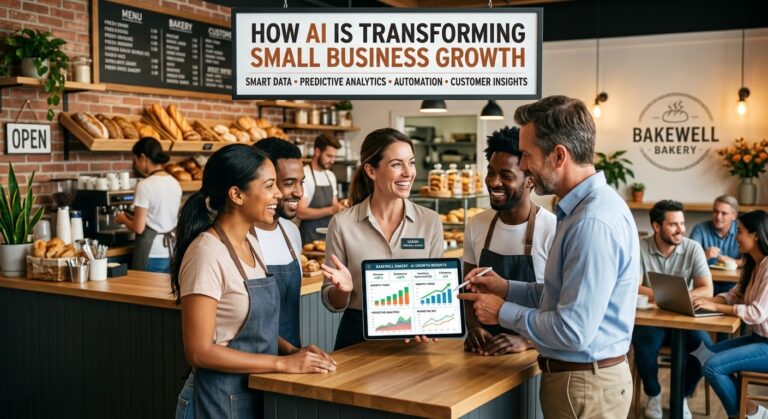
Small businesses have always faced unique challenges, from limited budgets and smaller teams to increasing competition from larger companies. Fortunately, artificial intelligence (AI) is changing the playing field. What was once considered enterprise-level technology is now accessible to businesses of all sizes, allowing entrepreneurs to automate tasks, improve customer experiences, and make smarter decisions without significantly increasing costs.
In 2026, AI has become one of the most valuable tools for small businesses looking to grow efficiently. Whether it’s streamlining daily operations, improving marketing performance, or providing personalized customer support, AI enables small companies to accomplish more with fewer resources.
This guide explores how AI is transforming small business growth and why adopting AI can give your business a competitive advantage.
AI for small business refers to the use of artificial intelligence technologies to automate repetitive tasks, analyze business data, enhance customer interactions, and improve overall efficiency.
Unlike traditional software that follows fixed rules, AI systems can learn from data, recognize patterns, and provide intelligent recommendations that help businesses make better decisions.
Today, AI is used by small businesses to:
By reducing manual work, AI allows business owners to focus on innovation and growth.
Running a small business often means wearing multiple hats. Owners must handle sales, marketing, customer support, operations, and financial management simultaneously.
AI reduces this workload by automating time-consuming tasks while improving accuracy and efficiency.
Some of the key reasons small businesses are adopting AI include:
Instead of replacing employees, AI helps teams work more effectively.
Administrative work can consume valuable time that could be spent growing the business.
AI can automate tasks such as:
Automation reduces human error while freeing employees to focus on higher-value activities.
Marketing is essential for business growth, but managing campaigns manually can be challenging for small teams.
AI-powered marketing tools help businesses:
These capabilities help small businesses compete with larger brands while using fewer resources.
Today’s customers expect quick and accurate responses.
AI-powered chatbots and virtual assistants allow businesses to provide 24/7 customer support by:
This improves customer satisfaction without requiring additional support staff.
Successful businesses make decisions based on data rather than assumptions.
AI analyzes information from multiple sources, including:
These insights help business owners identify opportunities, reduce inefficiencies, and plan for future growth.
Finding new customers is one of the biggest priorities for small businesses.
AI improves lead generation by:
This helps businesses convert more prospects into loyal customers.
Content marketing is one of the most effective ways to attract customers online.
AI assists with:
Rather than replacing creativity, AI accelerates the content creation process while helping maintain consistency.
AI gives sales teams access to valuable insights that improve conversion rates.
Businesses can use AI to:
These capabilities help sales professionals spend more time closing deals and less time on manual analysis.
Large corporations often have bigger budgets and larger teams.
AI levels the playing field by providing affordable tools that help small businesses:
With AI, small businesses can deliver professional, data-driven experiences without enterprise-level resources.
AI can support nearly every department within a business.
Common applications include:
Marketing
Customer Support
Sales
Operations
Finance
To maximize the value of AI, small businesses should:
Start With High-Impact Tasks
Focus on automating repetitive processes that consume the most time.
Use Reliable Data
AI performs best when trained on accurate, organized, and up-to-date information.
Train Your Team
Help employees understand how AI supports their work rather than replacing it.
Monitor Results
Track important metrics such as:
Regular evaluation ensures AI continues delivering value.
Although AI offers significant advantages, businesses should prepare for challenges such as:
A thoughtful implementation strategy helps overcome these obstacles.
AI technology continues to become more affordable, user-friendly, and powerful.
Future developments are expected to include:
As these innovations mature, AI will become an even more valuable partner for entrepreneurs and small business owners.
Artificial intelligence is transforming small business growth by making advanced technology accessible to companies of every size. From automating repetitive tasks and improving marketing to enhancing customer service and generating valuable insights, AI enables small businesses to operate more efficiently and compete more effectively.
The businesses that embrace AI today will be better prepared to adapt to changing customer expectations, improve operational efficiency, and unlock new growth opportunities in the years ahead.
Rather than viewing AI as a replacement for human expertise, successful organizations use it as a powerful tool that complements creativity, strengthens decision-making, and supports sustainable business growth.
To deliver innovative, scalable, AI, and human-centered technology solutions that empower businesses to thrive in a digital-first economy
1129 Northern Blvd., Suite 404, Manhasset, New York 11030
Privacy Policy | Team of Use | Cache © 2026 All rights reserved