
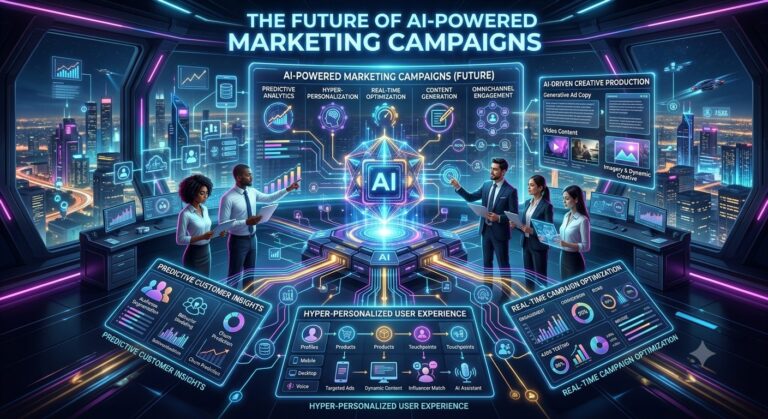
Artificial intelligence is rapidly changing the way businesses attract customers, build relationships, and generate revenue. What once required large marketing teams, extensive research, and countless hours of manual work can increasingly be handled with intelligent AI-powered systems.
AI-powered marketing campaigns are becoming more sophisticated as businesses use artificial intelligence to analyze customer behavior, personalize content, optimize advertising, automate workflows, and predict future trends.
In 2026, AI is moving beyond simple automation. Modern marketing systems can analyze information, recommend strategies, generate content, identify opportunities, and continuously improve campaign performance.
This transformation raises an important question: What will AI-powered marketing campaigns look like in the future?
From autonomous marketing agents to hyper-personalized customer journeys, the future of marketing is likely to be more intelligent, automated, predictive, and personalized than ever before.
AI-powered marketing campaigns use artificial intelligence to improve different stages of the marketing process.
Traditional marketing automation usually follows predefined rules. AI-powered systems can go further by analyzing data, identifying patterns, making recommendations, and adapting campaigns based on changing customer behavior.
AI can assist with:
This enables businesses to create marketing campaigns that are more responsive and data-driven.
Marketing has become increasingly complex. Customers interact with businesses through websites, search engines, social media, email, messaging platforms, video, and other digital channels.
Managing all these interactions manually can be difficult.
AI helps businesses process large amounts of information and coordinate marketing activities across multiple channels.
The biggest advantages include:
As AI becomes more accessible, these capabilities are no longer limited to large enterprises.
One of the most important developments in AI marketing is advanced personalization.
Traditional campaigns often divide customers into broad groups. AI can analyze individual behavior and identify more detailed preferences.
For example, AI can consider:
Businesses can then create highly relevant experiences for individual customers.
Future marketing campaigns may dynamically change messages, offers, products, and content depending on each customer’s behavior.
This could make personalization a standard expectation rather than an optional marketing feature.
The next generation of AI marketing will increasingly involve intelligent AI agents.
Instead of simply generating suggestions, AI agents can potentially coordinate multiple marketing activities around a specific objective.
For example, a marketing agent could:
This moves marketing automation from simple task execution toward more autonomous campaign management.
Human marketers will still play an important role in setting goals, reviewing strategies, maintaining brand standards, and making high-level decisions.
Marketing has traditionally relied heavily on historical information.
AI makes it possible to use existing data to identify patterns that may indicate future behavior.
Predictive marketing can help businesses estimate:
These insights can help businesses allocate marketing resources more effectively.
Instead of waiting for customers to take action, marketers can increasingly anticipate potential needs and deliver relevant experiences earlier.
Future AI-powered marketing campaigns will increasingly operate in real time.
Instead of launching a campaign and reviewing results days later, AI systems can continuously monitor performance.
They may analyze:
If performance changes, AI can identify potential adjustments much faster than traditional manual workflows.
This could make marketing campaigns more responsive and efficient.
Digital advertising is another area where AI is having a major impact.
AI can help marketers analyze audiences, test creative variations, identify high-performing segments, and optimize campaign spending.
Future AI advertising systems may increasingly automate:
The result could be advertising campaigns that continuously learn from customer responses.
However, marketers will still need to establish clear objectives, monitor performance, and ensure that automated decisions align with business and brand goals.
Content remains a central component of digital marketing.
AI can help businesses produce and optimize:
The future is not simply about producing more content.
The bigger opportunity is using AI to help marketers identify what content customers need, when they need it, and which formats are most relevant.
Human creativity, expertise, originality, and editorial judgment will remain important for producing trustworthy and valuable content.
Search behavior is changing as consumers increasingly interact with AI-powered search and conversational systems.
AI can help businesses understand:
Future SEO strategies will likely focus less on simply repeating keywords and more on providing useful, comprehensive information that satisfies real user needs.
Businesses will need to optimize content for traditional search engines as well as emerging AI-driven discovery experiences.
Customers increasingly expect businesses to respond quickly.
AI-powered conversational systems can engage visitors through websites, messaging platforms, and other digital channels.
They can help with:
This creates opportunities for businesses to engage customers at the moment they are most interested.
Conversational marketing can also collect useful information that helps businesses understand customer needs.
The customer journey is rarely linear.
A person may discover a brand through search, visit its website, watch a video, interact with social media, subscribe to an email list, and return weeks later before making a purchase.
AI can connect signals across these interactions and help marketers understand where customers are in the buying journey.
This can enable businesses to deliver more relevant messages based on customer intent and engagement.
As AI marketing becomes more powerful, responsible data management will become increasingly important.
Businesses will need to pay attention to:
Consumers want personalization, but they also want control over their information.
Successful AI-powered marketing strategies will need to balance personalization with privacy and trust.
AI is helping reduce the gap between small businesses and large corporations.
A small marketing team can use AI tools to assist with:
This gives smaller businesses access to capabilities that previously required larger teams and specialized resources.
As AI tools become easier to use, small businesses may be able to compete more effectively in crowded markets.
AI is unlikely to eliminate the need for marketers. Instead, it is likely to change what marketers spend their time doing.
When AI handles repetitive activities, marketing professionals can focus more on:
The future marketer may spend less time performing repetitive tasks and more time directing intelligent systems toward meaningful business objectives.
Despite rapid AI advancement, human creativity remains extremely important.
AI can analyze data, identify patterns, generate ideas, and automate workflows. Humans provide context, emotion, judgment, originality, and brand understanding.
The strongest marketing campaigns will likely combine both.
AI provides scale and intelligence. Humans provide creativity and strategic direction.
This combination can help businesses produce efficient campaigns without sacrificing authenticity.
AI marketing offers significant opportunities, but businesses should also understand its limitations.
Potential challenges include:
Businesses should establish clear processes for reviewing AI-generated content and monitoring automated decisions.
AI should support marketing strategy rather than operate without appropriate oversight.
Businesses don’t need to automate their entire marketing operation immediately.
A practical approach is to begin with high-impact areas.
Step 1: Identify Repetitive Tasks
Find marketing activities that consume significant time but don’t require constant human decision-making.
Step 2: Start With One AI Application
Consider beginning with:
Step 3: Establish Clear Goals
Define what success means before implementing AI.
Examples include:
Step 4: Measure Results
Track campaign performance and compare AI-assisted workflows with existing processes.
Step 5: Maintain Human Oversight
Review AI outputs and make sure automated decisions align with your brand, customers, and business objectives.
The future of AI marketing is likely to move toward increasingly autonomous and connected systems.
Marketing platforms may eventually coordinate multiple activities across the customer journey, from identifying potential customers to personalizing content, managing campaigns, analyzing performance, and recommending strategic changes.
The biggest transformation may not be individual AI tools. It may be the emergence of connected AI marketing ecosystems in which different systems work together.
Businesses that understand how to combine AI automation with human expertise will be better positioned to take advantage of these developments.
The future of AI-powered marketing campaigns is intelligent, personalized, automated, and increasingly predictive.
AI is already changing how businesses create content, analyze customer behavior, optimize advertising, generate leads, personalize experiences, and measure marketing performance.
As AI agents and intelligent automation become more capable, businesses will have new opportunities to improve efficiency and scale their marketing efforts.
However, successful AI marketing will not simply be about automating everything. The businesses that achieve the strongest results will combine artificial intelligence with human creativity, strategic thinking, responsible data practices, and genuine understanding of their customers.
The future belongs not to businesses that use AI blindly, but to those that learn how to use AI strategically.
What are AI-powered marketing campaigns?
AI-powered marketing campaigns use artificial intelligence to analyze data, personalize customer experiences, automate marketing tasks, optimize campaigns, and provide actionable insights.
How will AI change marketing in the future?
AI is expected to make marketing more personalized, predictive, automated, and responsive. AI agents may increasingly manage complex marketing workflows while humans provide strategic direction and oversight.
Can small businesses use AI-powered marketing?
Yes. Small businesses can use AI for content creation, SEO, customer support, lead generation, email marketing, advertising, and data analysis.
Will AI replace marketing professionals?
AI is more likely to change marketing roles than eliminate them entirely. Marketers can use AI to automate repetitive tasks and focus more on strategy, creativity, customer relationships, and brand development.
Is AI marketing expensive?
The cost varies depending on the tools and level of automation. Many AI marketing platforms offer affordable solutions suitable for small businesses, while more advanced enterprise systems can require larger investments.
How can a business start using AI marketing?
Start with one specific business problem, such as automating email marketing, analyzing campaigns, generating content ideas, or improving customer support. Measure the results before expanding AI adoption.
To deliver innovative, scalable, AI, and human-centered technology solutions that empower businesses to thrive in a digital-first economy
1129 Northern Blvd., Suite 404, Manhasset, New York 11030
Privacy Policy | Team of Use | Cache © 2026 All rights reserved