
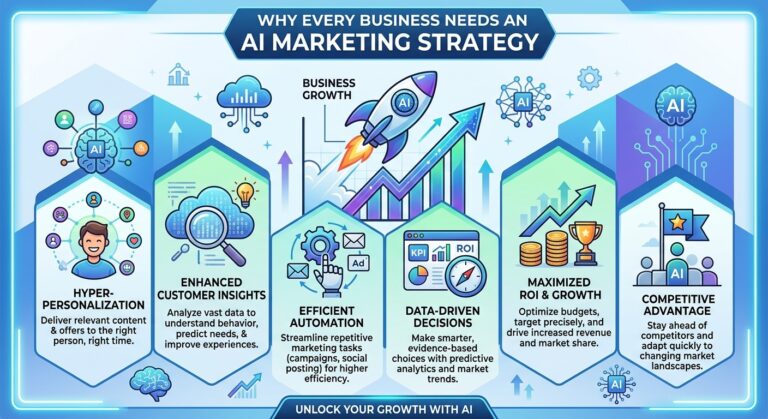
Artificial intelligence is changing how businesses attract customers, create content, analyze data, and compete in the digital marketplace. What was once an emerging technology has become an increasingly important part of modern business strategy.
In 2026, businesses face customers who expect personalized experiences, rapid responses, relevant content, and seamless interactions across multiple channels. At the same time, marketing teams are expected to produce more results while managing limited budgets and increasing competition.
An AI marketing strategy can help businesses address these challenges by combining artificial intelligence with marketing goals, customer data, automation, and human expertise.
From small businesses to large enterprises, companies that develop a thoughtful AI marketing strategy can improve efficiency, strengthen customer relationships, and uncover new opportunities for growth.
An AI marketing strategy is a structured approach to using artificial intelligence to achieve specific marketing and business objectives.
Instead of simply adding AI tools to existing workflows, an AI marketing strategy determines:
AI can support many areas of marketing, including:
The goal is not to automate everything. The goal is to use AI where it can create meaningful business value.
Digital marketing has become more complicated than ever.
Businesses compete across:
Managing these channels manually can consume enormous amounts of time.
AI allows businesses to process information faster, automate repetitive activities, and adapt campaigns based on customer behavior.
This makes AI particularly valuable for businesses looking to improve marketing efficiency while maintaining a strong customer experience.
Understanding customers is the foundation of effective marketing.
AI can analyze customer interactions across multiple channels to identify patterns and preferences.
Businesses can gain insights into:
These insights can help businesses create marketing campaigns that are more relevant to their audiences.
Consumers increasingly expect brands to understand their individual needs.
AI can help businesses personalize:
For example, an e-commerce business can use customer behavior to recommend products that are more relevant to each visitor.
Personalization can make marketing communication more useful and engaging.
Generating qualified leads is one of the biggest marketing challenges for businesses.
AI can help identify prospects who demonstrate strong buying signals.
AI-powered lead generation can analyze:
Businesses can use these insights to prioritize promising leads and improve their sales pipelines.
Marketing teams spend significant amounts of time performing repetitive activities.
AI can automate tasks such as:
Automation gives marketers more time to focus on strategic planning, creativity, and customer relationships.
One of the most immediate benefits of AI is increased productivity.
Instead of starting every task from scratch, marketers can use AI to accelerate:
This allows smaller teams to accomplish more without necessarily increasing their workforce.
Content marketing remains an important way to attract and educate potential customers.
AI can assist with:
However, businesses should not rely entirely on AI-generated content.
Human expertise is essential for adding originality, accuracy, experience, and brand personality.
The most effective approach is to use AI as a content assistant rather than a complete replacement for human creativity.
Digital advertising can become expensive when campaigns aren’t carefully managed.
AI can analyze advertising performance and identify:
This allows businesses to make faster adjustments and potentially reduce wasted advertising spend.
Customer service is closely connected to marketing because every customer interaction affects brand perception.
AI-powered chatbots and virtual assistants can provide support around the clock.
They can:
Human employees can then focus on complex problems that require judgment and empathy.
Modern businesses generate enormous amounts of marketing data.
AI can help turn that information into actionable insights.
Businesses can analyze:
Instead of spending hours manually reviewing reports, marketers can use AI to identify important patterns and opportunities more quickly.
Traditional analytics often focuses on what already happened.
AI can also help businesses identify patterns that may indicate what could happen next.
Predictive marketing can help estimate:
These insights can help businesses make more informed marketing decisions.
AI isn’t only for large corporations.
Small businesses can use AI to compete more efficiently by automating tasks that previously required larger teams.
For example, a small company can use AI to support:
This allows small businesses to operate with greater efficiency while delivering more sophisticated customer experiences.
As a business grows, its marketing requirements increase.
More customers can mean:
AI can help businesses scale these processes without increasing manual workload at the same rate.
This makes AI particularly valuable for businesses that want to grow without creating unnecessary operational complexity.
There is an important difference between using AI tools and having an AI marketing strategy.
Using random AI tools might involve subscribing to multiple platforms without a clear purpose.
An AI marketing strategy starts with business objectives.
For example:
Goal: Generate more qualified leads.
AI strategy:
This creates a connected process instead of a collection of disconnected AI tools.
Businesses can begin with a simple framework.
Step 1: Define Your Marketing Goals
Start by identifying what you want AI to accomplish.
Possible goals include:
Step 2: Identify Repetitive Processes
Look for tasks that consume significant time.
These may include:
These are often good candidates for AI automation.
Step 3: Choose the Right AI Tools
Don’t select tools simply because they are popular.
Evaluate them based on:
Step 4: Establish Human Oversight
AI should not operate without appropriate monitoring.
Businesses should review:
Human oversight helps maintain quality, accuracy, and brand consistency.
Step 5: Measure Results
Track meaningful KPIs such as:
Use these measurements to determine whether your AI strategy is actually creating value.
Businesses should avoid several common mistakes when adopting AI.
Automating Everything
Not every marketing task should be automated. Some activities require human creativity and judgment.
Using Poor-Quality Data
AI is heavily dependent on the quality of the information it receives.
Ignoring Privacy
Businesses must handle customer data responsibly and comply with applicable privacy requirements.
Publishing Unchecked AI Content
AI-generated content should be reviewed for accuracy, originality, and relevance.
Focusing on Tools Instead of Goals
The objective should be business growth—not simply using more AI software.
AI marketing will continue evolving as AI agents, predictive analytics, conversational systems, and automated workflows become more capable.
Future AI marketing strategies may involve systems that can:
However, businesses will still need human leadership to define objectives, maintain brand identity, understand customers, and make important strategic decisions.
The future of marketing is therefore likely to be a partnership between intelligent technology and human expertise.
Every business should consider developing an AI marketing strategy because artificial intelligence is fundamentally changing how companies attract, engage, and retain customers.
AI can help businesses understand customers better, automate repetitive work, personalize experiences, improve lead generation, optimize advertising, analyze performance, and scale marketing operations.
But successful AI adoption isn’t about replacing humans or collecting as many AI tools as possible.
It’s about identifying business problems, selecting the right technology, measuring results, and combining AI capabilities with human creativity and strategic thinking.
Businesses that develop a thoughtful AI marketing strategy today can build a stronger foundation for sustainable growth in 2026 and beyond.
What is an AI marketing strategy?
An AI marketing strategy is a structured plan for using artificial intelligence to improve marketing activities, customer experiences, automation, analytics, lead generation, and business growth.
Why does every business need an AI marketing strategy?
AI can help businesses improve efficiency, personalize customer experiences, analyze data, automate repetitive work, and identify new marketing opportunities.
Can small businesses use an AI marketing strategy?
Yes. Small businesses can start with affordable AI tools for content creation, SEO, customer service, lead generation, email marketing, and analytics.
Does AI replace marketing employees?
AI primarily automates repetitive activities and supports decision-making. Human creativity, strategic thinking, customer relationships, and brand management remain important.
How do I start an AI marketing strategy?
Start by defining a measurable business goal, identifying repetitive marketing processes, selecting appropriate AI tools, establishing human oversight, and measuring the results.
Is AI marketing expensive?
The cost depends on the tools and level of automation required. Businesses can begin with affordable solutions and expand their AI marketing capabilities as they see measurable results.
To deliver innovative, scalable, AI, and human-centered technology solutions that empower businesses to thrive in a digital-first economy
1129 Northern Blvd., Suite 404, Manhasset, New York 11030
Privacy Policy | Team of Use | Cache © 2026 All rights reserved