
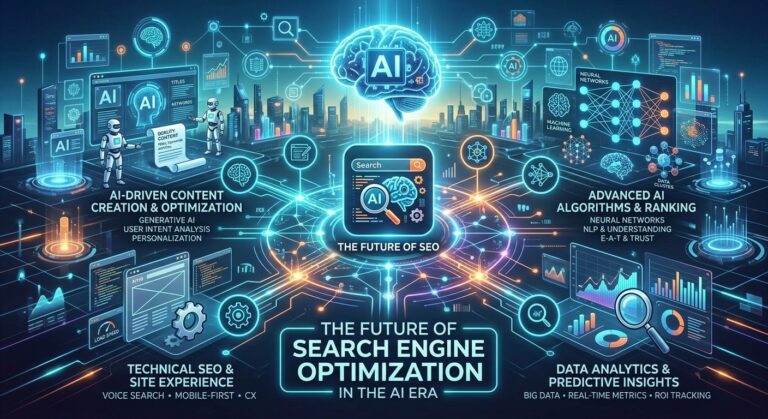
Search engine optimization has never been a static discipline. From keyword-focused strategies to mobile optimization, semantic search, structured data, and user experience, SEO has continuously evolved alongside search technology.
Now, artificial intelligence is creating another major shift.
AI is changing how people search for information, how search platforms understand content, and how businesses compete for online visibility. Instead of simply entering a few keywords and choosing from a list of links, users can increasingly ask detailed questions and receive conversational answers.
This transformation is creating new opportunities—and new challenges—for businesses.
The future of search engine optimization in the AI era will not simply be about ranking for individual keywords. It will increasingly involve understanding user intent, building topical authority, creating genuinely useful content, optimizing technical foundations, and making information easy for both people and intelligent search systems to understand.
SEO in the AI era refers to the evolving practice of improving a website’s visibility across traditional search engines and newer AI-powered discovery experiences.
AI can influence SEO in several ways:
This doesn’t mean traditional SEO is disappearing.
Instead, SEO is expanding.
Businesses still need strong websites, useful content, relevant keywords, internal links, technical optimization, and authoritative information. However, the way these elements work together is becoming more sophisticated.
Traditional search generally required users to enter a query and examine multiple results.
AI-powered search can interpret context and provide more conversational responses.
For example, instead of searching:
“best digital marketing tools”
a user might ask:
“Which digital marketing tools should a small business use if it has a limited budget and wants to generate more leads?”
The second query contains considerably more context.
AI systems can interpret that context and potentially provide a more tailored response.
This means businesses need to understand not just what people search for, but what they are trying to accomplish.
Keywords remain useful, but search intent is becoming increasingly important.
A search query may indicate that a user wants to:
Successful SEO strategies will focus on satisfying that intent.
For example, someone searching for “AI marketing tools” may want a list of options.
Someone searching for “how to use AI for marketing” likely needs an educational guide.
Creating the wrong type of content for a search query can make ranking more difficult even if the page contains the target keyword.
AI makes it easier for users to search using natural language.
People can ask questions as if they were talking to another person.
This creates opportunities for businesses to optimize content around:
Instead of writing content solely around short keywords, businesses should answer the questions their audiences genuinely have.
A website that publishes one article about a subject may struggle to demonstrate comprehensive expertise.
A website that consistently covers related aspects of a topic can create stronger topical depth.
For example, a website focused on AI marketing could cover:
These connected topics create a broader information ecosystem.
The future of SEO is therefore likely to reward businesses that demonstrate depth rather than simply producing isolated keyword-targeted pages.
AI makes content creation faster.
That also means the internet can become saturated with generic material.
When anyone can produce thousands of words in minutes, simply publishing more content is unlikely to provide a sustainable competitive advantage.
Businesses need to focus on content that provides genuine value.
Strong content should offer:
AI can assist with production, but quality and usefulness should remain the priority.
AI can summarize existing information, but businesses can differentiate themselves by contributing knowledge and experience that isn’t easily replicated.
Consider adding:
These elements can make content more useful and distinctive.
The future of SEO isn’t necessarily human versus AI.
It is more likely to be human expertise enhanced by AI technology.
Keyword research is also evolving.
Traditional keyword research often focuses on search volume and competition.
AI can help marketers identify relationships between queries and topics.
For example, AI can help group searches into themes such as:
Core topic: AI marketing
Related topics:
This allows marketers to build comprehensive content strategies instead of creating isolated pages for every keyword.
Conversational AI encourages users to ask detailed questions.
This creates opportunities around long-tail searches.
For example:
Short keyword:
AI SEO
Long-tail query:
How can a small business use AI to improve its SEO without hiring an SEO agency?
The second query reveals much more about the user’s needs.
Businesses that answer highly specific questions can attract visitors with strong intent.
AI systems need to understand information efficiently.
Clear organization can help both users and search systems interpret a page.
Use:
Well-structured content is easier to scan and understand.
The rise of AI does not eliminate technical SEO.
A website still needs a strong technical foundation.
Important areas include:
AI can help identify technical problems, but businesses still need to implement and verify appropriate solutions.
Technical excellence remains a fundamental part of sustainable SEO.
Search engines want to provide users with useful results.
If visitors arrive on a website and immediately leave because the page is confusing, slow, difficult to navigate, or filled with unnecessary information, the website may struggle to turn search visibility into meaningful results.
Businesses should therefore focus on:
SEO should ultimately lead to a better experience for the visitor.
SEO professionals already work with large amounts of data.
AI can make that analysis faster.
AI-powered systems can help marketers identify:
This allows marketers to spend less time manually processing data and more time making strategic decisions.
SEO doesn’t end when an article is published.
Information changes.
Competitors publish new content.
Search behavior evolves.
AI can help identify pages that may need updating by analyzing:
This can turn SEO into a continuous optimization process rather than a one-time publishing activity.
Businesses are increasingly interested in appearing in AI-generated answers and summaries.
This creates a broader concept of search visibility.
Instead of asking only:
“Does my page rank on the first page?”
businesses may also ask:
“Is my brand or information being discovered when users ask AI-powered search systems about this topic?”
This doesn’t mean abandoning traditional SEO.
Businesses should continue building strong websites and authoritative content while adapting to new search experiences.
As search becomes more conversational, users may encounter information without visiting multiple websites.
This makes brand recognition increasingly important.
Businesses should build authority through:
SEO and brand building are becoming increasingly interconnected.
AI can also change how people discover local businesses.
Instead of searching for:
“restaurants near me”
a user might ask:
“Where can I find a family-friendly restaurant nearby that’s good for a quick dinner?”
The more specific the question becomes, the more businesses need accurate and comprehensive information about their services, location, hours, products, and customer experience.
Local businesses should maintain accurate online information and create useful location-specific content.
Search is no longer limited to typed text.
Users can increasingly interact with technology through:
Businesses should consider how their content can serve different forms of discovery.
This means investing in:
A diversified search strategy can help businesses reach audiences across different discovery methods.
Many repetitive SEO activities can increasingly be assisted by AI.
These may include:
This doesn’t mean SEO professionals become unnecessary.
Instead, their role can shift toward strategy, quality control, analysis, and decision-making.
As AI handles more repetitive work, SEO professionals can spend more time on high-value activities.
These include:
Strategy
Understanding business objectives and developing an SEO roadmap.
Research
Understanding customers, competitors, and market opportunities.
Content Quality
Ensuring content provides information that genuinely helps users.
Authority
Building credibility around important topics.
Technical Performance
Maintaining a website that search systems and users can access efficiently.
Measurement
Connecting organic visibility with meaningful business outcomes.
Businesses don’t need to completely rebuild their SEO strategies overnight.
Instead, they can take several practical steps.
Understand what customers are trying to accomplish when they search.
Create comprehensive content around the subjects most important to your business.
Use expertise, examples, data, and experiences that differentiate your content.
Make sure your website is accessible, fast, mobile-friendly, and logically structured.
Use AI for research, analysis, optimization, and productivity rather than mass-producing generic content.
Measure leads, conversions, revenue, and customer acquisition—not just rankings.
Publishing Content Just Because AI Makes It Easy
More content does not automatically mean more visibility.
Ignoring Human Expertise
Generic AI-generated content can be difficult to differentiate from thousands of competing pages.
Focusing Only on Keywords
Search engines increasingly understand context and intent.
Neglecting Technical SEO
AI-generated content cannot fix a poorly structured or inaccessible website.
Chasing Every New Trend
Businesses should adopt technologies that solve genuine problems rather than following every AI trend.
Perhaps the biggest change in SEO is a shift in mindset.
Traditional SEO often asks:
“How can we rank this page?”
The future requires a broader question:
“How can we become the most useful and trustworthy source for this user’s problem?”
That shift changes everything.
Instead of creating content purely for search engines, businesses can create resources that genuinely help people.
Instead of targeting hundreds of unrelated keywords, they can build authority around important subjects.
Instead of focusing only on rankings, they can measure whether organic visibility produces meaningful business results.
The future of search engine optimization in the AI era is not the end of SEO.
It is the evolution of SEO.
Artificial intelligence is changing how people search, how search platforms interpret information, and how marketers conduct research and optimization.
Businesses that succeed will be those that adapt without abandoning the fundamentals.
They will understand search intent, build topical authority, publish valuable content, maintain strong technical foundations, use AI strategically, and invest in genuine expertise.
The most important SEO principle for the AI era is simple:
Don’t create content merely because AI can create it. Create information because people need it.
AI can make SEO faster and more intelligent, but usefulness, trust, expertise, and customer value will remain at the heart of sustainable search visibility.
Will AI replace SEO?
AI will automate many SEO tasks, but SEO strategy, content quality, technical decisions, brand development, and business judgment will continue to require human involvement.
Is traditional SEO still relevant in the AI era?
Yes. Technical SEO, search intent, content quality, internal linking, website performance, and authority remain important. AI expands the search landscape rather than eliminating traditional SEO.
How will AI change search engine optimization?
AI will make search more conversational and contextual while helping marketers automate research, content analysis, optimization, and reporting.
Should businesses use AI to create SEO content?
Businesses can use AI to assist with research, outlines, drafts, and optimization. However, published content should be accurate, useful, original, and reviewed by people with appropriate knowledge.
What is the most important SEO strategy for the future?
Focus on satisfying user intent with trustworthy, useful, well-structured content supported by strong technical SEO and genuine expertise.
How can small businesses prepare for AI-powered search?
Small businesses should maintain accurate online information, create useful content around customer questions, strengthen local SEO, build expertise, and use AI to improve research and marketing efficiency.
To deliver innovative, scalable, AI, and human-centered technology solutions that empower businesses to thrive in a digital-first economy
1129 Northern Blvd., Suite 404, Manhasset, New York 11030
Privacy Policy | Team of Use | Cache © 2026 All rights reserved