
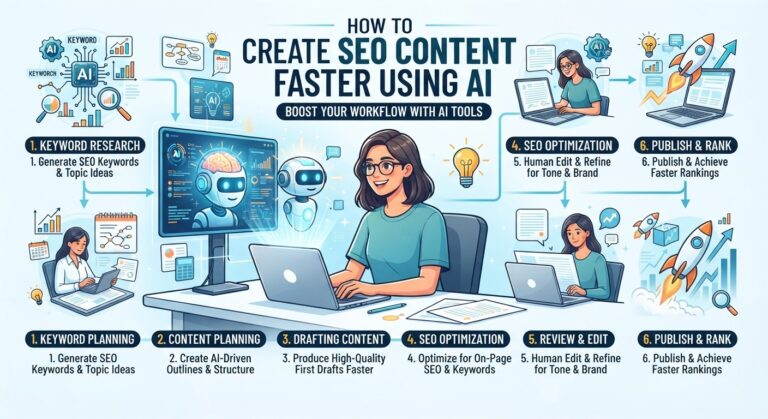
Creating SEO content can take a significant amount of time.
Marketers need to research keywords, understand search intent, develop content ideas, create outlines, write articles, optimize headings, add internal links, write metadata, proofread content, and eventually measure performance.
Artificial intelligence can make many of these tasks faster.
With the right workflow, AI can help businesses move from a blank page to a well-structured SEO article much more efficiently.
However, the goal shouldn’t be to publish as much AI-generated content as possible.
The better goal is to use AI to reduce repetitive work while increasing the amount of time available for strategy, expertise, originality, and quality control.
In 2026, businesses can use AI throughout the SEO content process—from research and planning to optimization and updating.
AI-assisted SEO content is content created or improved with the help of artificial intelligence.
AI can support many parts of the workflow, including:
The human marketer remains responsible for deciding what information should be published and ensuring that the final content is accurate, useful, original, and aligned with the brand.
Traditional content production can involve many repetitive tasks.
AI can help reduce the time spent on these activities.
For example, instead of manually brainstorming dozens of related questions, a marketer can use AI to generate a starting list and then evaluate the most relevant ideas.
Instead of beginning an article from scratch, AI can help create a structured outline.
Instead of manually reviewing an article for repetitive language, AI can identify areas that may need improvement.
This creates a more efficient workflow.
The biggest advantage isn’t necessarily producing content faster.
It’s spending less time on repetitive work and more time on high-value decisions.
The first step is still understanding what your audience is searching for.
AI can help expand a primary keyword into related topics and long-tail queries.
For example, if your main keyword is:
AI marketing
AI can help identify related topics such as:
These ideas can become individual articles or parts of a larger topic cluster.
However, keyword suggestions should be validated with actual search data before becoming the foundation of a major SEO campaign.
Keywords alone aren’t enough.
You also need to understand what users want when they search.
Search intent may be:
Informational
The user wants to learn.
Example:
What is AI SEO?
Commercial
The user is researching potential solutions.
Example:
Best AI SEO tools for small businesses
Transactional
The user is ready to take action.
Example:
Buy AI SEO software
Navigational
The user wants to reach a particular website or page.
AI can help classify search queries by likely intent.
This can save time during the content-planning process.
Don’t immediately ask AI to write a complete article.
Start with a content brief.
A useful brief can contain:
A detailed brief gives the writing process direction.
It also reduces the risk of producing generic content that doesn’t fully answer the user’s needs.
AI can quickly turn a topic into a logical structure.
For example:
H1: How to Create SEO Content Faster Using AI
H2: What Is AI-Assisted SEO Content?
H2: Why Use AI for SEO Content?
H2: How AI Speeds Up Content Creation
H2: AI SEO Content Workflow
H2: Common Mistakes
H2: Frequently Asked Questions
The writer can then review the outline and make changes before drafting begins.
This is usually more efficient than trying to fix a poorly structured article after it has already been written.
Once the strategy and outline are ready, AI can help produce an initial draft.
A useful prompt should provide context.
Include:
The more useful context you provide, the more useful the initial draft is likely to be.
The first draft should be treated as a starting point—not automatically as the finished article.
This is one of the most important steps.
AI can generate general explanations, but your business may have information that isn’t available in generic content.
Add:
For example, instead of simply explaining that AI can accelerate content production, describe the actual workflow your marketing team uses.
That makes the content more useful and differentiated.
AI can produce incorrect or outdated information.
Before publishing, verify important claims.
Pay particular attention to:
For rapidly changing topics such as AI and digital marketing, information can become outdated quickly.
Fact-checking should therefore be part of every serious AI-assisted content workflow.
Headings help readers understand the structure of an article.
AI can suggest clearer alternatives to vague headings.
For example:
Weak:
AI Benefits
Better:
How AI Helps Businesses Create SEO Content Faster
Specific headings tell readers exactly what they can expect from each section.
Long blocks of text can make an article difficult to scan.
AI can help identify:
Improve the final article with:
Readable content is easier for users to consume.
AI can help identify where relevant keywords may fit naturally.
However, avoid forcing keywords into every paragraph.
For example, an article targeting AI SEO content can naturally include related phrases such as:
The objective is to communicate the topic clearly rather than achieve an arbitrary keyword density.
Your title is one of the first things potential visitors see in search results.
AI can generate multiple title variations quickly.
For example:
Basic:
AI SEO Content
More compelling:
How to Create SEO Content Faster Using AI
The second title communicates a specific benefit and tells readers exactly what the article is about.
Always make sure the title accurately represents the page.
AI can also help generate meta-description options.
A good meta description should:
Avoid misleading descriptions that promise information the article doesn’t provide.
Internal linking is an important part of website structure.
AI can help identify pages that are contextually related.
For example, an article about AI SEO content might link to related articles about:
This creates connections between related pages and helps users discover more relevant information.
Human review is still necessary to make sure suggested links actually make sense.
Frequently asked questions can improve the usefulness of an article.
AI can help generate potential questions based on the topic.
For example:
The questions should reflect genuine audience needs rather than being added simply to increase page length.
You don’t always need to start from scratch.
AI can transform existing content into different formats.
One long-form article can become:
This allows businesses to get more value from every piece of high-quality content they create.
AI can also help identify opportunities to improve existing articles.
Review pages for:
Updating an existing strong page can sometimes be more efficient than creating an entirely new article.
Content gaps are subjects or questions that your existing content doesn’t adequately address.
AI can help compare your content strategy with the topics your audience is interested in.
For example, if your website has several articles about AI marketing but nothing about:
“How small businesses can implement AI marketing on a limited budget,”
that could represent a useful content opportunity.
The goal isn’t to copy competitors.
It’s to discover questions your audience still needs answered.
Instead of publishing disconnected articles, organize related content into topic clusters.
For example:
Pillar Topic:
AI Marketing
Supporting Articles:
AI can help identify related topics and organize them into clusters.
This creates a more comprehensive content strategy.
A content audit can take a considerable amount of time.
AI can help categorize pages based on:
Pages can then be placed into categories such as:
Keep → Update → Consolidate → Remove
Human review should guide the final decision.
A practical workflow can look like this:
Step 1: Research
Identify keywords, customer questions, and relevant topics.
Step 2: Analyze
Determine search intent and audience needs.
Step 3: Plan
Create a detailed content brief and outline.
Step 4: Draft
Use AI to accelerate initial content production.
Step 5: Enhance
Add human expertise, examples, research, and original insights.
Step 6: Verify
Fact-check important claims.
Step 7: Optimize
Improve keywords, headings, metadata, readability, and internal links.
Step 8: Publish
Make sure the page is technically sound and useful to visitors.
Step 9: Promote
Repurpose the content across appropriate channels.
Step 10: Measure
Monitor organic traffic, engagement, leads, and conversions.
Step 11: Update
Improve the article as information and search behavior change.
The answer depends on the workflow, topic, research requirements, and level of human editing.
AI can significantly reduce time spent on repetitive tasks such as:
But high-quality content still requires research, judgment, editing, and fact-checking.
The objective shouldn’t be:
“Create an article in five minutes.”
A better objective is:
“Reduce unnecessary production time while maintaining or improving content quality.”
Task | Traditional Workflow | AI-Assisted Workflow |
Topic ideas | Manual brainstorming | AI-assisted brainstorming |
Keyword expansion | Manual research | AI-assisted research |
Outline | Manual | AI-assisted |
First draft | Manual | AI-assisted |
Editing | Manual | AI + human |
Fact-checking | Human | AI assistance + human |
Internal links | Manual | AI suggestions + human review |
Metadata | Manual | AI-assisted |
Repurposing | Manual | AI-assisted |
Final approval | Human | Human |
The biggest advantage comes from combining automation with human judgment.
A generated draft isn’t automatically publication-ready.
Publishing hundreds of generic articles isn’t a substitute for useful content.
A keyword may have significant search volume but still be the wrong target for your audience.
AI can make mistakes that sound convincing.
Your experience and unique perspective can be what differentiates your content.
Natural language is better than repetitive keyword insertion.
Updating valuable pages can be an important part of an SEO strategy.
AI is a tool.
Your audience, goals, expertise, and SEO strategy should determine how that tool is used.
To get better results from AI-assisted content creation:
Give AI Detailed Instructions
Provide context, audience, goals, keywords, and structure.
Break Large Tasks Into Smaller Tasks
Instead of asking AI to do everything at once, use separate stages for research, planning, drafting, optimization, and editing.
Keep Humans in the Loop
Human review should remain part of the workflow.
Add Original Information
Use your own data, examples, expertise, and experiences.
Verify Important Claims
Don’t automatically trust generated information.
Measure Results
Determine whether faster production is actually producing better business outcomes.
AI will continue changing how businesses produce content.
Future SEO workflows are likely to become increasingly automated, with AI assisting marketers with:
But automation won’t eliminate the need for strategy.
As AI makes generic content easier to produce, originality and expertise can become even more valuable.
Businesses should therefore focus on creating content that provides something beyond information that could be generated anywhere.
That might be:
Experience.
Original research.
Expertise.
Data.
A unique perspective.
A better explanation.
These are the qualities that can turn AI-assisted content into genuinely valuable content.
Learning how to create SEO content faster using AI can dramatically improve the efficiency of a modern content marketing operation.
AI can help with keyword research, search-intent analysis, content briefs, outlines, drafting, editing, internal linking, FAQs, metadata, content repurposing, and content audits.
But speed should never become the only goal.
The strongest approach is to use AI for repetitive tasks while humans remain responsible for strategy, expertise, originality, accuracy, and quality.
A simple formula is:
AI efficiency + human expertise + SEO strategy + continuous optimization = better content production.
Businesses that adopt this approach can produce content more efficiently without turning their websites into collections of generic AI-generated articles.
The future of SEO content isn’t about creating the most content possible.
It’s about creating valuable content faster—and using the time saved to make that content better.
Can AI create SEO content?
Yes. AI can assist with research, outlines, drafts, optimization, metadata, FAQs, and other parts of SEO content creation. Human review remains important for accuracy, originality, and quality.
How can AI make SEO content creation faster?
AI can accelerate brainstorming, keyword expansion, search-intent analysis, outlining, drafting, editing, content repurposing, internal-link suggestions, and content updates.
Is AI-generated content good for SEO?
AI-generated content can be useful when it is accurate, relevant, helpful, and provides genuine value. Simply generating large amounts of generic content is not a sustainable SEO strategy.
Should I use AI to write entire blog posts?
You can use AI to create an initial draft, but a stronger approach is to combine AI assistance with human research, expertise, fact-checking, editing, and original insights.
Can AI help with keyword research?
Yes. AI can generate related keywords, long-tail queries, questions, topic clusters, and content ideas. These suggestions should be validated against appropriate search and audience data.
Can AI optimize old SEO content?
Yes. AI can help identify outdated sections, missing topics, content gaps, internal-link opportunities, and readability issues in existing content.
How do I avoid generic AI content?
Add original research, expert opinions, real-world examples, case studies, first-hand experience, unique data, and a distinctive brand voice.
What is the best AI SEO workflow?
A strong workflow is research, search-intent analysis, content planning, AI-assisted drafting, human enhancement, fact-checking, SEO optimization, publishing, measurement, and ongoing updates.
To deliver innovative, scalable, AI, and human-centered technology solutions that empower businesses to thrive in a digital-first economy
1129 Northern Blvd., Suite 404, Manhasset, New York 11030
Privacy Policy | Team of Use | Cache © 2026 All rights reserved