
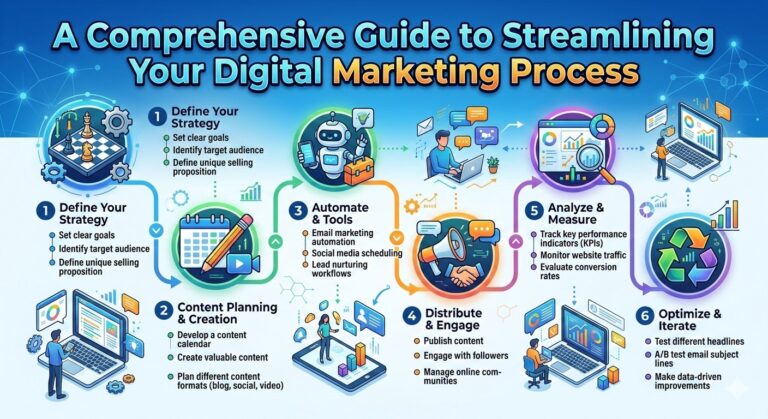
A Comprehensive Guide to Streamlining Your Digital Marketing Process
Overview
Content production, social media posting, email marketing, analytics tracking, and campaign management are just a few of the many duties involved in digital marketing. These chores might take a lot of time and effort when done by hand.
Businesses are using digital marketing automation more and more in 2026 to increase productivity and streamline processes. Marketers may automate monotonous operations, minimize mistakes, and concentrate on strategy and development by utilizing intelligent AI-powered tools and online platforms like Buzzency.
You will learn how to efficiently automate your digital marketing workflow with this step-by-step tutorial.
Workflow Automation in Digital Marketing: What Is It?
The practice of managing marketing operations automatically with software and AI solutions is known as digital marketing workflow automation.Instead of performing tasks manually every day, automation tools execute them based on predefined rules and triggers.
Examples include:
- Scheduling social media posts automatically
- Sending triggered email campaigns
- Generating analytics reports
- Automating content publishing
- Managing leads and customer interactions
Automation ensures that marketing processes run smoothly with minimal manual intervention.
Step 1: Identify Repetitive Marketing Tasks
Before implementing automation, identify tasks that consume the most time and require frequent repetition.
Common tasks suitable for automation include:
- Social media scheduling
- Email newsletters and follow-ups
- Lead capture and nurturing
- Blog publishing
- Campaign performance reporting
- Customer segmentation
Listing these tasks helps determine where automation will provide the greatest efficiency.
Step 2: Choose the Right Automation Tools
Selecting the right tools is critical for building an effective automated workflow. Many platforms now offer integrated solutions that combine multiple marketing functions.
Tools like Buzzency help marketers simplify processes by providing digital tools designed to improve productivity and marketing efficiency.
Look for tools that support:
- AI-powered automation
- Multi-channel integration
- Analytics and reporting
- Workflow management
- Content optimization
The right platform allows marketers to automate several processes within a single environment.
Step 3: Automate Content Planning and Creation
Content is the backbone of digital marketing, but producing it consistently can be time-consuming.
Automation can help by:
- Generating content outlines
- Scheduling blog posts
- Creating social media captions
- Suggesting SEO keywords
- Repurposing existing content
With AI-powered assistance, marketers can accelerate the content creation process while maintaining quality and consistency.
Step 4: Automate Social Media Scheduling
Managing multiple social media platforms manually can quickly become overwhelming.
Automation tools allow marketers to:
- Schedule posts across platforms in advance
- Automatically repost evergreen content
- Analyze engagement data
- Identify optimal posting times
This ensures consistent posting without requiring daily manual updates.
Step 5: Implement Automated Email Marketing
Email marketing remains one of the most effective digital marketing strategies. Automation can significantly enhance its efficiency.
Key automation features include:
- Welcome email sequences
- Abandoned cart reminders
- Behavior-triggered emails
- Personalized email campaigns
- Automated newsletter distribution
These automated workflows ensure that customers receive timely and relevant communication.
Step 6: Automate Lead Management and Customer Segmentation
Automation tools can track user behavior and organize leads based on their interests and actions.
This allows businesses to:
- Automatically categorize leads
- Deliver personalized offers
- Trigger targeted marketing messages
- Improve conversion rates
Automated segmentation ensures that marketing messages reach the right audience at the right time.
Step 7: Set Up Automated Analytics and Reporting
Monitoring campaign performance is essential for optimizing marketing strategies. Instead of manually collecting data from different sources, automation tools can generate reports automatically.
Automated analytics can provide insights such as:
- Website traffic performance
- Conversion rates
- Campaign engagement
- ROI tracking
With real-time dashboards, marketers can make informed decisions faster.
Step 8: Continuously Optimize Your Workflow
Automation is not a one-time setup. Successful marketers regularly review and refine their workflows.
Continuous optimization may include:
- Testing different content strategies
- Adjusting automation triggers
- Updating customer segmentation
- Improving campaign targeting
By analyzing data and refining processes, businesses can maximize the benefits of marketing automation.
Benefits of Automating Your Digital Marketing Workflow
Implementing marketing automation provides several key advantages:
Increased Productivity
Automation eliminates repetitive tasks, allowing marketers to focus on strategy and creativity.
Time Savings
Businesses can save several hours each week by automating routine processes.
Improved Accuracy
Automated systems reduce the risk of human error in scheduling, reporting, and campaign management.
Better Customer Engagement
Automation enables personalized marketing messages that improve customer experience.
Scalable Marketing Operations
Businesses can manage larger campaigns without significantly increasing workload.
The Role of AI in Marketing Automation
Artificial intelligence is making automation smarter and more effective. AI tools can analyze customer behavior, predict trends, and optimize campaigns in real time.
AI-powered marketing automation allows businesses to:
- Personalize marketing messages
- Predict customer needs
- Improve ad targeting
- Optimize content performance
As AI technology continues to evolve, automation will become even more powerful.
Conclusion
Automating your digital marketing workflow is one of the most effective ways to improve efficiency and scale your business in 2026. By identifying repetitive tasks, choosing the right tools, and implementing automated processes, businesses can save time while achieving better marketing results.
Platforms like Buzzency help simplify digital marketing by providing smart online tools that streamline workflows and boost productivity.
Businesses that embrace automation today will gain a competitive advantage and be better prepared for the future of digital marketing.
Buzzency Commitment
To deliver innovative, scalable, AI, and human-centered technology solutions that empower businesses to thrive in a digital-first economy
NY Corporate office
1129 Northern Blvd., Suite 404, Manhasset, New York 11030
Our Solution
Our Services
Privacy Policy | Team of Use | Cache © 2026 All rights reserved