
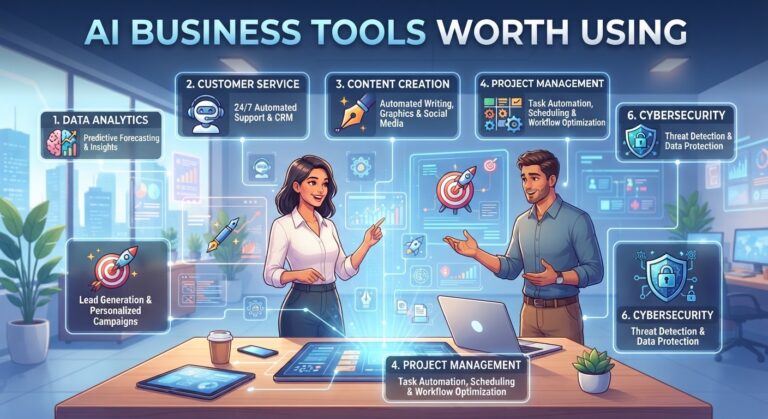
Artificial intelligence is becoming a practical part of everyday business operations.
Businesses no longer need to think of AI only as an experimental technology used by large technology companies. AI is increasingly being incorporated into tools for writing, research, customer service, sales, marketing, data analysis, project management, automation, and business communication.
However, having access to hundreds of AI tools does not automatically make a business more productive.
The real challenge is determining which AI business tools are actually worth using.
The best tools are not necessarily the ones with the longest feature lists. A useful business AI tool should solve a real problem, save meaningful time, improve the quality of work, or automate a process that would otherwise require unnecessary manual effort.
For small businesses, startups, agencies, and larger organizations, the right AI tools can create a more efficient digital workflow while allowing employees to focus on higher-value responsibilities.
This guide explores the major categories of AI business tools worth using in 2026, what they can do, who can benefit from them, and how businesses can choose the right tools without creating unnecessary complexity.
AI business tools are software applications that use artificial intelligence to help businesses perform tasks, analyze information, generate content, automate workflows, or make better use of data.
They can support almost every part of an organization.
Examples include AI tools for:
Some tools focus on a single business function, while others combine multiple AI capabilities.
The most useful approach is to select tools according to actual business needs rather than adopting AI simply because it is popular.
Businesses have limited time and resources.
Employees often spend hours performing repetitive tasks that do not necessarily require constant human attention.
Examples include:
AI can assist with many of these activities.
Potential benefits include:
The key is to use AI where it creates measurable value.
AI writing tools are among the most widely used business AI applications.
Businesses can use them to assist with:
Instead of starting with a blank page, employees can use AI to generate an initial draft and then improve it.
Best for:
AI writing tools are most useful when human employees provide context, verify information, and edit the final result.
Business research can take a significant amount of time.
AI research tools can help summarize information, identify patterns, compare concepts, and organize research findings.
They can support:
For example, instead of manually reviewing dozens of documents to identify common themes, an AI system may help summarize the major points.
Human verification remains important, especially when research is used for important business decisions.
Productivity is one of the strongest use cases for AI.
AI productivity tools can help employees:
The biggest benefit may not be doing more work.
It may be spending less time on low-value activities.
Meetings generate important information, but employees often need to manually write notes and action items.
AI meeting assistants can help with:
A typical workflow could look like:
Meeting
↓
AI transcription
↓
Summary
↓
Action items
↓
Assigned tasks
↓
Follow-up
This can make meetings easier to manage and reduce the risk of forgetting important decisions.
Customer service is another major area where AI can provide practical value.
AI customer service tools can help with:
Businesses can use AI to handle suitable routine requests while human representatives manage complex or sensitive situations.
This hybrid approach can combine automation with human support.
Sales teams often spend significant time researching prospects and managing administrative tasks.
AI sales tools can assist with:
AI can help salespeople spend less time on administrative work and more time talking with potential customers.
Marketing teams can use AI to accelerate many parts of their workflow.
AI marketing tools can support:
The strongest use cases usually combine AI assistance with human marketing strategy.
AI can help produce and organize information, while marketers decide what the business should communicate and why.
Search engine optimization involves research, content planning, technical analysis, and continuous improvement.
AI SEO tools can assist with:
AI can speed up SEO workflows, but successful SEO still depends on useful content, strong technical foundations, appropriate search intent, and genuine value for users.
Businesses generate large amounts of data.
AI data analysis tools can help employees understand information without manually processing every data point.
Potential applications include:
Employees can use natural-language prompts to ask questions about structured data in some AI-powered analytics environments.
However, important business decisions should still be based on validated data and appropriate analysis.
Businesses work with large numbers of documents.
Examples include:
AI document-processing tools can help extract information, summarize documents, classify files, and identify important sections.
This can reduce manual document handling.
Businesses should pay close attention to security and privacy when processing sensitive information.
Project management can involve dozens of small administrative activities.
AI can help with:
For example, an AI system might transform meeting notes into a structured list of project tasks.
This can help teams keep projects moving without requiring someone to manually document every action.
AI automation tools connect different business processes.
A simple workflow could be:
New lead
↓
CRM record created
↓
AI analyzes lead
↓
Lead categorized
↓
Salesperson notified
↓
Follow-up task created
Automation becomes particularly useful when a business has repetitive processes involving multiple systems.
AI can add capabilities such as classification, summarization, content generation, and decision support.
Businesses also need visual content.
AI creative tools can assist with:
AI can help teams move from an idea to an initial visual concept more quickly.
Human designers and marketers remain important for brand consistency, creative direction, and final quality.
Business communication can consume hours each week.
AI can assist with:
For busy teams, the ability to quickly summarize long conversations can be particularly useful.
The goal should be to improve communication efficiency without making business communication feel impersonal.
AI is also being incorporated into financial workflows.
Potential applications include:
Because financial information can be sensitive and business decisions may have significant consequences, businesses should use appropriate controls and professional review.
AI should support financial operations rather than replace necessary accounting expertise.
Human resources departments manage a wide range of administrative processes.
AI can assist with:
However, businesses should be particularly careful with AI systems used for employment-related decisions.
Sensitive employment decisions require appropriate human oversight, fairness considerations, and compliance with applicable laws and policies.
Business Function | Useful AI Applications |
Marketing | Content, campaigns, research, SEO |
Sales | Prospecting, qualification, CRM |
Customer Support | Chat, ticketing, summaries |
Operations | Workflow automation |
Finance | Documents, reporting, categorization |
HR | Onboarding, documentation, communication |
Management | Research, summaries, analysis |
Content | Writing, editing, repurposing |
Design | Visual concepts and creative assistance |
Analytics | Data analysis and reporting |
This makes it easier to identify where AI could fit into an organization’s existing workflow.
The biggest mistake businesses make is choosing tools based only on popularity.
Instead, start with the problem.
Step 1: Identify a Business Bottleneck
Ask:
What is taking too much time?
Examples:
Step 2: Estimate the Cost of the Problem
Calculate approximately how much employee time is being spent on the task.
If employees spend 20 hours every week on a repetitive activity, the opportunity for automation may be significant.
Step 3: Determine Whether AI Is Actually Necessary
Some tasks only need simple automation.
For example:
Send an email when a form is submitted.
A traditional automation workflow may be sufficient.
But:
Read the customer’s message, determine the request, summarize it, and route it to the appropriate department.
This may benefit from AI.
Step 4: Evaluate Integration
A great AI tool is less useful if it cannot fit into the systems your business already uses.
Consider:
Step 5: Consider Security
Before adopting an AI tool, determine:
Security should be considered before deployment rather than after a problem occurs.
Not every AI tool deserves a place in your business technology stack.
A useful framework is:
Problem → Workflow → AI Tool → Measurement
For example:
Problem: Salespeople spend too much time researching leads.
Workflow: Automate prospect research and create summaries.
AI Tool: AI research and CRM workflow.
Measurement: Time saved per qualified prospect.
This approach prevents businesses from collecting unnecessary AI tools without a clear purpose.
AI does not necessarily replace existing business software.
Instead, AI is increasingly being added to software that businesses already use.
For example:
Traditional Software | AI-Enhanced Capability |
CRM | Lead analysis and summaries |
Helpdesk | AI support and ticket classification |
Project management | Task assistance |
Analytics | Natural-language analysis |
Drafting and summarization | |
Document systems | Intelligent search |
Marketing platforms | Content and campaign assistance |
This means businesses can often add AI capabilities to existing workflows rather than rebuilding their entire technology stack.
Productivity improvements can come from several areas.
Less Manual Work
Employees spend less time performing repetitive activities.
Faster Information Retrieval
AI can help employees find and summarize information.
Faster Content Creation
Teams can create initial drafts more quickly.
Better Workflow Coordination
AI automation can connect multiple processes.
Faster Decision Support
AI can summarize information and highlight potential patterns.
More Employee Capacity
When repetitive work decreases, employees have more time for higher-value activities.
Small businesses often have limited employees and budgets.
This makes productivity particularly important.
A small company could start with AI tools for:
The goal should not be to adopt dozens of tools.
A small number of well-integrated tools can often create more value than a large collection of disconnected applications.
Startups often need to move quickly while keeping operating costs under control.
AI can help startup teams handle tasks across:
A small startup team can use AI as a productivity layer that helps increase its operational capacity.
However, startups should avoid building their entire business around AI-generated output without human validation.
Speed is valuable, but quality and customer trust remain essential.
Marketing agencies can use AI to manage multiple client workflows.
Potential applications include:
AI automation can help agencies increase capacity while allowing marketers to spend more time on strategy and creative work.
Sales teams can use AI to reduce administrative work.
Common applications include:
The result can be a sales workflow where representatives spend less time entering information and more time communicating with prospects.
Customer support teams can use AI to handle suitable repetitive requests.
AI can assist with:
Human agents should remain available for complex, sensitive, or unusual situations.
More software does not necessarily mean more productivity.
Every AI tool should solve a specific business problem.
Disconnected tools can create additional administrative work.
Business data should not be shared with AI systems without understanding how it is handled.
AI cannot automatically fix a badly designed workflow.
AI can produce inaccurate or incomplete information.
Generating more content or sending more messages does not necessarily improve business performance.
Start With One Problem
Choose a specific bottleneck.
Test Before Scaling
Run a small pilot before deploying AI across the organization.
Keep Humans Involved
Human review remains important for important decisions and customer-facing work.
Protect Business Data
Use appropriate access controls and data-management practices.
Measure Results
Track:
Train Employees
Employees should know how to use AI responsibly and effectively.
Review the Tool Stack Regularly
Remove tools that no longer provide meaningful value.
AI business tools are likely to become increasingly integrated into everyday software.
Instead of opening a separate AI application for every task, employees may increasingly interact with AI directly inside:
AI agents may also become more capable of completing multi-step workflows.
For example:
Analyze this week’s leads, identify the highest-priority opportunities, prepare summaries, create follow-up tasks, and update the sales pipeline.
This represents a shift from AI that simply generates information toward AI that can assist with complete business workflows.
Human oversight, permissions, security, and reliable data will remain important as these systems become more capable.
Businesses can follow a simple five-stage process.
Stage 1: Discover
Identify repetitive and time-consuming work.
Stage 2: Prioritize
Select tasks that have meaningful potential value.
Stage 3: Test
Run a limited AI implementation.
Stage 4: Measure
Compare productivity and quality before and after automation.
Stage 5: Scale
Expand successful workflows across additional teams or processes.
This approach reduces unnecessary spending and helps businesses build an AI strategy based on measurable results.
Before adding an AI tool, ask these questions:
If the answer to most of these questions is yes, the tool may deserve further evaluation.
What are AI business tools?
AI business tools are software applications that use artificial intelligence to help businesses perform tasks such as writing, research, analysis, customer service, sales, marketing, and workflow automation.
What AI tools are worth using for a business?
The best AI tools depend on the business’s specific needs. Tools that solve repetitive, time-consuming problems and integrate with existing workflows are generally more valuable than tools adopted simply because they are popular.
Are AI business tools useful for small businesses?
Yes. Small businesses can use AI to reduce repetitive work, improve customer service, accelerate content creation, support sales, and automate administrative processes.
Can AI business tools replace employees?
AI can automate certain tasks, but many business roles involve judgment, creativity, communication, relationships, and accountability. AI is often most valuable when it supports employees rather than simply replacing them.
How do I choose the right AI tool?
Start with a specific business problem. Determine the workflow, evaluate available tools, consider integration and security requirements, test the solution, and measure its results.
Are AI business tools expensive?
Costs vary widely. Some tools are free or low-cost, while specialized enterprise solutions can be significantly more expensive. Businesses should evaluate tools based on the value they create rather than price alone.
What business tasks should be automated first?
Start with repetitive, predictable, measurable tasks such as reporting, data organization, meeting summaries, customer FAQs, lead routing, and routine content workflows.
Is it safe to use AI with business data?
It depends on the tool, data, configuration, and security practices involved. Businesses should understand how information is processed, stored, accessed, and protected before using AI with sensitive information.
The growing number of AI applications can make choosing business technology difficult.
The solution is not to adopt every new AI product.
Instead, businesses should focus on AI business tools worth using because they solve meaningful problems.
The most valuable tools can help reduce repetitive work, accelerate research, improve customer experiences, support employees, automate workflows, and create additional operational capacity.
Whether you run a small business, startup, marketing agency, sales organization, or larger company, the right AI tools can become a practical part of your technology strategy.
The most successful businesses will not necessarily be the ones using the most AI tools.
They will be the ones using the right AI tools in the right workflows, with clear goals, responsible implementation, and measurable results.
To deliver innovative, scalable, AI, and human-centered technology solutions that empower businesses to thrive in a digital-first economy
1129 Northern Blvd., Suite 404, Manhasset, New York 11030
Privacy Policy | Team of Use | Cache © 2026 All rights reserved