
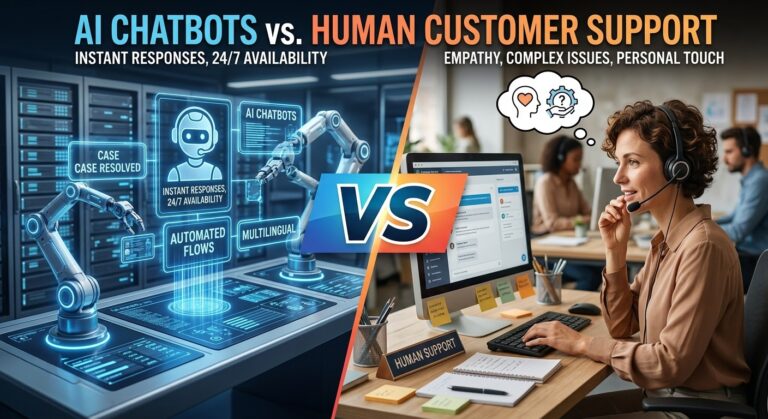
Customer support has become one of the most important factors influencing how customers perceive a business. People expect fast responses, accurate information, convenient communication channels, and helpful solutions whenever they encounter a problem. As these expectations grow, companies are exploring new ways to deliver better customer service without overwhelming their support teams.
One of the biggest decisions businesses face is choosing between AI chatbots and human customer support.
AI chatbots can answer common questions, guide customers through simple processes, retrieve information, and assist with repetitive requests. Human customer support agents, meanwhile, provide empathy, judgment, creativity, and personalized problem-solving when situations become complicated.
The debate over AI chatbots vs human customer support is not simply about deciding which option is better. Each approach has different strengths, and the right choice depends on the complexity of customer inquiries, business resources, service expectations, and the level of human interaction customers need.
For many organizations, the most practical solution is a hybrid customer support model that combines AI automation with human expertise.
In this guide, we compare AI chatbots and human customer service, explore their benefits and limitations, examine their costs and business applications, and explain how companies can build a customer support strategy that balances efficiency with meaningful human interaction.
AI chatbots are software applications designed to communicate with users through text or, in some cases, voice. They use predefined rules, natural language processing, machine learning, or generative AI to understand requests and provide responses.
Modern AI chatbots can do more than display scripted answers. Depending on their capabilities and integrations, they may interpret customer questions, search a knowledge base, summarize information, recommend next steps, and help customers complete specific tasks.
Common uses include:
For example, an online store might use a chatbot to explain its shipping policy, help a customer find a product, or retrieve order information from an authorized system.
The chatbot’s effectiveness depends on the quality of its information, the reliability of its integrations, the clarity of its instructions, and the safeguards in place.
Human customer support involves trained employees who communicate directly with customers to answer questions, resolve problems, provide guidance, and manage service requests.
Human agents can interpret complex situations, ask clarifying questions, recognize emotional cues, and adapt their responses based on context.
Their responsibilities may include:
Human support is particularly valuable when a situation requires discretion, nuanced judgment, or a level of empathy that automated systems cannot reliably provide.
Although human agents may need more time to handle each inquiry, they can offer flexibility when a customer’s problem does not fit a standard workflow.
The main difference is how each approach handles customer requests, complexity, and human interaction.
Feature | AI Chatbots | Human Customer Support |
Availability | Can operate around the clock | Depends on staffing and schedules |
Response speed | Often immediate for supported questions | May involve waiting or queue times |
Repetitive tasks | Well suited to common, predictable requests | Can handle them but may spend time on repetitive work |
Complex problems | Limited by tools, context, and reliability | Better suited to nuanced troubleshooting |
Empathy | Can use empathetic language but may misunderstand emotions | Can provide genuine human understanding |
Personalization | Depends on available data and integrations | Can adapt through conversation and judgment |
Consistency | Can follow configured guidance consistently | May vary by training and individual experience |
Scalability | Can handle many simultaneous conversations, subject to system capacity | Requires sufficient staff to handle growing demand |
Judgment | Needs defined limits and safeguards | Can apply contextual judgment within authority |
Initial setup | Requires configuration, integration, and testing | Requires hiring, training, and management |
Ongoing costs | Software, usage, maintenance, and oversight costs | Salaries, benefits, training, and management costs |
Accountability | Requires clear escalation and monitoring | Employees can take responsibility within their roles |
Neither approach is universally superior. Businesses should evaluate the actual needs of their customers and the types of problems they receive.
Customers often contact support because they need an answer immediately.
AI chatbots can respond to supported questions without requiring customers to wait for an available agent. This is especially useful for common inquiries about operating hours, shipping policies, account procedures, or product features.
Faster responses do not automatically mean faster resolution, however. A chatbot that gives an incorrect answer or repeatedly misunderstands a request can create more work.
Businesses should measure successful resolution, not just initial response time.
An AI chatbot can make basic support available outside normal business hours.
This is valuable for online stores, software companies, service providers, and businesses serving customers across multiple time zones.
A chatbot can answer routine questions overnight and collect information for a human agent when a problem requires further attention.
Customer service teams frequently answer the same questions.
AI chatbots can handle many repetitive inquiries, allowing employees to focus on unusual problems, complicated requests, and conversations that require human judgment.
This can help businesses use their support resources more effectively.
A human support team has a finite number of agents and conversations it can manage at once.
A properly configured chatbot can handle multiple conversations concurrently, subject to system limits and the complexity of each interaction.
This can help businesses manage sudden increases in inquiries during promotions, product launches, seasonal periods, or service disruptions.
A chatbot connected to a maintained knowledge base can provide answers based on approved product information, policies, and support documentation.
This can reduce variation in responses to common questions.
However, businesses must regularly review source material and monitor AI-generated answers. AI systems can still misinterpret information or generate inaccurate responses.
Before a customer reaches a human agent, a chatbot can collect relevant information, such as:
This can reduce repetitive questioning and help the human agent begin with more context.
Sensitive information should only be collected when necessary and through appropriate, secure processes.
Despite their benefits, chatbots are not a complete replacement for human support.
A chatbot may struggle when a customer describes an unusual technical issue, provides contradictory information, or needs a solution that falls outside its approved workflow.
Without effective escalation, the customer may become frustrated by repeated or irrelevant answers.
AI can recognize language patterns associated with frustration or urgency, but it does not experience human emotions.
A response that sounds polite may still feel insensitive when a customer is dealing with a serious problem.
Businesses should route emotionally sensitive or high-impact cases to trained human agents when appropriate.
Generative AI can produce convincing but incorrect information. This is particularly concerning when a response involves billing, contractual terms, security, refunds, or other consequential matters.
Useful safeguards include:
Customers may become annoyed when a chatbot repeatedly asks the same question, misunderstands an answer, or makes it difficult to reach a person.
A well-designed chatbot should recognize when it is not helping and offer a clear route to human support.
Deploying a chatbot involves more than installing a widget on a website.
Businesses may need to maintain knowledge bases, connect business systems, review conversation logs, configure permissions, monitor performance, and update the chatbot when policies change.
The ongoing work should be included in the cost calculation.
A trained human agent can listen to a customer’s concerns, acknowledge the impact of a problem, and adjust the conversation based on the customer’s needs.
This is particularly important when a customer is upset about a failed service, unexpected charge, missed delivery, or repeated issue.
Human agents can ask follow-up questions, evaluate unusual circumstances, and determine whether a standard procedure fits the situation.
They may also coordinate with supervisors or specialist teams when a request falls outside their normal responsibilities.
Some interactions involve personal concerns, financial difficulties, serious complaints, security incidents, or major service failures.
These situations often require discretion, contextual understanding, and clear accountability.
Human support provides an important layer of judgment in such cases.
Customers may appreciate speaking with a person who understands their situation and takes ownership of a problem.
Human agents can help establish trust by explaining decisions, setting realistic expectations, and following through on commitments.
Not every customer follows the expected journey.
A human agent can recognize when an inquiry requires an exception, an alternative solution, or coordination across several departments.
This flexibility is especially useful for businesses that sell complex products or provide specialized services.
Human support also has challenges that businesses must manage.
Human agents generally work scheduled shifts. Providing round-the-clock coverage may require additional staffing, shift planning, and management.
Growing customer demand may require businesses to recruit and train more employees.
Costs can include salaries, benefits, onboarding, supervision, equipment, and workforce management.
During busy periods, customers may need to wait in a queue.
Without effective routing and workload management, delays can damage the customer experience.
Human agents may spend significant time answering routine questions, recording details, and searching for information.
This can reduce the time available for complex customer problems.
Different employees may interpret policies differently or have different levels of experience.
Training, documentation, quality assurance, and support tools can help improve consistency.
The cost comparison depends on the type of business, customer volume, software requirements, staffing model, and complexity of inquiries.
AI chatbots can reduce the amount of human time needed for routine requests, but they still require setup, maintenance, monitoring, and technical support.
Human support involves staffing costs, but trained agents can resolve complicated cases that might otherwise require several automated interactions.
Businesses should compare the total cost of achieving a successful resolution rather than comparing chatbot subscription prices with employee salaries alone.
Cost Factor | AI Chatbot | Human Support |
Initial setup | Configuration and integration | Recruitment and onboarding |
Ongoing expense | Subscription, usage, maintenance | Salaries, benefits, and management |
Training | Knowledge-base and model configuration | Employee training and coaching |
Quality assurance | Testing, monitoring, and correction | Reviews, coaching, and performance monitoring |
Complex cases | May require human escalation | Often handled directly |
Scaling demand | May handle additional volume with incremental system costs | Usually requires additional staffing capacity |
Technical requirements | Integration, security, and system maintenance | Support software, equipment, and management systems |
A useful starting point is:
Cost per resolved inquiry = Total support costs ÷ Number of successfully resolved inquiries
For a fair comparison, include relevant software, staffing, implementation, maintenance, and oversight expenses.
Businesses should also track repeat contacts and customer satisfaction. A cheap interaction that fails to resolve the problem may increase total costs rather than reduce them.
AI chatbots work best when requests are common, predictable, and supported by reliable information or well-defined workflows.
Consider using chatbots for:
For example, a small online store could use a chatbot to answer shipping questions and direct customers to relevant return instructions.
If the customer reports a missing parcel or disputes a refund decision, the chatbot should collect useful details and transfer the issue to a human agent when required.
Human support is especially valuable when the situation involves complexity, ambiguity, sensitivity, or significant consequences.
Human agents should generally handle or supervise:
The precise boundaries depend on the business and the risks associated with each type of request.
A useful principle is to automate routine assistance while preserving straightforward access to a person for problems that require judgment or accountability.
For many businesses, the strongest approach is not choosing between AI and people. It is designing a system in which each handles the work it is best suited for.
A hybrid customer support model uses AI to assist with routine interactions and information gathering while human agents manage complex cases, sensitive conversations, and decisions requiring judgment.
Step 1: Customer Starts a Conversation
A customer opens a chat window and explains the issue.
Step 2: AI Identifies the Request
The chatbot classifies the inquiry and searches approved information or connected systems.
Step 3: AI Handles Supported Questions
For a straightforward request, the chatbot provides an answer or completes an authorized task.
Step 4: AI Recognizes the Need for Human Help
If the issue is complex, uncertain, sensitive, or unresolved, the chatbot initiates an escalation.
Step 5: Human Agent Receives Context
The agent receives a summary of the conversation and relevant information collected with appropriate permissions.
Step 6: Human Resolves the Problem
The agent investigates the issue, communicates with the customer, and determines the appropriate next step.
Step 7: The Business Learns From the Interaction
With suitable privacy safeguards, the support team can identify recurring issues and improve documentation, workflows, and service quality.
This approach helps reduce repetitive work without making customers feel trapped in an automated system.
AI is not limited to communicating directly with customers. It can also improve the tools human agents use.
Automated Conversation Summaries
AI can summarize previous interactions so agents do not need to read an entire conversation before responding.
Suggested Responses
AI can draft replies using approved knowledge sources. Agents can review and edit the response before sending it.
Knowledge Retrieval
AI-powered search can help agents find relevant policies, troubleshooting instructions, and product documentation.
Ticket Classification
AI can categorize inquiries and recommend routing based on issue type, urgency, or required expertise.
Quality Assurance
AI can help identify recurring problems, incomplete responses, or possible policy deviations for human review.
Follow-Up Management
AI can prepare action items and reminders so customer commitments are less likely to be overlooked.
These applications can improve employee productivity while keeping people responsible for important decisions.
Before investing in chatbots or expanding a human support team, businesses should assess their operational needs.
Review the types of questions customers ask most often.
If a large portion of inquiries involve straightforward, repetitive questions, automation may be useful.
If most cases require complex investigation or personalized judgment, human support should remain central.
Some customers prefer self-service, while others want immediate access to a human agent.
Provide suitable options and evaluate customer feedback rather than assuming everyone prefers automation.
A chatbot may need access to a knowledge base, CRM, order management platform, help desk, or scheduling system.
Confirm that integrations work reliably and that permissions restrict the system to appropriate actions.
Define when the chatbot should transfer a conversation to a human.
Examples include repeated misunderstandings, low confidence, customer requests for a person, sensitive issues, and actions outside the chatbot’s authority.
Track the quality of the customer experience and the operational impact.
Do not evaluate a chatbot solely by the number of conversations it handles.
Review failed interactions, customer complaints, unresolved inquiries, and employee feedback.
Use these insights to improve the chatbot’s knowledge, workflows, and escalation process.
Businesses should use a balanced set of performance indicators.
Metric | Why It Matters |
First Response Time | Measures how quickly a customer receives an initial response |
First Contact Resolution | Shows how often issues are resolved in the initial interaction |
Average Resolution Time | Measures the time needed to resolve a request |
Customer Satisfaction (CSAT) | Captures customers’ reported satisfaction |
Customer Effort Score | Measures how easy customers find it to obtain help |
Escalation Rate | Shows how frequently chatbot conversations require human assistance |
Repeat Contact Rate | Helps identify unresolved or recurring issues |
Cost per Resolved Inquiry | Measures operational efficiency |
Agent Workload | Indicates whether AI is reducing repetitive tasks |
Complaint Rate | Helps identify frustrating or unsuccessful interactions |
Interpret metrics together. A lower escalation rate is not necessarily positive if customers cannot reach human agents when they need help. Likewise, faster responses do not guarantee accurate solutions.
Replacing Human Support Too Quickly
Removing human support before understanding customer needs can damage service quality.
Start with selected use cases and expand gradually.
Using Outdated Information
A chatbot that relies on obsolete policies or product information can mislead customers.
Establish clear processes for maintaining the knowledge base.
Hiding the Human Support Option
Customers should not have to fight through endless automated prompts to reach an agent.
Make escalation simple and visible.
Ignoring Difficult Conversations
Test how the chatbot responds to vague questions, repeated failures, angry customers, and unusual requests.
Measuring Only Cost Savings
Customer satisfaction, accuracy, resolution quality, and long-term loyalty also matter.
Failing to Protect Customer Data
Use appropriate access controls, secure integrations, data minimization, and vendor reviews.
Neglecting Employee Training
Human agents need to understand how AI works, when to trust its suggestions, and when to verify or reject them.
Customer service is likely to become more integrated, conversational, and AI-assisted.
AI systems may become better at understanding context, retrieving accurate information, coordinating tasks, and assisting agents across multiple communication channels.
AI agents may also handle more multi-step workflows, such as gathering details, checking authorized records, preparing service requests, and coordinating follow-ups.
At the same time, human skills will remain important for empathy, complex problem-solving, accountability, and decisions that require nuanced judgment.
The future is unlikely to be defined by a simple choice between people and technology. Instead, businesses will need to determine which tasks can be automated reliably and where human involvement creates the greatest value.
Organizations that make these decisions carefully can build customer support systems that are efficient, trustworthy, and easier for customers to use.
AI chatbots are often better suited to repetitive questions, immediate responses, and routine workflows. Human agents are generally better for complex problems, sensitive conversations, and situations requiring contextual judgment. Many businesses benefit from combining both.
AI chatbots can automate some customer service tasks, but they cannot reliably handle every situation. Human agents remain important for complex issues, emotional support, exceptions, and accountability.
They can reduce some operating costs, particularly for high-volume routine inquiries. However, total costs include implementation, software, integrations, maintenance, oversight, and human escalation. Businesses should compare cost per successfully resolved inquiry.
Preferences vary depending on the customer, issue, and quality of service. Some customers prefer immediate self-service for simple questions, while others prefer human assistance. Offering both options can accommodate different needs.
Common candidates include FAQs, basic product information, appointment scheduling, ticket classification, order-status checks, and knowledge-base navigation, provided the necessary information and system integrations are reliable.
They can provide immediate responses, operate outside normal business hours, manage repetitive inquiries, collect relevant details, and help customers find information. Their effectiveness depends on accuracy and appropriate escalation.
Hybrid customer support combines AI tools with human agents. AI handles suitable routine tasks and assists with information retrieval, while humans manage complex, sensitive, or unresolved issues.
Businesses can track customer satisfaction, first contact resolution, average resolution time, escalation rate, repeat contacts, complaint rates, and cost per resolved inquiry.
Yes. Small businesses can use chatbots to answer common questions, collect inquiries, guide customers through basic processes, and provide support outside business hours. They should begin with a clearly defined use case and maintain access to human assistance.
The future will likely involve more capable AI assistants, automated multi-step workflows, better agent assistance, and closer integration between AI systems and human support teams. Trust, privacy, accuracy, and human accountability will remain essential.
The comparison between AI chatbots and human customer support highlights two different but complementary approaches to customer service.
AI chatbots can provide fast responses, automate repetitive tasks, and help businesses manage high volumes of routine inquiries. Human agents contribute empathy, flexible problem-solving, accountability, and the ability to navigate complex situations.
For many businesses, the most effective strategy is to combine these strengths. AI can manage appropriate routine work, gather information, and assist employees, while human agents remain available for conversations that need personal attention and informed judgment.
The key is to design customer support around successful resolutions rather than maximizing automation.
Businesses should begin by identifying common customer needs, choosing suitable automation opportunities, setting clear escalation rules, protecting customer information, and measuring results across the entire support experience.
The best customer support strategy is not the one that uses the most AI. It is the one that helps customers get accurate answers and meaningful solutions with the least unnecessary effort.
As customer service technology continues to evolve, businesses that balance intelligent automation with human expertise will be better positioned to improve efficiency, build trust, and deliver lasting customer value.
To deliver innovative, scalable, AI, and human-centered technology solutions that empower businesses to thrive in a digital-first economy
1129 Northern Blvd., Suite 404, Manhasset, New York 11030
Privacy Policy | Team of Use | Cache © 2026 All rights reserved