
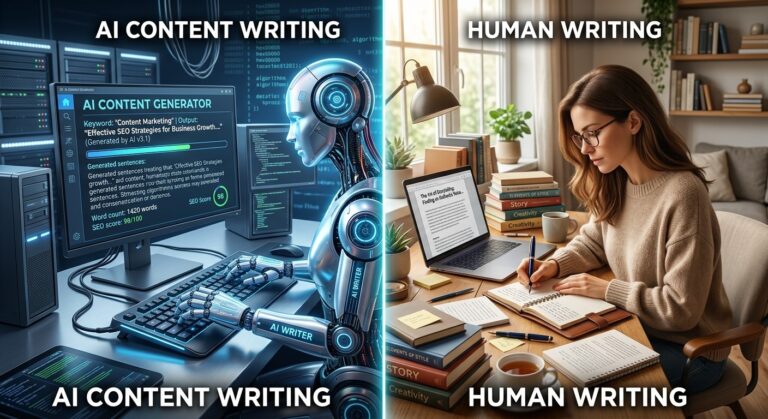
Artificial intelligence has transformed the way businesses create content.
AI writing tools can generate articles, social media posts, email campaigns, product descriptions, scripts, and marketing copy within seconds. For businesses producing large amounts of content, this can dramatically reduce the time required to move from an idea to a finished draft.
But human writers still play an important role.
Human writers bring experience, creativity, emotional understanding, storytelling ability, judgment, and unique perspectives that automated systems may not consistently reproduce.
This raises an important question for marketers in 2026:
Should businesses use AI content writing, human writers, or a combination of both?
The answer depends on the type of content, the goals of the business, the audience, and the level of expertise required.
Rather than viewing AI and human writing as direct competitors, businesses can use both strategically.
AI content writing uses artificial intelligence to assist with or generate written material.
AI tools can help create:
AI can analyze patterns in language and generate text based on instructions provided by the user.
This makes it useful for accelerating repetitive or structured writing tasks.
However, AI-generated content still requires appropriate review, editing, and fact-checking.
Human content writing is created primarily by people using their knowledge, creativity, research, experience, and judgment.
Human writers can:
Human writing can be particularly valuable when a topic requires expertise, originality, nuance, or a strong personal perspective.
Factor | AI Content Writing | Human Writing |
Speed | Very fast | Slower |
Scalability | Very high | Limited by time |
Cost | Often lower | Usually higher |
Creativity | Pattern-based | Original and adaptive |
Emotional understanding | Limited | Strong |
Personal experience | Limited | Strong |
Research assistance | Excellent | Excellent |
Consistency | High | Depends on writer |
Brand voice | Requires guidance | Naturally adaptable |
Fact-checking | Necessary | Necessary |
Editing | Often required | Usually required |
Strategic thinking | Limited | Strong |
Storytelling | Can assist | Strong |
Neither approach is automatically better in every situation.
The best option depends on what the content needs to accomplish.
Speed is one of the biggest advantages of AI content writing.
A marketer can provide a topic and instructions and receive an initial draft almost immediately.
AI can also generate multiple variations of:
This can significantly accelerate the early stages of content production.
For businesses managing large content calendars, speed can be a major advantage.
Human writers can draw from experiences that are specific to themselves or their organizations.
For example, a human writer can include:
This information can make an article significantly more distinctive.
AI can organize and transform information, but businesses should add genuine original value rather than relying entirely on generic generated text.
Hiring professional writers for every content task can be expensive.
AI can reduce the amount of manual work involved in:
For example, a marketer could use AI to turn an existing article into:
This can improve content-production efficiency.
However, lower production costs should not come at the expense of quality.
Writing isn’t simply about arranging words.
A writer needs to understand:
Human writers can make contextual decisions that may require judgment rather than pattern recognition.
This is especially important for sensitive, complex, or highly specialized subjects.
AI doesn’t need to write the final article to be useful.
It can help writers brainstorm:
For example, a marketer planning an article about AI marketing can ask AI to identify 20 potential subtopics.
The writer can then select the most valuable ideas and develop them using research and expertise.
This is a powerful example of human-AI collaboration.
Stories connect information with emotion.
A skilled writer can use:
to make an idea memorable.
AI can help develop story structures, but authentic human experiences often provide the strongest storytelling material.
This is particularly important for:
AI can assist marketers with several SEO activities.
It can help identify:
It can also help optimize existing content for readability and structure.
However, SEO success should not be reduced to keyword insertion.
Content still needs to satisfy search intent and provide meaningful value.
A competitive SEO article needs more than keywords.
Human expertise can add:
These elements can help differentiate a page from generic competing content.
The strongest SEO strategy is often AI-assisted research combined with human expertise.
Businesses with large content teams often struggle with consistency.
Different writers may use different:
AI can help create guidelines and identify inconsistencies.
For example, it can review content for:
This can help maintain a more consistent brand voice.
Marketing often involves emotion.
Customers may be:
Human writers can better recognize subtle emotional context and adjust communication accordingly.
This matters for content involving customer stories, difficult situations, persuasive messaging, and brand communication.
AI can help businesses create different versions of content for different audiences.
For example, a company could create variations for:
AI can accelerate this process.
Human oversight remains important to ensure that personalization feels useful rather than artificial or intrusive.
Trust is particularly important when content influences purchasing or business decisions.
Readers may respond more strongly to content that demonstrates:
A human expert explaining how they solved a real problem can be more persuasive than a generic article that simply summarizes existing information.
AI can produce convincing text that contains incorrect information.
Potential problems include:
For this reason, businesses should verify important claims before publishing AI-assisted content.
Human editorial review remains essential.
Real-world communication doesn’t always follow predictable patterns.
A writer may need to respond to:
Human judgment is valuable when the situation requires nuanced interpretation.
AI can assist with research and drafting, but people should make important editorial decisions.
Some writing tasks are highly structured.
AI can be particularly useful for:
Using AI for these tasks can free human writers to focus on more strategic content.
Thought leadership requires more than information.
It requires a perspective.
Strong thought leadership can include:
AI can help research and organize these ideas, but businesses should ensure that the central perspective comes from genuine expertise and strategic thinking.
There isn’t a simple answer.
AI content can perform well when it is useful, accurate, relevant, original, and properly edited.
Human-written content can also perform well when it satisfies search intent and provides genuine value.
Search performance should therefore be judged by the quality and usefulness of the final content—not simply by whether AI or a human produced the first draft.
A strong SEO workflow can look like this:
AI research → Human strategy → AI-assisted draft → Human expertise → Fact-checking → SEO optimization → Publication → Performance analysis
The best approach is usually a combination.
Use AI when you need:
Use humans when you need:
This creates a more efficient content operation without removing the human element.
Businesses can create a practical hybrid workflow.
Step 1: Define the Goal
Determine what the content needs to accomplish.
Examples:
Step 2: Research the Topic
Use AI to accelerate keyword and topic research.
Step 3: Build the Content Brief
Identify:
Step 4: Create the Initial Draft
Use AI to accelerate the drafting process where appropriate.
Step 5: Add Human Expertise
Add original insights, examples, data, experiences, and opinions.
Step 6: Fact-Check
Verify important information.
Step 7: Edit for Brand Voice
Make sure the content sounds like the business—not like a generic AI system.
Step 8: Optimize for Search
Review headings, internal links, metadata, readability, and search intent.
Step 9: Publish and Measure
Track organic visibility, engagement, leads, conversions, and other relevant KPIs.
Step 10: Improve
Update content based on performance and changing audience needs.
The debate between AI and human writing may become less important as businesses become more comfortable with hybrid workflows.
Instead of asking:
“Should AI replace human writers?”
businesses should ask:
“Which parts of our content workflow can AI improve while humans remain responsible for quality and strategy?”
This approach allows businesses to gain the efficiency of AI while preserving the qualities that make great content valuable.
AI can handle more repetitive tasks.
Humans can focus on creativity, expertise, strategy, and relationships.
Together, they can create a stronger content operation.
Publishing AI Content Without Review
Always evaluate important content before publication.
Removing Human Expertise
AI should not eliminate the unique knowledge that differentiates your brand.
Chasing Content Volume
More articles don’t automatically mean better results.
Using Generic AI Prompts
Detailed instructions produce more useful results.
Ignoring Brand Voice
Content should remain consistent with the company’s identity.
Forgetting the Audience
Technology should serve the reader—not the other way around.
The debate over AI content writing vs human writing isn’t really about choosing one or the other.
AI offers speed, scalability, efficiency, brainstorming support, and automation.
Human writers offer creativity, expertise, storytelling, emotional intelligence, original perspectives, and strategic judgment.
The strongest content strategy combines both.
Businesses can use AI to accelerate research, generate ideas, organize information, create drafts, and repurpose existing material. Human writers and editors can then add expertise, originality, personality, fact-checking, and strategic direction.
In 2026, the competitive advantage won’t necessarily belong to businesses that use the most AI.
It will belong to businesses that use AI intelligently while preserving the human qualities that make content useful, trustworthy, and memorable.
Is AI writing better than human writing?
Neither is universally better. AI is faster and highly scalable, while humans are generally stronger at original thinking, storytelling, emotional context, and expert judgment.
Can AI-written content rank in search engines?
AI-assisted or AI-generated content can appear in search results when it provides useful, relevant, high-quality information. The method used to create the content should not replace the need for quality and usefulness.
Should businesses use AI to write blog posts?
Businesses can use AI to assist with blog research, outlines, drafting, and optimization. Human review and expertise should be added before publication.
Will AI replace human content writers?
AI is likely to automate many repetitive writing tasks, but human writers remain valuable for strategy, expertise, storytelling, creativity, editing, and original thought leadership.
What is the best way to combine AI and human writing?
Use AI for research, brainstorming, outlining, drafting, editing, and repurposing. Use humans for strategy, expertise, originality, fact-checking, brand voice, and final editorial decisions.
Is human-written content better for SEO?
Not necessarily. SEO performance depends on factors such as relevance, search intent, quality, usefulness, technical optimization, and authority. Human involvement can help add originality and expertise, but simply being human-written does not guarantee rankings.
What types of content should humans write?
Humans are particularly valuable for thought leadership, expert analysis, case studies, personal stories, opinion pieces, complex topics, and content requiring substantial original insight.
What content is suitable for AI?
AI can be particularly useful for brainstorming, outlines, summaries, content repurposing, product descriptions, social media variations, metadata, and other structured tasks.
To deliver innovative, scalable, AI, and human-centered technology solutions that empower businesses to thrive in a digital-first economy
1129 Northern Blvd., Suite 404, Manhasset, New York 11030
Privacy Policy | Team of Use | Cache © 2026 All rights reserved