
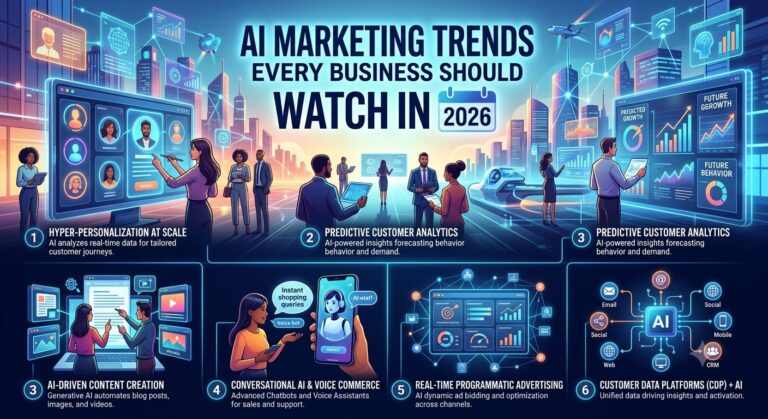
Artificial intelligence (AI) is no longer a futuristic concept—it has become an essential part of modern marketing. Businesses of all sizes are leveraging AI to automate repetitive tasks, personalize customer experiences, analyze vast amounts of data, and improve marketing performance.
As AI technology continues to evolve, new trends are reshaping how brands connect with customers and compete in the digital marketplace. Companies that stay informed about these developments can gain a significant competitive advantage while delivering more efficient, data-driven marketing campaigns.
In this article, we’ll explore the most important AI marketing trends every business should watch in 2026 and how these innovations can support long-term growth.
Traditional marketing often relies on manual processes, assumptions, and historical data. AI changes this by enabling businesses to make faster, smarter decisions based on real-time insights.
Today’s AI-powered marketing platforms can:
As these capabilities become more advanced, AI is moving from a helpful tool to a core component of successful marketing strategies.
Automation remains one of the biggest drivers of AI adoption.
Modern AI systems can automate repetitive marketing tasks such as:
Instead of spending hours on routine activities, marketers can focus on creativity, strategy, and business growth.
Why it matters
Businesses improve productivity while reducing operational costs and maintaining consistent marketing performance.
Consumers increasingly expect personalized experiences across every digital channel.
AI analyzes customer data to deliver:
Rather than treating every customer the same, businesses can provide experiences tailored to individual preferences and behaviors.
Business impact
Hyper-personalization improves engagement, customer loyalty, and conversion rates.
One of the fastest-growing trends is the rise of AI agents.
Unlike traditional automation tools, AI agents can:
These intelligent systems help businesses reduce manual work while improving marketing efficiency.
Predictive analytics uses AI to forecast future customer behavior based on historical and real-time data.
Businesses can predict:
These insights help marketers allocate budgets more effectively and create campaigns that resonate with the right audience.
AI-powered content creation continues to evolve.
Businesses are using AI to assist with:
While human creativity remains essential, AI significantly speeds up content production and helps maintain publishing consistency.
Search engine optimization is becoming increasingly data-driven.
AI tools now help marketers:
Businesses using AI-powered SEO can identify opportunities faster and respond to search engine changes more effectively.
Customer service is becoming an important part of digital marketing.
AI-powered chatbots and virtual assistants now provide:
These tools improve customer satisfaction while generating qualified leads around the clock.
Consumers increasingly interact with businesses through voice assistants and conversational interfaces.
Businesses should optimize for:
This trend is changing how customers discover products and interact with brands online.
Consumers are becoming more concerned about how businesses collect and use personal information.
Modern AI marketing emphasizes:
Building trust through responsible AI practices is becoming a competitive advantage.
One of the biggest reasons businesses adopt AI is its ability to maximize return on investment.
AI continuously optimizes campaigns by:
These improvements help businesses generate better results while controlling marketing costs.
To stay competitive, organizations should begin integrating AI into their marketing strategies.
Consider these best practices:
Choose solutions that align with your business goals and integrate with your existing systems.
AI relies on accurate and organized data. Clean customer data leads to more reliable insights and better automation.
AI can automate tasks and analyze information, but human creativity and strategic thinking remain essential for building authentic customer relationships.
Monitor key performance indicators (KPIs) such as:
Use these insights to refine your AI-powered marketing strategy over time.
Despite its many advantages, businesses should prepare for challenges such as:
Addressing these challenges proactively helps ensure successful AI adoption.
AI is expected to become even more integrated into every stage of the customer journey.
Future developments may include:
Businesses that embrace these innovations today will be better positioned to adapt to tomorrow’s digital landscape.
AI continues to reshape digital marketing by making campaigns more intelligent, personalized, and efficient. From automation and predictive analytics to AI agents and privacy-first strategies, these trends are helping businesses improve customer engagement and drive measurable growth.
Organizations that monitor emerging AI marketing trends and invest in the right technologies will be better equipped to stay competitive, improve marketing ROI, and build stronger customer relationships in 2026 and beyond.
Rather than replacing marketers, AI empowers teams to work smarter, make better decisions, and focus on creating meaningful customer experiences.
To deliver innovative, scalable, AI, and human-centered technology solutions that empower businesses to thrive in a digital-first economy
1129 Northern Blvd., Suite 404, Manhasset, New York 11030
Privacy Policy | Team of Use | Cache © 2026 All rights reserved