
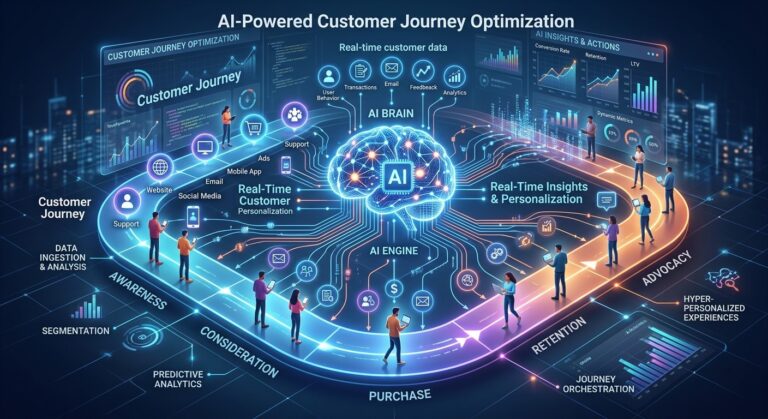
Customers no longer follow a simple path from discovering a business to making a purchase. Today’s customer journey can involve search engines, social media, websites, emails, advertisements, chatbots, mobile applications, and multiple interactions with a brand before a purchasing decision is made.
For businesses, understanding and optimizing this complex journey can be challenging.
This is where AI-powered customer journey optimization is changing the way companies understand and engage their customers.
Artificial intelligence can analyze customer behavior, identify patterns, predict future actions, personalize interactions, and automate communication across multiple stages of the customer journey.
Instead of treating every customer the same, businesses can use AI to deliver more relevant experiences at the right time and through the right channel.
In 2026, AI-powered customer journey optimization is becoming an increasingly important strategy for businesses that want to improve customer engagement, increase conversions, and build stronger long-term relationships.
AI-powered customer journey optimization is the use of artificial intelligence to analyze and improve the different interactions customers have with a business.
AI can collect and analyze information from multiple touchpoints, including:
The technology can then identify patterns and recommend or automate actions designed to improve the customer experience.
For example, if a visitor repeatedly views a particular product but doesn’t purchase it, an AI system could identify the customer’s interest and trigger a relevant follow-up message or recommendation.
A poor customer journey can cause potential customers to leave before completing a purchase.
Common problems include:
AI can help businesses identify these problems and improve customer interactions throughout the journey.
A better customer journey can lead to:
A typical customer journey may include several stages.
Awareness
The customer first discovers a brand through search, social media, advertising, content, or recommendations.
Consideration
The customer researches products or services and compares different options.
Decision
The customer evaluates pricing, reviews, features, and other factors before making a purchase.
Purchase
The customer completes a transaction.
Retention
The business continues engaging with the customer through support, personalized recommendations, loyalty programs, and relevant communication.
Advocacy
Satisfied customers may recommend the brand to others through reviews, referrals, and social media.
AI can support each of these stages.
One of the biggest advantages of AI is its ability to analyze large amounts of customer data.
AI can identify patterns involving:
These insights help businesses understand what customers want and where they may encounter problems.
Instead of relying entirely on assumptions, marketers can use behavioral data to improve the customer journey.
Customers are more likely to engage with content that is relevant to their interests.
AI can personalize:
For example, an online retailer can recommend products based on a customer’s browsing and purchase history.
This makes the experience more relevant without requiring marketers to manually create a different campaign for every customer.
AI can analyze behavioral signals to estimate what a customer may do next.
For example, a customer who:
may demonstrate strong purchase intent.
An AI system can identify this pattern and trigger an appropriate follow-up strategy.
Predictive customer analytics can help businesses engage customers before they disappear from the sales funnel.
Not every potential customer is ready to purchase immediately.
AI can help businesses nurture leads by automatically determining what type of communication may be appropriate at different stages.
For example:
New visitor → Educational content
Engaged visitor → Product information
High-intent prospect → Personalized offer
Existing customer → Retention campaign
This creates a more relevant customer journey while reducing manual marketing work.
Businesses communicate with customers through multiple channels.
These may include:
AI can analyze customer engagement and help determine which channels are most effective for different audiences.
It can also assist with timing and content personalization.
This reduces the likelihood of sending irrelevant messages at inappropriate times.
Customers often have questions before making a purchase.
AI-powered chatbots can provide immediate assistance by:
24/7 availability can make the customer journey faster and more convenient.
Human support teams can then focus on complex issues requiring empathy, judgment, or specialized knowledge.
Customer journey optimization isn’t only about personalization.
Businesses also need to identify where customers are leaving the journey.
AI can help identify patterns such as:
By identifying these friction points, businesses can make targeted improvements.
A smoother customer journey can increase the likelihood that visitors become customers.
AI helps by delivering:
Instead of treating conversion as a single event, AI helps businesses optimize the entire sequence of interactions leading to the conversion.
The customer journey doesn’t end after a purchase.
Keeping existing customers can be just as important as acquiring new ones.
AI can identify customers who may be:
Businesses can use these insights to create targeted retention campaigns.
Examples include:
Customers expect consistent interactions across different channels.
A customer may discover a product through social media, research it on a website, ask a question through chat, and purchase through a mobile device.
AI can help businesses connect information across these interactions.
This creates a more unified customer experience.
Instead of treating every interaction as a separate event, businesses can develop a more complete understanding of the customer’s journey.
Traditional customer analysis may involve reviewing reports after a campaign has finished.
AI can process information much faster.
Real-time insights can help businesses identify:
This enables marketers to respond more quickly to changing customer needs.
Personalizing the customer experience manually for thousands or millions of customers is extremely difficult.
AI makes large-scale personalization more practical.
Businesses can automatically adjust experiences based on:
This allows companies to provide personalized experiences without requiring a separate marketing strategy for every individual.
Traditional customer journey management often depends on predefined customer segments and manual campaign rules.
AI-powered optimization can analyze customer behavior continuously and adjust experiences dynamically.
Feature | Traditional Approach | AI-Powered Approach |
Customer segmentation | Manual | Data-driven |
Personalization | Basic | Advanced |
Customer prediction | Limited | Predictive |
Campaign optimization | Periodic | Continuous |
Data analysis | Manual | Automated |
Communication | Rule-based | Behavior-based |
Customer insights | Historical | Real-time |
Scalability | Limited | High |
The major advantage of AI is its ability to process more information and adapt more quickly.
Businesses can begin with a simple process.
Step 1: Map the Customer Journey
Identify all major customer touchpoints.
Document how customers discover, evaluate, purchase, and interact with your business.
Step 2: Collect Relevant Data
Bring together useful information from:
Step 3: Identify Friction Points
Determine where customers commonly abandon the journey.
Look for:
Step 4: Introduce AI
Start with a specific application, such as:
Step 5: Measure Performance
Track metrics such as:
Use these metrics to evaluate whether AI is improving the journey.
Keep the Customer at the Center
AI should improve the customer experience rather than simply automate marketing.
Use Quality Data
Accurate customer information is essential for reliable AI insights.
Protect Customer Privacy
Businesses should collect and use customer information responsibly and follow applicable privacy requirements.
Maintain Human Oversight
AI should support human employees rather than eliminate meaningful human interaction where it is needed.
Continuously Test
Customer behavior changes over time. Businesses should regularly test and optimize their AI-powered experiences.
Common Challenges
AI-powered customer journey optimization can also present challenges.
Businesses may encounter:
The solution is to implement AI gradually, monitor its performance, and maintain appropriate human oversight.
AI is expected to play an increasingly important role in customer experience.
Future systems may become better at predicting customer needs, coordinating interactions across channels, and automatically recommending the next best action.
AI agents may eventually help businesses manage complex customer journeys by:
This could create customer experiences that are increasingly adaptive and responsive.
AI-powered customer journey optimization is changing how businesses understand and engage their customers.
By analyzing behavior, predicting intent, personalizing communication, automating interactions, and identifying journey friction points, AI can help businesses create smoother and more relevant customer experiences.
The goal isn’t simply to automate customer interactions.
The real opportunity is to understand customers better and deliver the right experience at the right moment.
Businesses that combine AI technology with high-quality data, human expertise, responsible privacy practices, and customer-focused strategies will be better positioned to improve engagement, increase conversions, and build lasting customer relationships.
What is AI-powered customer journey optimization?
AI-powered customer journey optimization uses artificial intelligence to analyze customer behavior and improve interactions across different stages of the customer journey.
How does AI personalize the customer journey?
AI analyzes customer data such as browsing behavior, purchases, interactions, and preferences to deliver more relevant content, recommendations, offers, and communication.
Can AI improve customer retention?
Yes. AI can identify changes in customer behavior and help businesses create personalized retention and re-engagement campaigns.
How does AI improve customer experience?
AI can provide faster support, personalized recommendations, predictive insights, relevant communication, and more consistent experiences across different channels.
Is AI customer journey optimization suitable for small businesses?
Yes. Small businesses can start with individual AI applications such as chatbots, email personalization, lead scoring, and customer analytics before expanding their strategy.
Will AI replace human customer service?
AI can automate routine interactions, but human support remains important for complex problems, emotional situations, and interactions requiring judgment and empathy.
To deliver innovative, scalable, AI, and human-centered technology solutions that empower businesses to thrive in a digital-first economy
1129 Northern Blvd., Suite 404, Manhasset, New York 11030
Privacy Policy | Team of Use | Cache © 2026 All rights reserved