
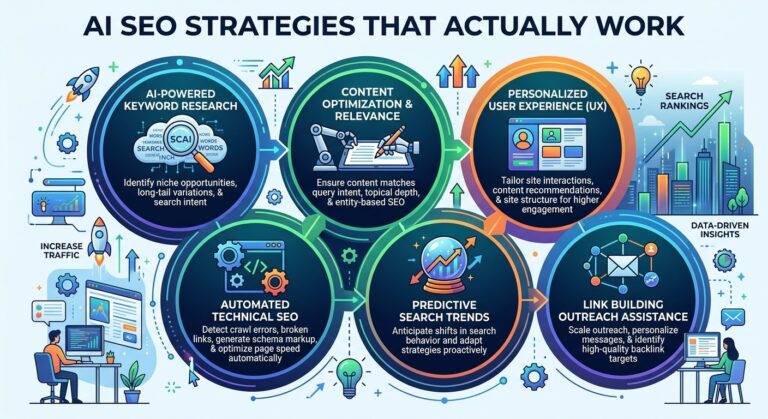
Search engine optimization continues to evolve, but one of the biggest changes in modern SEO is the growing role of artificial intelligence.
AI can help marketers analyze search behavior, identify content opportunities, understand search intent, optimize websites, and create more efficient SEO workflows. However, simply using AI to produce large amounts of content does not guarantee better rankings.
The businesses that succeed with AI SEO strategies focus on using artificial intelligence to make better decisions—not just to create more content.
In 2026, effective SEO is increasingly about understanding users, providing useful information, demonstrating expertise, maintaining technical quality, and adapting to changing search experiences.
This guide explores AI SEO strategies that actually work and explains how businesses can use AI without sacrificing quality or authenticity.
AI SEO refers to the use of artificial intelligence to improve search engine optimization activities.
AI can assist with:
The important distinction is that AI should support SEO strategy rather than replace it.
A strong AI SEO workflow combines machine-assisted analysis with human expertise, editorial judgment, and original insights.
Search is becoming more sophisticated.
People increasingly use conversational queries, long-tail searches, voice interfaces, and AI-powered search experiences to find information.
At the same time, businesses are competing against more content than ever.
AI can help marketers process large amounts of information and identify opportunities faster.
The biggest advantages include:
But AI should be used strategically.
More AI-generated content does not automatically mean more organic traffic.
One of the most useful AI SEO strategies is using AI to understand why someone is searching for a particular query.
A keyword can have different intentions.
For example, someone searching for:
“best AI marketing tools”
may be researching available solutions.
Someone searching for:
“how to use an AI marketing tool”
is looking for educational information.
Someone searching for:
“AI marketing software pricing”
may be closer to making a purchasing decision.
AI can help analyze search queries and group them according to intent.
Why this strategy works
Creating content that matches what users actually want is more valuable than simply inserting keywords into an article.
Instead of creating isolated articles around individual keywords, businesses can use AI to identify related topics.
For example, a website targeting AI marketing could create a content cluster containing:
These related pages can support one another through internal links.
The benefit
Topic clusters help businesses build comprehensive resources around important subjects while creating a logical website structure.
AI can help expand traditional keyword research.
Instead of focusing only on high-volume keywords, use AI to identify:
For example, instead of targeting only:
“AI SEO”
you might discover related searches such as:
These queries can reveal additional content opportunities.
AI can help marketers discover the questions customers are asking.
Use AI to analyze:
Then turn those questions into useful content.
A strong article should answer the reader’s question clearly rather than simply trying to satisfy a keyword target.
The winning approach
Question → Useful answer → Supporting information → Practical examples → Next step
This creates content designed for people rather than search engines alone.
AI isn’t only useful for creating new articles.
One of the most effective SEO strategies is improving content that already exists.
AI can help identify:
For example, an article published several years ago may still receive organic traffic but contain outdated information.
Updating it can be more valuable than creating another article from scratch.
A content gap exists when your website doesn’t adequately cover a topic that your audience is searching for.
AI can compare your existing content with competing pages and identify subjects you haven’t addressed.
For example, if your website has several articles about AI marketing but nothing about:
AI can help identify those gaps.
The next step is creating genuinely useful content that fills them.
Modern search engines don’t rely solely on exact keyword matches.
They increasingly understand relationships between words, concepts, entities, and topics.
Instead of repeatedly using one keyword, create comprehensive content covering the subject naturally.
For example, an article about AI SEO might naturally discuss:
This gives search engines stronger contextual signals about the topic.
Internal links help users navigate a website and help search engines understand relationships between pages.
AI can analyze your content and identify pages that should be connected.
For example:
AI Marketing Strategy
could link to:
This creates a stronger information architecture.
Best practice
Don’t add internal links simply to increase the number of links.
Links should be contextually relevant and genuinely useful to readers.
Technical SEO problems can prevent otherwise excellent content from performing well.
AI-assisted SEO tools can help identify potential issues involving:
AI can help prioritize issues based on their potential impact.
However, technical recommendations should still be reviewed before implementation, especially on large or complex websites.
AI can help generate and test ideas for:
A good title should clearly communicate what the page offers.
For example:
Weak:
AI SEO
Better:
AI SEO Strategies That Actually Work in 2026
The second title gives users more context and a stronger reason to click.
However, titles should accurately represent the content rather than rely on clickbait.
Even valuable information can perform poorly if it is difficult to understand.
AI can help identify:
This can make content easier to scan and understand.
Readable content is particularly important because many users don’t read an article from beginning to end. They scan headings and sections looking for specific answers.
One of the most important AI SEO strategies is adding something AI cannot simply reproduce from generic information.
Add:
AI can help organize information, but human expertise can make content more distinctive and valuable.
This is especially important in competitive search results where thousands of pages may discuss the same subject.
Search is increasingly expanding beyond traditional lists of blue links.
AI-powered search experiences can provide direct answers and summaries.
Businesses should therefore create content that clearly communicates:
Use clear headings and concise explanations so important information is easy to understand.
The goal is not to manipulate AI search systems.
The goal is to make your content genuinely useful and easy to interpret.
Competitive research can reveal opportunities.
AI can help marketers analyze competing pages for:
But don’t simply copy competing content.
Instead, ask:
What can our content provide that competing pages don’t?
That could be:
Before writing an article, create a detailed content brief.
AI can help organize:
A strong brief gives writers a clear direction and reduces unnecessary revisions.
One of the biggest mistakes businesses can make is assuming that publishing hundreds of AI-generated articles will automatically produce organic traffic.
It won’t.
Search engines aim to provide useful results to users, not simply reward websites for producing large volumes of content.
Mass-produced content can also create:
Use AI to accelerate research and production while maintaining strong editorial standards.
AI SEO should ultimately support business goals.
Don’t focus only on rankings.
Track metrics such as:
A page ranking #1 for a keyword that generates no business value may be less useful than a page ranking lower but consistently generating qualified customers.
Businesses can use the following workflow to build a scalable AI SEO process.
Step 1: Research
Use AI to identify keywords, questions, trends, and customer needs.
Step 2: Analyze
Study search intent, competitors, existing content, and content gaps.
Step 3: Plan
Create topic clusters and detailed content briefs.
Step 4: Create
Use AI to assist with research, outlining, drafting, and content organization.
Step 5: Improve
Add human expertise, original examples, accurate information, and unique insights.
Step 6: Optimize
Improve headings, metadata, internal links, readability, and relevant on-page elements.
Step 7: Publish
Make sure the page provides a clear and satisfying answer to the target search intent.
Step 8: Measure
Monitor organic traffic, rankings, conversions, and user engagement.
Step 9: Update
Use new data and AI-assisted analysis to identify opportunities for improvement.
Keyword Stuffing
Using the same keyword repeatedly can make content unnatural.
Publishing Without Editing
AI-generated drafts should be reviewed before publication.
Ignoring Search Intent
A perfectly optimized article can still fail if it doesn’t answer the user’s actual question.
Creating Generic Content
AI-generated information needs original value and useful context.
Focusing Only on Rankings
SEO should ultimately support traffic, leads, customers, and business growth.
Ignoring Technical SEO
Great content cannot compensate for serious technical problems.
AI will continue to change how marketers conduct SEO.
Future SEO workflows may increasingly involve AI systems that can:
AI agents may eventually coordinate many of these activities as part of a continuous SEO workflow.
However, the fundamentals will remain important:
Create useful content. Understand your audience. Solve real problems. Build trust. Maintain technical quality.
Technology may change how SEO is performed, but providing value to users will remain at the center of sustainable organic growth.
The best AI SEO strategies are not about producing the largest amount of content in the shortest amount of time.
They are about using artificial intelligence to make SEO smarter and more efficient.
AI can help businesses understand search intent, discover keywords, identify content gaps, improve existing pages, optimize internal linking, analyze competitors, and monitor technical performance.
But human expertise remains essential.
The strongest strategy is to combine AI-powered efficiency with human creativity, experience, accuracy, and strategic thinking.
Businesses that use AI responsibly can build more useful content, create stronger websites, and develop SEO strategies capable of adapting to the rapidly changing search landscape in 2026 and beyond.
What are AI SEO strategies?
AI SEO strategies are methods of using artificial intelligence to improve keyword research, search-intent analysis, content creation, optimization, technical SEO, competitor research, and performance analysis.
Does AI-generated content help SEO?
AI can assist with content creation, but simply generating content does not guarantee better rankings. Content should be accurate, useful, original, relevant, and created to satisfy user needs.
Can AI replace SEO professionals?
AI can automate many SEO tasks, but human professionals remain important for strategy, editorial judgment, technical decisions, brand positioning, and understanding business objectives.
How can AI improve keyword research?
AI can analyze large collections of search queries and identify related keywords, questions, long-tail phrases, search intent, and topic relationships.
Is AI SEO good for small businesses?
Yes. Small businesses can use AI to perform SEO research, create content briefs, optimize pages, analyze competitors, and identify opportunities without requiring a large SEO team.
What is the biggest AI SEO mistake?
One of the biggest mistakes is treating AI as a content-generation machine instead of using it as a strategic assistant. Quality, relevance, originality, and user value should remain the priority.
To deliver innovative, scalable, AI, and human-centered technology solutions that empower businesses to thrive in a digital-first economy
1129 Northern Blvd., Suite 404, Manhasset, New York 11030
Privacy Policy | Team of Use | Cache © 2026 All rights reserved