
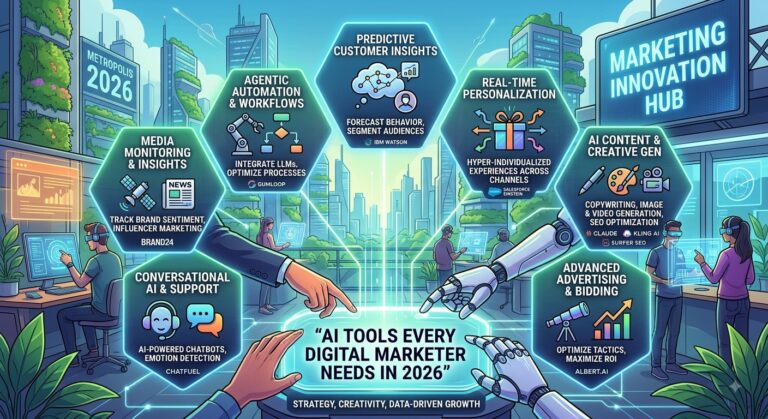
Digital marketing is becoming more competitive, data-driven, and demanding. Marketers are expected to create more content, understand customer behavior, manage multiple channels, analyze performance, and deliver personalized experiences—all while working with limited time and resources.
This is where AI tools for digital marketers can make a significant difference.
Artificial intelligence is helping marketers automate repetitive tasks, analyze large amounts of data, discover new opportunities, create content, optimize campaigns, and improve customer experiences.
In 2026, AI is no longer simply an experimental technology. It has become an important part of the modern digital marketing toolkit.
But with thousands of AI-powered platforms available, how do you know which types of tools are actually worth using?
This guide explores the most important AI tools every digital marketer needs in 2026, what they can do, and how businesses can use them to improve marketing performance.
Why Digital Marketers Need AI Tools in 2026
Marketing teams now manage numerous channels simultaneously, including:
Managing all these channels manually can quickly become overwhelming.
AI tools help marketers work more efficiently by automating repetitive processes and turning large amounts of information into useful insights.
Some of the biggest benefits include:
The goal isn’t to replace marketers. The goal is to help marketers accomplish more with the time and resources they have.
Content remains one of the most important parts of digital marketing.
However, creating high-quality content consistently can require significant time.
AI content tools can assist marketers with:
AI can help generate an initial draft or ideas, while marketers provide the expertise, originality, editing, and brand perspective necessary to produce useful content.
Why marketers need them
AI content tools can dramatically speed up the early stages of content production and help marketing teams maintain consistent publishing schedules.
Search engine optimization continues to evolve, especially as search engines and AI-powered discovery systems become more sophisticated.
AI SEO tools can help marketers:
Instead of manually analyzing thousands of keywords and pages, marketers can use AI to identify patterns and prioritize opportunities.
Best use
Use AI for research and optimization, but maintain human oversight to ensure that content genuinely satisfies search intent and provides value to readers.
Keyword research is the foundation of many SEO campaigns.
Traditional keyword research can involve examining search volume, competition, related terms, and user intent.
AI-powered keyword research can make this process faster by identifying related topics and search patterns.
Marketers can use AI to discover:
This can help businesses build more comprehensive content strategies.
Managing multiple social media platforms can consume a significant amount of time.
AI-powered social media tools can help marketers:
AI can also help adapt the same core idea for different platforms.
For example, a long-form blog post can be transformed into:
This makes content repurposing much more efficient.
Email remains a powerful channel for lead nurturing and customer retention.
AI can improve email marketing by helping marketers:
Instead of sending identical messages to an entire mailing list, AI can help create more relevant communication based on customer behavior.
Paid advertising can become expensive when campaigns aren’t properly optimized.
AI advertising tools can analyze campaign performance and help marketers identify:
AI can also assist with testing different headlines, images, messages, and audience segments.
This can help marketers reduce wasted advertising spend and improve campaign efficiency.
Data is one of the most valuable assets in digital marketing.
The challenge is turning enormous amounts of data into useful decisions.
AI analytics tools can help marketers understand:
Advanced AI systems can identify patterns that might be difficult to spot through manual analysis.
Why this matters
Better data interpretation allows marketers to make decisions based on evidence rather than assumptions.
Customer experience is becoming an increasingly important part of marketing.
AI-powered chatbots and virtual assistants can provide support around the clock.
They can:
This can improve response times while allowing human support teams to focus on more complex customer issues.
Generating qualified leads is a major priority for most businesses.
AI can help identify potential customers by analyzing:
AI lead generation tools can then help businesses score prospects and prioritize leads that appear more likely to convert.
This allows sales teams to spend more time on promising opportunities.
Marketing automation is becoming more intelligent through AI.
Modern AI-powered automation can connect multiple marketing activities into a single workflow.
For example:
Website visitor → Lead capture → AI qualification → Personalized email → Sales notification → Automated follow-up
AI can help determine which action should happen next based on customer behavior.
This reduces manual work and creates a more consistent customer journey.
Visual content has become essential across social media, websites, advertising, and video marketing.
AI-powered visual tools can help marketers create:
These tools can significantly reduce the time required to produce visual marketing assets.
However, marketers should ensure that AI-generated visuals remain consistent with their brand identity.
Audio marketing is another area where AI is creating new opportunities.
AI voice and audio tools can help businesses create:
This makes audio production more accessible to businesses that don’t have professional recording equipment or dedicated voice talent.
Personalization is becoming increasingly important as consumers expect brands to understand their needs.
AI can personalize:
Instead of creating one marketing experience for everyone, businesses can use AI to dynamically adapt experiences based on customer behavior.
Understanding competitors is essential for developing an effective marketing strategy.
AI can help marketers analyze:
These insights can help businesses identify gaps and opportunities within their own strategies.
The goal should not be to copy competitors, but to understand the market and identify ways to differentiate your brand.
Digital marketers spend a significant amount of time on planning, meetings, research, documentation, and repetitive administrative tasks.
AI productivity tools can assist with:
Reducing administrative work gives marketers more time for creative and strategic activities.
How to Choose the Right AI Marketing Tools
With so many options available, businesses should avoid adopting AI tools simply because they are popular.
Instead, evaluate each tool based on your actual marketing objectives.
Consider:
Choose tools that address a specific business challenge.
Integration can prevent unnecessary manual work and duplicate data.
AI-generated information should be reviewed before being used in customer-facing marketing.
Privacy and security should be major considerations when selecting AI software.
The best AI tool isn’t necessarily the one with the most features. It’s the one that produces measurable business value.
How to Build an AI Marketing Stack
Businesses don’t need dozens of AI applications.
A simple AI marketing stack could include:
Content AI
For writing assistance and content ideas.
SEO AI
For keyword research and content optimization.
Social Media AI
For content creation, scheduling, and analytics.
Email AI
For personalization and automation.
Analytics AI
For performance analysis and insights.
Customer Service AI
For chatbots and automated support.
Automation AI
For connecting marketing workflows.
The goal is to create a connected system rather than accumulate unnecessary software.
Best Practices for Using AI in Digital Marketing
Use AI as an Assistant
AI should support your marketing team rather than completely replace human judgment.
Maintain Brand Consistency
Review AI-generated content to ensure it follows your brand voice and standards.
Verify Important Information
AI can sometimes generate inaccurate information. Fact-check important claims before publishing.
Protect Customer Data
Don’t provide sensitive customer information to AI systems without understanding how that information is handled.
Measure Results
Track whether AI actually improves:
If a tool doesn’t produce meaningful results, reconsider whether it belongs in your marketing stack.
The Future of AI Tools for Digital Marketers
AI marketing tools are likely to become increasingly integrated.
Instead of using separate applications for every task, marketers may increasingly use AI platforms capable of managing multiple activities through a single intelligent interface.
Future AI marketing systems may:
AI agents may also become more capable of completing multi-step marketing workflows with limited manual intervention.
This will shift the role of marketers from manually executing every task toward managing intelligent systems and focusing on strategy, creativity, and customer relationships.
Conclusion
The best AI tools for digital marketers in 2026 are not simply tools that generate content. They are technologies that help businesses understand customers, automate workflows, improve marketing performance, and make better decisions.
From AI SEO and content creation to advertising, analytics, customer service, personalization, and automation, artificial intelligence can support nearly every part of a modern marketing strategy.
However, successful AI adoption isn’t about using as many tools as possible. It’s about selecting the right technologies for your specific goals and combining AI efficiency with human creativity and strategic thinking.
As AI continues to evolve, marketers who learn how to use these tools effectively will be better positioned to save time, reach the right audiences, improve customer experiences, and drive sustainable business growth.
Frequently Asked Questions
What are the best AI tools for digital marketers in 2026?
The best tools depend on your goals. Common categories include AI content creation, SEO, social media, email marketing, advertising, analytics, customer service, lead generation, and workflow automation.
How can AI help digital marketers?
AI can automate repetitive tasks, analyze customer data, personalize marketing campaigns, generate content ideas, optimize advertising, improve SEO, and provide actionable insights.
Will AI replace digital marketers?
AI is more likely to transform marketing roles than eliminate them. Marketers can use AI to automate repetitive tasks while focusing on strategy, creativity, brand development, and customer relationships.
Are AI marketing tools worth the investment?
They can be, particularly when they solve specific business problems and produce measurable improvements in productivity, leads, conversions, or revenue. Businesses should evaluate tools based on their actual return on investment.
Can small businesses use AI marketing tools?
Yes. Many AI marketing tools are accessible to small businesses and can help them compete more efficiently by automating content creation, customer support, SEO, advertising, and other marketing activities.
How many AI marketing tools does a business need?
There is no ideal number. A small, well-integrated collection of tools is generally more useful than subscribing to dozens of platforms that perform overlapping functions.
To deliver innovative, scalable, AI, and human-centered technology solutions that empower businesses to thrive in a digital-first economy
1129 Northern Blvd., Suite 404, Manhasset, New York 11030
Privacy Policy | Team of Use | Cache © 2026 All rights reserved