
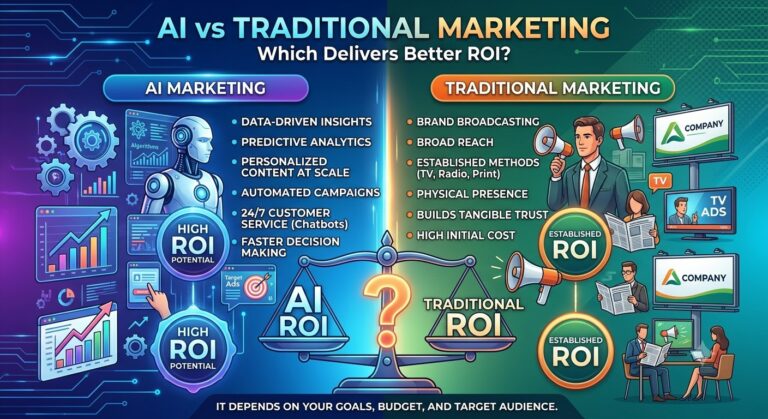
Businesses have always looked for better ways to reach customers, increase sales, and maximize marketing budgets. For decades, traditional marketing methods such as television, radio, newspapers, billboards, direct mail, and print advertising dominated the industry.
Today, AI-powered marketing is changing the way businesses attract and engage customers.
Artificial intelligence can analyze customer data, personalize campaigns, automate repetitive tasks, predict consumer behavior, and optimize marketing performance in real time. This raises an important question:
Does AI marketing deliver a better return on investment than traditional marketing?
The answer depends on the business, audience, campaign objectives, and implementation. However, AI-powered marketing generally provides advantages in areas such as targeting, personalization, automation, measurement, and scalability.
Let’s compare the two approaches and examine which one can deliver better marketing ROI.
Traditional marketing refers to promotional strategies that existed before the widespread adoption of digital and AI technologies.
Common examples include:
Traditional marketing can still be effective, particularly for businesses targeting local audiences or large groups of consumers.
For example, a local restaurant may use billboards, flyers, and radio advertisements to reach people within a specific geographic area.
AI marketing uses artificial intelligence to improve marketing activities and decision-making.
AI-powered marketing systems can analyze large amounts of information and use those insights to improve campaigns.
Common applications include:
Instead of relying entirely on predefined marketing rules, AI can analyze changing customer behavior and adjust strategies accordingly.
The biggest difference between the two approaches is how decisions are made and how campaigns are optimized.
Traditional marketing often depends on audience research, historical data, and manual campaign management.
AI marketing uses data, algorithms, automation, and predictive analysis to continuously improve campaigns.
Factor | AI Marketing | Traditional Marketing |
Targeting | Highly precise | Broad targeting |
Personalization | Advanced | Limited |
Automation | Extensive | Mostly manual |
Measurement | Real-time | Often delayed |
Optimization | Continuous | Periodic |
Scalability | Very high | More resource-intensive |
Customer insights | Data-driven | Research-driven |
Campaign adjustments | Fast | Slower |
Initial investment | Varies | Varies |
ROI tracking | Detailed | More difficult |
One of the biggest advantages of AI marketing is audience targeting.
AI can analyze information such as:
This allows businesses to identify customers who are more likely to be interested in their products or services.
Traditional advertising often reaches a broader audience, which can result in marketing spend being directed toward people who are unlikely to become customers.
Personalization can have a major impact on customer engagement.
Traditional marketing typically delivers the same message to a large audience.
AI marketing can create different experiences based on individual customer behavior.
For example, an online store can use AI to recommend products based on:
This creates a more relevant experience and can increase the likelihood of conversion.
Traditional marketing often requires employees to manually manage campaigns.
AI can automate many repetitive activities, including:
Automation allows marketing teams to accomplish more without increasing their workload proportionally.
Traditional campaigns may run for weeks or months before marketers evaluate their results.
AI-powered systems can monitor performance continuously.
For example, an AI system can identify that one advertisement is generating significantly more conversions than another and recommend reallocating resources toward the better-performing campaign.
This ability to respond quickly can reduce wasted marketing spend.
Measuring traditional marketing ROI can sometimes be challenging.
A business may know how many people saw a billboard or heard a radio advertisement, but determining exactly how many purchases resulted from that exposure can be difficult.
Digital and AI-powered marketing provide more detailed performance data.
Businesses can track:
This allows marketers to identify which activities generate the greatest return.
Despite the growth of AI, traditional marketing should not be dismissed.
Traditional channels can be particularly effective for:
A well-designed billboard in a high-traffic location can generate thousands of impressions every day.
Similarly, television and radio can help businesses establish broad brand recognition.
The key is understanding where traditional marketing fits within the overall customer journey.
AI can help businesses reduce costs by automating repetitive work and improving campaign efficiency.
For example, AI can assist with:
Instead of spending hours performing repetitive tasks, marketing teams can dedicate more time to strategy and creative development.
Lower operational costs can contribute to improved ROI.
Scaling traditional marketing can require significant increases in resources.
More advertising campaigns may require:
AI allows businesses to automate many of these processes.
A small marketing team can manage significantly more campaigns when AI handles repetitive analysis, optimization, and communication.
AI marketing excels at precision, but traditional marketing can still have an advantage in broad brand exposure.
Television commercials, billboards, events, and print campaigns can create memorable experiences that reinforce brand recognition.
For some businesses, combining broad traditional marketing with targeted AI-powered digital campaigns can produce stronger results than relying on either approach alone.
There is no universal answer.
AI marketing is generally stronger when businesses prioritize:
Traditional marketing can be stronger when businesses prioritize:
The most effective strategy may therefore be a hybrid marketing approach.
Instead of choosing between AI and traditional marketing, businesses can combine both.
For example:
Step 1: Build Awareness
Use television, radio, outdoor advertising, events, or print campaigns to increase brand awareness.
Step 2: Capture Digital Interest
Direct potential customers to a website, landing page, or social media profile.
Step 3: Use AI for Personalization
Analyze visitor behavior and deliver personalized content or recommendations.
Step 4: Automate Follow-Up
Use AI-powered email marketing or customer engagement tools to nurture prospects.
Step 5: Optimize Performance
Analyze campaign data and shift marketing resources toward the channels generating the strongest results.
This approach combines the reach of traditional marketing with the precision and automation of AI.
Businesses can maximize AI marketing ROI by following several best practices.
Define Clear Goals
Determine what you want your marketing campaign to accomplish.
Possible objectives include:
Track the Right Metrics
Monitor metrics such as:
Start Small
Businesses don’t need to automate everything immediately.
Start with one area, such as email marketing, lead scoring, customer support, or advertising optimization.
Keep Humans Involved
AI can analyze information and automate tasks, but human judgment remains important for brand strategy, creativity, messaging, and ethical decisions.
Businesses should avoid assuming that simply adding AI will automatically increase ROI.
Common mistakes include:
AI is most effective when it supports a well-defined marketing strategy.
The gap between traditional and AI-powered marketing is likely to continue changing as AI technology becomes more sophisticated.
AI agents, predictive analytics, automated campaign management, and real-time personalization are expected to become increasingly common.
Businesses will increasingly be able to create marketing systems that:
Much of this process can happen with minimal manual intervention.
However, traditional marketing will likely remain valuable for brand awareness and offline customer engagement.
The future of marketing isn’t necessarily AI versus traditional marketing.
It is likely to be AI-enhanced marketing combined with proven traditional strategies.
So, which delivers better ROI: AI marketing or traditional marketing?
For campaigns that require precise targeting, personalization, automation, real-time optimization, and detailed measurement, AI marketing can provide significant advantages.
Traditional marketing remains valuable for broad awareness, local visibility, and brand recognition.
For many businesses, the strongest strategy is not choosing one over the other. Instead, companies can combine the broad reach of traditional marketing with the intelligence, efficiency, and precision of AI.
As competition increases in 2026, businesses that learn how to integrate AI into their existing marketing strategies will have more opportunities to improve efficiency, reduce wasted spending, and generate stronger returns.
To deliver innovative, scalable, AI, and human-centered technology solutions that empower businesses to thrive in a digital-first economy
1129 Northern Blvd., Suite 404, Manhasset, New York 11030
Privacy Policy | Team of Use | Cache © 2026 All rights reserved