Creating great content is only part of the challenge for today’s content creators. Getting that content discovered by search engines, AI-powered search platforms, and the right audience is equally important.
Fortunately, AI SEO tools are making the process faster and more efficient.
Modern SEO platforms can help content creators discover keyword opportunities, analyze competitors, build content briefs, optimize articles, identify content gaps, improve on-page SEO, and increasingly monitor visibility in AI-generated search results.
Instead of spending hours manually analyzing search results and competitors, creators can use AI-powered tools to automate repetitive SEO tasks while keeping human creativity and expertise at the center of the publishing process.
In this guide, we’ll explore the best AI SEO tools for content creators in 2026, what each tool does best, and how to choose the right one for your content strategy.
AI SEO tools are software platforms that use artificial intelligence, machine learning, natural-language processing, search data, or automation to help improve a website’s visibility in search.
Depending on the platform, an AI SEO tool may help with:
The important thing to remember is that AI SEO does not mean letting AI handle your entire SEO strategy automatically.
The best results usually come from combining AI-powered analysis with human expertise, original insights, fact checking, editing, and strategic decision-making.
Content creators face an increasingly competitive publishing environment.
Thousands of new articles, videos, social posts, product pages, and other content assets are published every day.
Simply publishing more content is not enough.
Creators need to understand:
What are people searching for?
What questions do they want answered?
What topics are competitors covering?
What information is missing from existing content?
How can a new piece of content provide something more useful?
AI SEO tools can help answer these questions much faster.
They can also reduce the amount of time spent on repetitive research and optimization tasks.
There is no single AI SEO platform that is perfect for every creator. Different tools specialize in different parts of the SEO workflow.
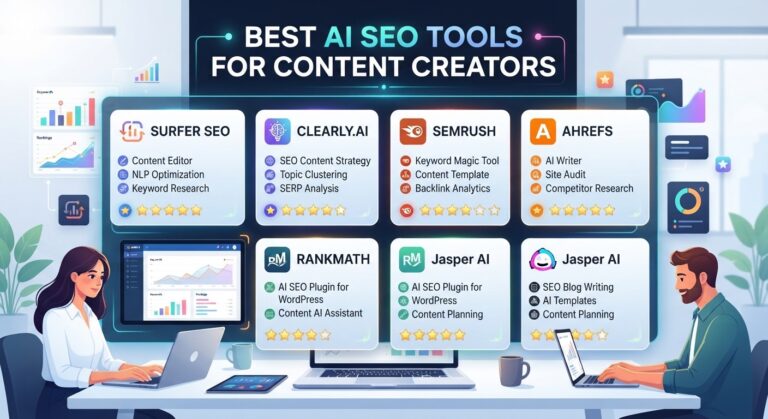
Here are some of the leading options to consider.
Best for: Bloggers, content writers, publishers, and SEO-focused creators
Surfer SEO is particularly useful for creators who want to optimize content while writing.
The platform focuses heavily on content optimization and helps creators compare their content against search results to identify opportunities for improving topical coverage and on-page relevance.
Surfer is frequently positioned among the leading content optimization platforms in current 2026 comparisons.
Useful Features
Why Creators Like It
Instead of publishing an article and hoping it performs well, creators can optimize the draft against search-related data before publication.
This makes Surfer particularly useful for bloggers producing SEO articles regularly.
Best choice if: Your primary goal is creating and optimizing articles that compete in organic search.
Best for: Serious bloggers, marketers, agencies, and growing websites
Semrush is one of the most comprehensive platforms for SEO and digital marketing.
It combines keyword research, competitor analysis, backlink research, site auditing, content tools, rank tracking, and newer AI-search capabilities.
Current 2026 comparisons frequently place Semrush among the strongest all-in-one AI-assisted SEO platforms.
Useful Features
Why Creators Like It
Content creators can use Semrush to go beyond individual articles.
For example, you can research an entire website’s SEO performance, identify keyword gaps, analyze competitors, discover backlink opportunities, and build a long-term content strategy.
Best choice if: You want one platform that covers most areas of SEO and digital marketing.
Best for: SEO-focused creators and publishers
Ahrefs has long been recognized for its keyword, backlink, and competitive research capabilities.
For content creators, one of its biggest advantages is the ability to investigate what competitors are ranking for and which websites are linking to them.
Current 2026 comparisons continue to highlight Ahrefs for keyword and backlink research, while its newer products also address AI-search visibility.
Useful Features
Why Creators Like It
Suppose you want to create an article about “AI marketing tools.”
Ahrefs can help you investigate:
This information can help you create a more strategic content plan.
Best choice if: Keyword research and competitor/backlink analysis are your priorities.
Best for: Bloggers, freelance writers, and small content teams
Frase focuses heavily on content research, briefs, and optimization.
It can help creators understand what search results are discussing before they start writing.
Current 2026 comparisons frequently position Frase as a value-oriented option for content briefs and optimization.
Useful Features
Why Creators Like It
A strong content brief can dramatically simplify the writing process.
Instead of staring at a blank document, creators can start with an organized structure based on search intent and competitive research.
Best choice if: You want to research and plan SEO articles quickly.
Best for: Professional writers, publishers, and editorial teams
Clearscope is designed around content optimization and provides structured guidance for improving the topical relevance of written content.
It is particularly useful for teams that already have human writers and editors but want a more data-driven optimization process.
Current comparisons continue to position Clearscope as a premium content optimization platform.
Useful Features
Why Creators Like It
Clearscope can help editors determine whether an article adequately covers the subject before it is published.
Best choice if: You run a professional editorial operation and prioritize content quality and optimization.
Best for: Established websites and publishers
MarketMuse focuses on broader content strategy rather than simply helping writers optimize individual paragraphs.
It can help creators understand topical authority, content gaps, and opportunities for building a stronger content library.
MarketMuse remains one of the platforms commonly included in 2026 AI SEO comparisons for content strategy and topical authority.
Useful Features
Why Creators Like It
Instead of asking only:
“How do I rank this article?”
you can ask:
“What content should my website publish to become more authoritative in this topic?”
That makes it useful for larger content strategies.
Best choice if: You want to build topical authority rather than optimize isolated articles.
Best for: Creators who want AI writing and SEO workflows together
Writesonic combines AI content generation with SEO-oriented workflows.
For content creators producing large amounts of material, tools in this category can help accelerate research, drafting, optimization, and content production.
Some 2026 comparisons position Writesonic as an increasingly workflow-oriented or agentic option.
Useful Features
Why Creators Like It
It can reduce the time needed to move from an idea to a structured first draft.
However, creators should still review AI-generated content carefully for accuracy, originality, brand voice, and usefulness.
Best choice if: You want AI-assisted writing combined with SEO workflows.
Best for: Freelancers, bloggers, and smaller websites
NeuronWriter focuses on content optimization and competitive analysis.
It is often included among lower-cost alternatives for creators who want SEO content guidance without committing to a larger enterprise platform.
Useful Features
Best choice if: You need an affordable content optimization platform.
Best for: Marketing teams and creators producing branded content
Jasper is primarily known as an AI content and marketing platform, but it can also play a role in SEO content workflows.
Its strongest advantage is not necessarily replacing dedicated SEO platforms but helping teams create consistent content aligned with their brand voice.
Some 2026 comparisons identify Jasper as particularly useful for brand-voice-oriented content production.
Useful Features
Best choice if: Maintaining a consistent brand voice across large amounts of content is important.
Traditional SEO is no longer the entire visibility equation.
Content creators increasingly need to understand how their websites appear in AI-generated answers.
AI search platforms can summarize information from multiple sources instead of simply presenting a traditional list of blue links.
This has created a growing category of AI visibility and Generative Engine Optimization (GEO) tools.
Some 2026 tools focus specifically on tracking mentions and citations across AI search platforms.
These tools can help monitor:
For content creators, this means SEO increasingly involves two questions:
Can people find my content through traditional search?
and
Can AI systems discover, understand, and cite my content?
Tool | Best For | Main Strength |
Surfer SEO | Content optimization | On-page content guidance |
Semrush | All-in-one SEO | SEO and marketing research |
Ahrefs | Research | Keywords and backlinks |
Frase | Content briefs | SERP research and planning |
Clearscope | Editorial teams | Content optimization |
MarketMuse | Content strategy | Topical authority |
Writesonic | AI content production | AI writing workflows |
NeuronWriter | Budget optimization | Affordable content optimization |
Jasper | Brand content | Brand voice and AI writing |
AI visibility platforms | AI search | Monitoring AI-generated visibility |
The best choice depends on what you actually need. Current comparisons consistently emphasize that no single tool excels at every SEO task.
Before purchasing an AI SEO platform, identify the specific problem you want to solve.
Do you primarily need:
Your answer should determine which tool you choose.
A creator publishing two articles per month has different requirements from a publisher producing 100 articles per month.
If you publish occasionally, a simple content optimization tool may be enough.
If you’re managing a large publishing operation, an all-in-one SEO platform may provide better value.
AI SEO tools can range from relatively affordable platforms to expensive enterprise systems.
Don’t purchase a large SEO suite simply because it has dozens of features.
Choose the platform that solves your most important SEO problems.
Traditional Google rankings remain important, but AI-generated search experiences are becoming increasingly relevant.
Some modern SEO platforms are adding AI-search visibility features, while specialized tools focus specifically on tracking citations and mentions in AI answers.
If AI search visibility is important to your business, make sure the tool actually provides the monitoring capabilities you need.
A simple workflow can make these tools much more effective.
Step 1: Find a Topic
Start with a topic relevant to your audience.
For example:
Best AI Tools for Small Businesses
Step 2: Research Keywords
Use an SEO platform to identify:
Step 3: Analyze Competitors
Study the pages already ranking for your target topic.
Look for:
Step 4: Build a Content Brief
Create a structure containing:
Step 5: Write the Article
Use AI to accelerate research and drafting where appropriate.
But don’t simply publish an unedited AI-generated article.
Add:
Step 6: Optimize the Content
Run the article through your preferred content optimization platform.
Look for opportunities to improve:
Step 7: Fact Check Everything
AI can produce incorrect information.
Always verify important:
Step 8: Publish and Monitor
SEO doesn’t stop when you publish.
Track:
Then update the article when new information becomes available.
One of the biggest mistakes content creators can make is assuming that AI can completely replace human writers.
AI can help with research, organization, brainstorming, optimization, and repetitive tasks.
But human creators are still responsible for making content useful.
A strong article should answer:
Why should someone read this instead of the other 50 articles covering the same topic?
That question requires creativity, experience, judgment, and originality.
AI should therefore be treated as a productivity tool, not a replacement for expertise.
Publishing AI Content Without Editing
AI-generated content can sound generic or repetitive.
Always review and improve the output.
Focusing Only on Keywords
SEO isn’t about inserting a keyword into every paragraph.
Search engines increasingly evaluate whether content genuinely satisfies user intent.
Ignoring Search Intent
A keyword may have informational, commercial, navigational, or transactional intent.
Make sure your content matches what searchers actually want.
Over-Optimizing Content
Adding every suggested keyword can make an article unnatural.
Write for humans first.
Forgetting Originality
If your article simply repeats what the top-ranking pages already say, AI optimization alone won’t make it exceptional.
Add something new.
Ignoring AI Search
As AI-powered search experiences become more prominent, creators should consider whether their content is easy for both search engines and AI systems to understand and reference.
A practical SEO stack might look like this:
Keyword Research → Content Planning → AI-Assisted Drafting → Human Editing → SEO Optimization → Technical Review → Publishing → Performance Monitoring
For example, a creator might use:
Ahrefs or Semrush for research
↓
Frase or MarketMuse for content planning
↓
AI writing tools for brainstorming and first drafts
↓
Surfer SEO or Clearscope for content optimization
↓
Google Search Console and analytics for performance monitoring
↓
AI visibility tools for monitoring AI-generated search presence
The exact combination depends on the creator’s goals and budget.
For serious content creators, AI SEO tools can be worth the investment when they save significant amounts of research and optimization time.
They can help transform SEO from a slow, manual process into a more structured workflow.
However, buying more tools doesn’t automatically produce better rankings.
A creator with three well-integrated tools may outperform a creator with ten disconnected platforms.
The goal isn’t to use the most AI.
The goal is to use AI strategically.
AI SEO is evolving beyond automated keyword suggestions and content scoring.
The next generation of SEO platforms is increasingly focused on:
At the same time, technical performance remains important. AI-powered search systems still need to access, crawl, and understand websites, making site structure, accessibility, speed, and clear content organization increasingly important parts of digital visibility.
For content creators, the future is therefore not simply about producing more articles.
It is about producing better, more useful, more authoritative, and more discoverable content.
What is the best AI SEO tool for content creators?
There is no universal winner. Surfer SEO is a strong choice for content optimization, Semrush is useful as an all-in-one SEO platform, Ahrefs is particularly strong for keyword and backlink research, and Frase is useful for content briefs and optimization.
What is the best AI SEO tool for bloggers?
For bloggers focused primarily on article optimization, Surfer SEO, Frase, and Clearscope are strong options. The right choice depends on budget, publishing volume, and the level of SEO research required.
Can AI SEO tools write blog posts?
Yes. Some AI SEO platforms can assist with outlines, briefs, drafts, and complete articles. However, human editing, fact checking, originality, and expertise remain important.
Are AI-generated articles good for SEO?
AI-generated articles can perform well when they are accurate, useful, original, well-structured, and aligned with search intent. Simply generating large quantities of generic content is not a reliable SEO strategy.
Should content creators use more than one SEO tool?
Often, yes. Different tools specialize in different areas. For example, one platform might be better for keyword research while another is stronger at content optimization.
What is GEO in SEO?
GEO, or Generative Engine Optimization, refers to optimizing content so it has a better chance of being discovered, represented, or cited in AI-generated search experiences.
Will AI replace SEO content creators?
AI is more likely to change the role of content creators than eliminate it. Creators can use AI to automate repetitive work while focusing more on strategy, expertise, storytelling, originality, and editorial quality.
The best AI SEO tools for content creators are not necessarily the platforms with the most artificial intelligence.
The best tool is the one that helps you solve your biggest SEO challenge.
If you need content optimization, consider Surfer SEO or Clearscope.
If you need comprehensive SEO research, Semrush or Ahrefs can provide a broader set of capabilities.
If content briefs and planning are your priority, Frase can be useful.
For broader content strategy, MarketMuse is worth considering.
And if you’re focused on AI-generated search visibility, look beyond traditional SEO tools toward platforms specifically designed to monitor AI mentions and citations.
Ultimately, successful SEO still depends on the fundamentals: understanding your audience, choosing the right topics, satisfying search intent, creating genuinely useful content, earning authority, and continually improving your website.
AI can make that process faster.
But great content still requires human thinking.
To deliver innovative, scalable, AI, and human-centered technology solutions that empower businesses to thrive in a digital-first economy
1129 Northern Blvd., Suite 404, Manhasset, New York 11030
Privacy Policy | Team of Use | Cache © 2026 All rights reserved