
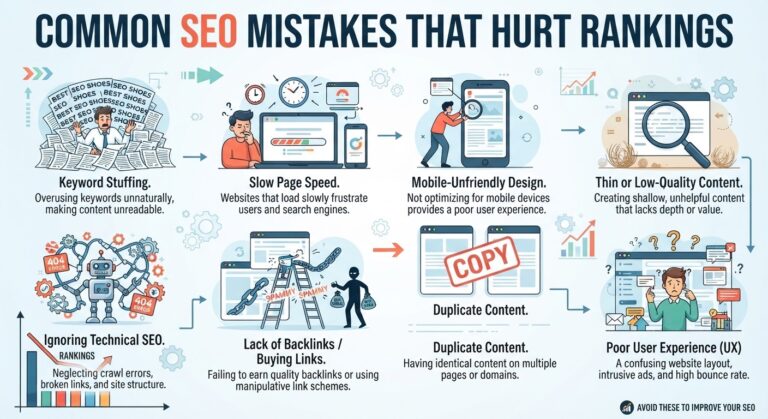
Getting a website to rank in search engines requires more than simply publishing content and adding keywords.
Many websites struggle with organic visibility because of small or recurring SEO mistakes that gradually weaken their performance.
Some problems are obvious, such as broken links or pages that cannot be crawled. Others are more subtle, such as targeting the wrong search intent, creating repetitive content, neglecting internal links, or publishing articles that don’t provide anything meaningfully different from competing pages.
In 2026, SEO has also become more complex because search experiences increasingly include AI-generated answers, conversational queries, multimedia results, and other forms of discovery.
That makes it more important than ever to build a website around useful content, clear structure, technical accessibility, and a strong user experience.
In this guide, we’ll examine the common SEO mistakes that hurt rankings, explain why they cause problems, and show practical ways to fix them.
SEO mistakes are errors or poor practices that can reduce a website’s ability to be crawled, understood, indexed, or considered relevant by search engines.
They can occur in several areas:
Not every SEO mistake causes an immediate ranking drop.
Some mistakes prevent pages from performing at their potential, while others can create serious technical or quality problems.
The first step is identifying which issues are actually affecting your website.
Search engines need to crawl and understand websites efficiently.
They also need to determine whether pages provide useful answers to users.
When a website contains:
it becomes more difficult to provide a strong search experience.
SEO is therefore not about optimizing one element in isolation.
It is about creating a website that works well as a complete system.
One of the biggest SEO mistakes is creating content without understanding what the searcher actually wants.
Suppose someone searches:
Best AI SEO tools for content creators
They are probably looking for a comparison or recommendation.
If your page instead provides a 2,000-word history of artificial intelligence, it may not satisfy the searcher’s intent.
Before creating content, ask:
What does the person behind this query actually want?
Search intent can generally be categorized as:
Match the content format to the intent.
Keyword stuffing happens when keywords are inserted excessively or unnaturally.
For example:
Our best SEO tools are the best SEO tools because these SEO tools are among the best SEO tools for SEO.
This is bad writing and provides little value.
Instead, use the primary keyword naturally and discuss related concepts where relevant.
Good SEO writing should sound like something a knowledgeable human would actually say.
Another common mistake is targeting only extremely competitive keywords.
A new website may struggle to compete immediately for broad phrases such as:
SEO
Digital Marketing
AI
Marketing
Instead, consider more specific opportunities.
For example:
AI SEO tools for small businesses
or:
How to use AI for keyword research
Specific keywords often reveal clearer search intent and can provide more realistic opportunities.
High search volume can look attractive.
But search volume isn’t the only factor that matters.
Consider:
A keyword with 500 monthly searches that closely matches your audience may be more valuable than a keyword with 50,000 searches that attracts the wrong visitors.
Thin content provides little useful information to the reader.
It might:
Long content isn’t automatically better.
A 1,200-word article that completely answers a question can be more valuable than a 4,000-word article filled with repetition.
The goal should be useful content, not a specific word count.
AI can be extremely useful for SEO workflows.
It can help with:
However, publishing generic AI-generated content without meaningful human review can create problems.
AI-generated drafts may contain:
Use AI to improve productivity, but add human judgment and original value.
Looking at competitors is useful.
Copying their content isn’t.
If the top-ranking pages all provide essentially the same information, simply producing another version of the same article may not give users a compelling reason to choose your page.
Look for opportunities to add:
The goal is not to become a copy of the current search results.
SEO should help people discover useful content.
It shouldn’t make the content difficult to read.
Avoid:
Write naturally.
Then optimize the page without sacrificing readability.
Your title is one of the first things users see in search results.
A vague title can reduce interest in your page.
For example:
SEO Tips
is much less descriptive than:
15 Practical SEO Techniques to Improve Website Rankings
A strong title should clearly communicate the subject and potential value of the page.
Avoid making exaggerated promises that the content doesn’t fulfill.
A meta description should give searchers a useful preview of the page.
Avoid descriptions that are:
Instead, explain what the reader will learn.
For example:
Learn how to identify and fix common SEO mistakes involving content, keywords, technical SEO, internal links, mobile optimization, and search intent.
Internal links are frequently overlooked.
A website should not consist of hundreds of isolated pages.
Connect related content.
For example:
SEO Guide
→ Keyword Research
→ On-Page SEO
→ Technical SEO
→ Content Marketing
→ Link Building
→ AI SEO
This creates a logical information structure and helps visitors discover additional resources.
Avoid relying heavily on generic anchor text such as:
When appropriate, use descriptive anchor text.
For example:
Learn how AI improves keyword research
provides more context than:
Click here
Don’t force keywords into every internal link, however. Keep anchor text natural.
Broken links create a poor user experience.
Regularly check for:
Fix or replace problematic links when appropriate.
Duplicate or substantially similar pages can make it harder to manage a website’s search visibility.
Examples include:
Where appropriate, consolidate similar content or use canonicalization and other technical solutions.
Complicated URLs can make websites harder to understand.
A clean URL might look like:
/common-seo-mistakes
instead of:
/article?id=73829&category=4&source=blog
Use readable URLs that communicate the subject of the page.
Images can contribute to content quality and user experience.
But huge, poorly optimized images can slow pages down.
Optimize:
Use descriptive alt text when an image contains meaningful information.
Don’t turn alt text into keyword stuffing.
A website that works poorly on mobile devices can frustrate visitors.
Check your website on different screen sizes.
Pay attention to:
Make sure important content remains easy to access.
Performance matters for user experience.
Common causes of slow websites include:
Use appropriate performance testing tools to identify bottlenecks.
Don’t optimize blindly.
Find the actual causes of slow performance and address them.
Sometimes technical configuration can prevent search engines from accessing important pages.
Review:
A page cannot perform in search if search engines cannot properly access or index it.
An XML sitemap can help search engines discover URLs on larger or more complex websites.
Make sure your sitemap:
A sitemap isn’t a substitute for good internal linking, but it can support website discovery.
Website owners sometimes publish content and never check what happens afterward.
Search performance data can reveal:
This information can help you identify pages that deserve improvement.
For example, a page receiving many impressions but few clicks might benefit from a clearer title or stronger search-result presentation.
SEO isn’t a one-time activity.
Industries change.
Statistics become outdated.
Products change.
Search intent evolves.
Competitors improve their pages.
Review important content periodically and update it when there is a genuine reason to do so.
Improve:
Publishing dozens of articles that target nearly identical topics can create an inefficient content library.
For example, instead of creating separate pages for:
consider whether some of these searches can be served by one comprehensive resource.
Keyword clustering and search-intent analysis can help determine when pages should be combined.
A website should have a logical hierarchy.
For example:
Home
→ SEO
→ Keyword Research
→ On-Page SEO
→ Technical SEO
→ Content SEO
A clear architecture makes navigation easier and helps search engines understand how pages relate to each other.
Content isn’t the entire SEO equation.
Technical problems can affect:
Regular technical audits can help identify problems before they become significant.
Structured data should accurately describe the content on a page.
Don’t add markup simply because you want enhanced search visibility.
Misleading or inaccurate structured data can create problems and undermine trust.
Only implement structured data that is relevant and properly supported for the content.
HTTPS is a basic expectation for modern websites.
Make sure:
Website security is important for both users and overall website quality.
Content that makes important claims should be supported appropriately.
When discussing:
use credible sources where appropriate.
External references can help readers verify important information.
Trying to manipulate rankings through large numbers of low-quality links can create serious SEO problems.
Avoid link schemes involving:
Instead, focus on creating content that people genuinely want to reference.
Rankings are useful, but they aren’t the only measure of SEO success.
Also consider:
A page ranking first for a keyword that produces no meaningful business value isn’t necessarily a successful SEO asset.
SEO Mistake | Better Practice |
Keyword stuffing | Use keywords naturally |
Ignoring search intent | Match content to user needs |
Thin content | Provide comprehensive value |
Generic AI content | Add human expertise and originality |
High-volume-only strategy | Evaluate relevance and opportunity |
Weak internal links | Build logical content connections |
Slow pages | Optimize real performance bottlenecks |
Duplicate pages | Consolidate or manage technically |
Outdated content | Update when information changes |
Poor mobile experience | Design for mobile users |
Low-quality backlinks | Earn relevant, trustworthy links |
Ranking-only mindset | Measure meaningful outcomes |
Fixing SEO problems doesn’t have to happen all at once.
Start with the issues that have the greatest potential impact.
Step 1: Run a Technical Audit
Check:
Step 2: Review Your Highest-Value Pages
Start with pages that already generate:
Improving pages that already have visibility can be highly valuable.
Step 3: Analyze Search Intent
Review your target keywords and ranking results.
Make sure your content type matches what users expect.
Step 4: Improve Content Quality
Remove:
Add:
Step 5: Strengthen Internal Links
Connect related pages using natural, descriptive anchor text.
Step 6: Monitor Results
After making changes, monitor performance rather than assuming the changes worked.
SEO improvements can take time to produce measurable results.
Use this checklist when reviewing a website.
Content
On-Page SEO
Internal SEO
Technical SEO
User Experience
Authority
Artificial intelligence can make SEO auditing more efficient.
AI tools can help analyze:
For example, an AI-assisted workflow might identify that several pages on a website target nearly identical topics.
Instead of continuing to publish more pages, the website owner can review whether some content should be consolidated.
AI is particularly useful for processing large amounts of information.
However, human review remains essential.
Not every automated recommendation is appropriate for every website.
If you use AI to create content, establish an editorial process.
Before Writing
During Writing
Before Publishing
This transforms AI from a simple content generator into a more useful part of an SEO workflow.
The biggest lesson is simple:
Don’t optimize your website only for algorithms. Optimize it for people and information quality.
Search engines are becoming better at understanding context and user needs.
AI-powered search is also creating new ways for people to discover information.
That makes genuinely useful content more important.
Instead of asking:
“How many keywords should I put on this page?”
ask:
“Does this page provide the best answer for someone searching this topic?”
That question leads to a much stronger SEO strategy.
What are the most common SEO mistakes?
Common SEO mistakes include ignoring search intent, keyword stuffing, creating thin or repetitive content, publishing unedited AI content, neglecting internal links, having technical SEO problems, ignoring mobile performance, and failing to update outdated content.
Can SEO mistakes cause rankings to drop?
Yes. Certain technical, content, and website-quality problems can reduce a page’s ability to perform in search. However, ranking changes can have many causes, so a decline shouldn’t automatically be attributed to one SEO mistake.
Is keyword stuffing bad for SEO?
Yes. Excessive or unnatural keyword usage creates poor content and can violate search engine spam policies. Keywords should be used naturally and in context.
Does AI-generated content hurt SEO?
Using AI to assist with content does not automatically make a page unsuccessful. The important consideration is whether the resulting content is useful, accurate, original, and created to satisfy users rather than manipulate search rankings.
Why isn’t my website ranking even though I use keywords?
Keywords alone aren’t enough. Other factors include search intent, content quality, competition, website authority, internal linking, technical accessibility, page experience, and overall relevance.
How often should I perform an SEO audit?
The appropriate frequency depends on the size and complexity of your website. Larger websites may benefit from ongoing monitoring, while smaller websites can conduct more comprehensive audits periodically and whenever major changes are made.
Should I delete old SEO content?
Not automatically. First determine whether the content has value, traffic, backlinks, or ranking potential. Improving or consolidating an existing page may be better than simply deleting it.
What is the biggest SEO mistake to avoid?
One of the biggest mistakes is treating SEO as a keyword-placement exercise. Sustainable SEO requires understanding users, creating useful content, maintaining technical accessibility, and continually improving the website.
The common SEO mistakes that hurt rankings are often surprisingly simple.
Keyword stuffing, weak search intent, thin content, poor internal linking, slow pages, duplicate content, technical errors, outdated information, and unedited AI-generated content can all weaken an SEO strategy.
The solution isn’t to chase every new SEO trick.
Instead, build a strong foundation.
Understand what your audience is searching for. Create useful content that satisfies their intent. Optimize titles and headings. Connect related pages. Keep your website technically accessible. Improve performance and mobile usability. Update important information. Use AI as an assistant rather than a substitute for human judgment.
SEO in 2026 is increasingly about quality, relevance, usefulness, and discoverability.
When you eliminate common mistakes and consistently improve your website, you create a stronger foundation for sustainable organic visibility.
The best SEO strategy isn’t about finding shortcuts to rankings. It’s about giving searchers a better experience and providing information they can trust.
To deliver innovative, scalable, AI, and human-centered technology solutions that empower businesses to thrive in a digital-first economy
1129 Northern Blvd., Suite 404, Manhasset, New York 11030
Privacy Policy | Team of Use | Cache © 2026 All rights reserved