
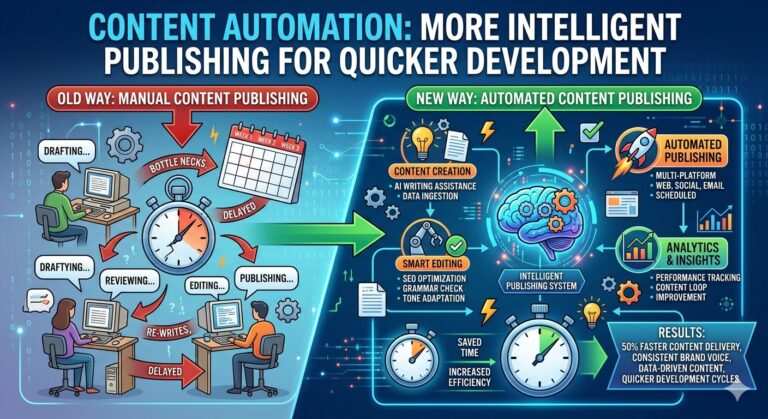
One of the best strategies for increasing brand recognition, drawing in organic traffic, and interacting with online audiences is content marketing. But regularly producing and disseminating content can take a lot of effort, particularly for expanding companies and busy marketing teams.
Businesses are using content automation more and more in 2026 to improve operations and speed up digital expansion. Businesses may create and disseminate content more effectively without compromising quality by integrating automation technologies, artificial intelligence (AI), and intelligent publishing platforms.
The use of technology and AI-powered solutions to automate different phases of the content marketing process is known as content automation.
This can include:
Instead of manually managing every step, businesses use automation tools to improve efficiency and consistency.
The demand for content continues to grow across websites, blogs, social media platforms, and email campaigns. Businesses that publish consistently often gain better visibility and stronger audience engagement.
However, manual publishing processes can create challenges such as:
It helps solve these problems by simplifying workflows and speeding up execution.
One of the biggest benefits of content automation is faster content production.
AI-powered tools can assist marketers by:
These tools reduce the time spent on repetitive writing tasks, allowing marketers to focus on strategy and creativity.
Consistency is essential for successful content marketing. Search engines and audiences both favor brands that publish regularly.
Automation tools allow businesses to:
This ensures content continues to reach audiences even during busy periods.
It’s tools often include SEO optimization features that help businesses improve search visibility.
AI-powered SEO tools can:
By automating SEO best practices, businesses can create content that ranks more effectively in search engines.
Publishing content is only part of the process. Effective distribution is necessary to maximize reach and engagement.
Automation platforms help businesses distribute content across multiple channels simultaneously, including:
Automated distribution increases visibility and saves valuable time.
Modern consumers expect personalized interactions with brands. AI-driven automation tools analyze audience behavior and deliver more targeted content experiences.
Examples include:
Personalized content improves engagement and increases conversion opportunities.
It’s tools provide analytics and reporting features that help marketers monitor content performance.
Businesses can track metrics such as:
Real-time insights help marketers optimize strategies and improve future content performance.
Automation eliminates many repetitive tasks that traditionally consume time and resources.
This allows marketing teams to:
Increased efficiency supports faster business growth.
While it offers many benefits, businesses should avoid relying entirely on automation without human oversight.
Common challenges include:
Human editing and strategic planning remain important for maintaining quality and authenticity.
To maximize the benefits of it, businesses should:
A balanced approach ensures automation improves efficiency without reducing content quality.
As AI technology continues to evolve, it will become even more advanced. Future systems may offer:
Businesses that adopt automation early will gain a competitive advantage in digital marketing.
It is transforming the way businesses create, publish, and distribute content. By automating repetitive tasks, improving SEO optimization, and streamlining workflows, businesses can publish content more efficiently and scale their marketing efforts faster.
However, the most effective content strategies combine automation with human creativity and strategic thinking.
In 2026 and beyond, smarter publishing through content automation will be a key driver of digital growth, helping businesses stay competitive in an increasingly content-driven online world.
To deliver innovative, scalable, AI, and human-centered technology solutions that empower businesses to thrive in a digital-first economy
1129 Northern Blvd., Suite 404, Manhasset, New York 11030
Privacy Policy | Team of Use | Cache © 2026 All rights reserved