
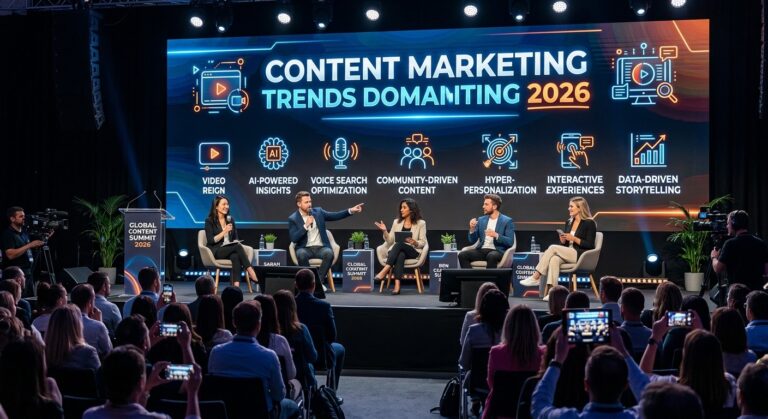
Content marketing is entering a new era.
For years, businesses could build an audience by publishing blog posts, optimizing keywords, sharing social media updates, and distributing email campaigns. Today, those tactics still matter—but the content landscape is becoming significantly more competitive.
Artificial intelligence has dramatically increased the speed at which content can be produced. At the same time, consumers are discovering information through search engines, AI assistants, social platforms, video, online communities, and creator content.
This means businesses can no longer compete simply by publishing more.
They need to publish better, more useful, more authentic, and more strategically distributed content.
Recent 2026 marketing research points to several major shifts, including increased use of AI for personalization and content production, greater emphasis on adapting SEO for AI search, stronger use of video, content repurposing, and renewed attention to brand values and authenticity.
Here are the content marketing trends dominating 2026 and what businesses should do about them.
Artificial intelligence is no longer an experimental addition to content marketing.
It is becoming part of everyday workflows.
Marketers are using AI to assist with:
Research published in 2026 shows that AI is becoming deeply integrated into content operations, with marketers using it for tasks such as identifying content gaps, building content clusters, outlining, editing, and maintaining brand voice.
However, the important trend isn’t simply AI-generated content.
It is AI-assisted content with human oversight.
Businesses that use AI as a productivity tool while adding expertise, original insights, fact-checking, and editorial judgment are better positioned to create content that stands out.
AI has made it possible to produce enormous quantities of content.
That creates a problem.
When thousands of businesses can generate similar articles, publishing more pages doesn’t necessarily create a competitive advantage.
The focus is shifting from:
“How much content can we publish?”
to:
“How much value can each piece of content provide?”
High-value content can include:
The goal is to create something that would still be valuable even if search engines did not exist.
Search is no longer limited to traditional search-engine results.
AI-powered search experiences can provide direct answers, summaries, recommendations, and conversational responses.
This means businesses are increasingly thinking about visibility across both traditional search and AI-driven discovery.
A 2026 Clutch and Conductor report found that nearly nine in ten content marketers planned to increase content budgets, while one in four said large language models were the primary audience for most of their content.
This represents a major strategic shift.
Businesses need content that is:
Traditional SEO focuses heavily on search-engine visibility.
Answer Engine Optimization, often called AEO, focuses on making information easier for answer engines and AI-powered search systems to understand and use.
Businesses can prepare by creating content that directly answers customer questions.
For example:
Question:
What is AI marketing automation?
Answer:
AI marketing automation uses artificial intelligence to automate marketing activities such as customer segmentation, personalization, lead nurturing, campaign analysis, and communication.
Clear answers like this make content easier for people to understand and potentially easier for intelligent search systems to interpret.
The goal should not be to manipulate AI systems.
The goal should be to create information that is genuinely useful and clearly presented.
Video is no longer simply an additional marketing channel.
It is becoming a central part of content strategy.
Industry research for 2026 highlights video as a major content marketing priority, with marketers emphasizing short-form video, authentic storytelling, customer experiences, and executive or founder-led video.
Businesses can use video for:
Video also allows brands to communicate personality and emotion in ways that traditional text cannot always achieve.
Consumers have increasingly short attention windows.
Short-form video makes it possible to communicate an idea quickly.
Examples include:
A long article can also become several short videos.
For example:
One blog post →
This makes content repurposing particularly valuable.
Creating completely new content for every platform is inefficient.
Instead, businesses are increasingly turning one strong piece of content into multiple formats.
For example:
Original content:
The Ultimate Guide to AI Marketing
Can become:
This allows businesses to reach audiences across multiple channels without starting from zero every time.
Content repurposing is also identified among the major marketing trends reported by HubSpot for 2026.
Generic content is becoming easier to ignore.
Customers increasingly expect brands to understand their interests and needs.
AI can help businesses personalize content based on:
HubSpot’s 2026 research identifies AI-powered personalized content as its leading marketing trend, while the report also found strong reported business benefits from personalized and segmented experiences.
The key is to personalize without becoming intrusive.
Useful personalization should make content more relevant—not make customers uncomfortable.
Consumers often trust other customers more than traditional advertising.
User-generated content can include:
UGC provides something AI-generated content often struggles to reproduce convincingly:
real human experience.
It can help businesses demonstrate how products and services work in real situations.
Creators are becoming an increasingly important part of the content ecosystem.
Their content can appear across:
More importantly, creator content can influence how AI systems understand products and brands.
Recent search-industry reporting highlights the growing role of creator reviews, videos, and social content in AI-generated answers and brand visibility.
This means creator marketing and SEO may increasingly overlap.
Businesses should focus on authentic creator relationships rather than artificial attempts to manufacture recommendations.
When generic information becomes abundant, expertise becomes more valuable.
Thought leadership allows businesses to demonstrate what they actually know.
Effective thought leadership can include:
Instead of simply explaining what everyone else already knows, businesses should contribute something new to the conversation.
AI can make content polished.
But polished doesn’t necessarily mean trustworthy.
Consumers increasingly want content that feels:
This is one reason video, customer stories, creator content, and expert commentary are becoming increasingly important.
Businesses should avoid making every piece of content sound identical.
A recognizable brand voice can become a competitive advantage.
Static content isn’t the only option.
Interactive content can encourage users to participate rather than simply read or watch.
Examples include:
Interactive experiences can increase engagement while helping customers make decisions.
For example, a marketing website could create an AI Marketing Readiness Assessment that gives users a personalized recommendation.
That provides value while also creating a potential lead-generation opportunity.
As digital privacy expectations increase, businesses need stronger relationships with their own audiences.
First-party data can come from:
Content can help businesses collect this information ethically by offering something useful in exchange.
Examples include:
The more businesses understand their audiences through permission-based data, the more relevant their content can become.
Audiences don’t simply want to consume content.
They increasingly want to participate.
Businesses can create communities through:
Community conversations can also reveal valuable content ideas.
If customers repeatedly ask the same question, that question could become:
The audience can effectively become a source of the content strategy.
Creating excellent content isn’t enough if nobody discovers it.
Businesses need to think about distribution from the beginning.
A content distribution strategy may include:
This creates multiple discovery paths.
Instead of relying entirely on Google traffic, businesses can build a broader content ecosystem.
SEO and content marketing have traditionally been treated as separate disciplines.
In 2026, they are becoming increasingly connected.
Content needs to satisfy users while also being discoverable across search and AI-powered platforms.
That means content marketers need to understand:
At the same time, SEO professionals need to think more like content strategists.
The goal isn’t to publish hundreds of mediocre articles.
A smaller library of highly useful resources can be more valuable.
For example, instead of creating 50 shallow articles about AI marketing, a business could create:
This creates a deeper content ecosystem.
Page views alone don’t tell the whole story.
Modern content teams need to understand whether content contributes to business outcomes.
Important metrics include:
As AI changes search behavior, businesses should also consider measuring visibility across AI-powered discovery where meaningful measurement is available.
AI will continue to automate repetitive content tasks.
But humans will remain responsible for:
The future isn’t necessarily about replacing content teams with AI.
It is about creating human-AI content teams where each side does what it does best.
AI can accelerate production.
Humans provide meaning.
Businesses can turn these trends into a practical strategy.
Step 1: Define Your Audience
Understand who you’re creating content for and what problems they need solved.
Step 2: Identify Core Topics
Choose the subjects most closely connected to your products, services, and expertise.
Step 3: Research Customer Questions
Use search data, customer conversations, communities, and AI-assisted research to identify important questions.
Step 4: Create High-Value Content
Focus on original insights, useful information, examples, and expertise.
Step 5: Add Multiple Formats
Turn important content into videos, social posts, visuals, emails, and interactive experiences.
Step 6: Optimize for Search
Use SEO fundamentals while also considering AI-powered discovery.
Step 7: Personalize Where Appropriate
Use customer data to make content more relevant.
Step 8: Distribute Strategically
Promote content across the channels where your audience actually spends time.
Step 9: Measure Business Results
Track leads, conversions, revenue, and engagement.
Step 10: Update Continuously
Refresh valuable content as customer needs, technology, and search behavior change.
The content marketing landscape will continue evolving.
Several developments are worth watching:
The businesses that adapt quickly while maintaining quality are likely to have the strongest long-term advantage.
The biggest content marketing trends of 2026 reflect a fundamental shift in how businesses create, distribute, and measure content.
AI is accelerating production, but quality is becoming more important.
Video is expanding.
Personalization is becoming easier.
Creator and user-generated content are gaining influence.
SEO is expanding into AI-powered search.
And audiences increasingly expect authentic, useful, human-centered experiences.
The answer isn’t to chase every new trend.
Instead, businesses should identify the trends that align with their audience and goals.
Use AI to work smarter. Create content with genuine expertise. Repurpose valuable ideas across multiple formats. Build relationships with customers and communities. And focus on becoming a trusted source of information.
In 2026, the winners in content marketing won’t necessarily be the businesses that publish the most.
They will be the businesses that consistently create content worth discovering, watching, sharing, trusting, and remembering.
Frequently Asked Questions
What are the biggest content marketing trends in 2026?
The major trends include AI-assisted content creation, video marketing, personalization, AI-powered search optimization, user-generated content, creator marketing, interactive content, thought leadership, content repurposing, and stronger emphasis on authenticity.
Is AI replacing content marketers?
AI is automating many repetitive content tasks, but human strategy, creativity, expertise, editing, storytelling, and judgment remain important.
Is video important for content marketing in 2026?
Yes. Video is a major content format, particularly short-form and authentic video. Businesses are increasingly using video for education, product demonstrations, storytelling, testimonials, and social media.
How is AI changing content marketing?
AI is helping marketers research topics, identify content gaps, personalize experiences, create drafts, repurpose content, analyze performance, and optimize workflows.
What is AEO in content marketing?
AEO, or Answer Engine Optimization, is the practice of structuring and creating content so that it can better satisfy direct-answer and conversational search experiences.
Should businesses publish more content in 2026?
Not necessarily. Publishing more isn’t automatically better. Businesses should prioritize useful, authoritative, original content that solves real customer problems.
Why is personalization important in content marketing?
Personalization helps businesses provide more relevant experiences based on customer interests, behavior, and needs. AI is making personalized content more scalable.
What is the future of content marketing?
The future will likely combine AI-assisted workflows, human expertise, video, personalization, interactive experiences, creator content, community engagement, and visibility across traditional and AI-powered search.
To deliver innovative, scalable, AI, and human-centered technology solutions that empower businesses to thrive in a digital-first economy
1129 Northern Blvd., Suite 404, Manhasset, New York 11030
Privacy Policy | Team of Use | Cache © 2026 All rights reserved