
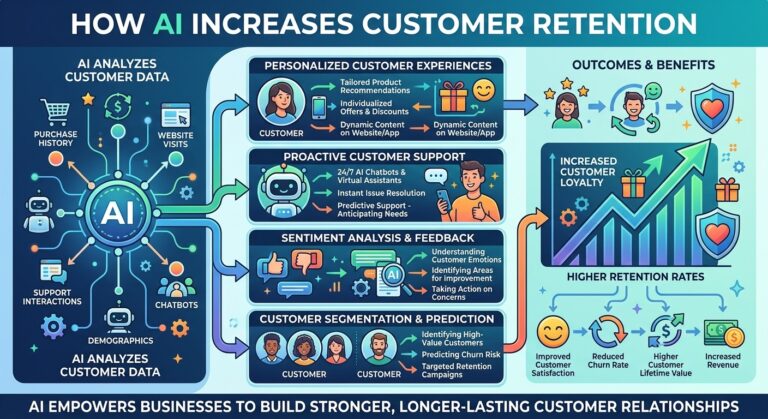
Customer retention is one of the most important factors in building a sustainable business. Attracting new customers can require significant investment in advertising, marketing, sales, and promotional campaigns. However, when businesses successfully retain existing customers, they have more opportunities to generate repeat purchases, strengthen customer relationships, and develop predictable revenue streams.
The challenge is that customer expectations continue to change. People want fast support, relevant recommendations, convenient communication, and products or services that consistently meet their needs. When businesses fail to deliver these experiences, customers may become dissatisfied and look for alternatives.
Artificial intelligence is helping businesses address these challenges by making customer retention strategies more intelligent, personalized, and proactive.
Understanding how AI increases customer retention starts with recognizing that AI can analyze customer interactions, identify behavioral patterns, automate helpful communication, and assist businesses in responding to customer needs. Instead of relying entirely on broad marketing campaigns or waiting until customers complain, businesses can use AI to identify opportunities to improve the customer experience earlier.
From predictive analytics and personalized recommendations to AI-powered customer support and automated follow-ups, artificial intelligence offers practical ways to encourage customers to stay engaged with a brand.
In this guide, we will explore how AI improves customer retention, the strategies businesses can implement in 2026, the metrics they should monitor, and the best practices for building lasting customer relationships.
AI customer retention refers to using artificial intelligence technologies to help businesses maintain customer relationships, reduce avoidable customer loss, and encourage continued engagement with their products or services.
AI systems can analyze permitted customer data, identify patterns in purchasing behavior, summarize feedback, and help businesses determine which customers may need additional attention.
For example, a subscription-based company might use AI to identify customers who have stopped using an important feature. The company could then offer a helpful tutorial, provide personalized assistance, or investigate whether a technical problem is preventing customers from receiving value.
Similarly, an online retailer might use AI to recommend relevant products based on a customer’s preferences and previous purchases.
The objective is not simply to persuade customers to buy more frequently. Effective customer retention focuses on consistently delivering value, resolving problems, and making the customer experience easier and more satisfying.
Customer retention contributes to business performance in several ways.
Retention does not mean every customer should be retained at any cost. Businesses should focus on creating mutually beneficial relationships with customers who genuinely benefit from their products or services.
Artificial intelligence can strengthen customer retention by helping businesses understand customer behavior, recognize problems, and provide more relevant experiences.
Here are the most effective ways AI can support these goals.
Customer churn occurs when customers stop buying from a business, cancel a subscription, or discontinue using a service.
One of the most valuable applications of AI is helping businesses identify patterns that may indicate an increased likelihood of churn.
Traditional retention strategies often depend on customers complaining or canceling before the business takes action. Predictive analytics can help identify potential warning signs earlier.
Depending on the available data and the quality of the model, AI systems may identify patterns such as:
For example, a software company might notice that customers who do not complete onboarding are more likely to stop using the product. An AI model could help identify accounts showing similar patterns so the company can offer additional guidance.
A practical churn-prevention process involves four steps:
AI predictions should not be treated as certain outcomes. A customer who reduces usage may simply have completed a task or changed their routine. Businesses should use predictions as signals for further investigation rather than automatically labeling customers as dissatisfied.
Customers are more likely to remain engaged when a business understands their needs and provides relevant experiences.
AI can help businesses personalize interactions by analyzing appropriate customer preferences, stated interests, purchasing history, and previous interactions.
Instead of sending the same message to every customer, businesses can use AI-supported segmentation to deliver more relevant content and recommendations.
Examples include:
For example, an online learning platform might identify that a learner frequently studies a particular subject. It could recommend relevant lessons or provide a reminder about an unfinished course, provided the communication is appropriate and consistent with the learner’s preferences.
Personalization should improve convenience rather than make customers feel watched. Businesses should use data responsibly, avoid intrusive assumptions, and provide customers with suitable communication controls.
Poor customer service is a common reason customers consider switching providers. Slow responses, repeated explanations, and unresolved problems can weaken customer confidence.
AI can improve customer support by helping businesses respond faster and manage routine inquiries more efficiently.
AI-powered chatbots and virtual assistants can handle common questions about products, services, business hours, account procedures, and other approved information.
More advanced systems may also help customers navigate troubleshooting instructions or connect them with the appropriate support team.
Customer problem | How AI can help |
Repeated questions | Provide answers using approved support information |
Slow initial responses | Respond to routine inquiries automatically |
Complicated support history | Summarize previous interactions for agents |
Difficulty finding information | Retrieve relevant help articles |
Incorrect support routing | Classify inquiries and suggest the right team |
Unresolved recurring problems | Identify patterns for further investigation |
AI should not make customer support more difficult by forcing people through endless automated conversations. Customers need a clear way to reach human assistance, especially when an issue is complicated, sensitive, or unresolved.
When businesses combine efficient automation with knowledgeable human support, they can create a more dependable customer experience.
Many businesses communicate with customers only when a purchase is completed, a payment is due, or a customer initiates contact.
AI makes it possible to develop more proactive engagement strategies by identifying situations in which timely assistance may be useful.
For example, a business could use customer interaction patterns to identify when new customers may benefit from additional onboarding guidance. An AI system might help trigger an educational email, suggest a tutorial, or notify a support representative that a customer needs assistance.
Other applications include:
The key is relevance. Proactive communication should address a genuine customer need rather than simply create more opportunities to send marketing messages.
Businesses should also respect customer consent, frequency preferences, and applicable communication regulations.
Customer feedback provides direct insight into what people appreciate, what frustrates them, and what they want businesses to improve.
However, manually reviewing large volumes of reviews, surveys, emails, and support conversations can be difficult.
AI-assisted feedback analysis can organize comments into themes, summarize recurring concerns, and help teams identify issues that deserve attention.
For example, an online store might discover that customers repeatedly complain about unclear delivery estimates. The business could improve its checkout information and delivery notifications to address the underlying problem.
AI can help businesses:
AI-generated summaries should be checked against the original feedback, particularly before making major business decisions. Automated sentiment analysis can misunderstand sarcasm, context, or culturally specific expressions.
The greatest value comes when businesses turn customer insights into meaningful improvements.
The first few interactions after a customer purchases a product or signs up for a service can strongly influence whether that customer continues using it.
A confusing onboarding process can leave customers unsure how to get started. If they cannot quickly understand the product’s value, they may disengage before developing a lasting relationship with the business.
AI can help create more supportive onboarding experiences.
For example, an AI assistant might guide a new user through setup, answer questions about important features, and recommend educational resources based on the user’s stated goals.
An effective AI-assisted onboarding strategy may include:
Businesses should measure whether customers successfully complete onboarding and begin receiving value. Sending more messages is not necessarily evidence of a better onboarding experience.
Customer loyalty programs can encourage repeat engagement, but generic rewards may not appeal equally to every customer.
AI can help businesses understand which benefits, products, or experiences different customer groups find useful.
For example, a retailer could analyze purchasing patterns to organize customers into appropriate segments and provide relevant product suggestions or reward information.
AI-supported loyalty strategies may include:
A good loyalty program should be easy to understand and provide genuine value. Businesses should avoid creating confusing reward rules or using customer data in ways that customers would not reasonably expect.
Personalized rewards work best when they complement product quality, fair pricing, reliable service, and a positive customer experience.
Customer retention depends on more than customer service. It also depends on how easily people can discover products, make purchases, access services, and resolve problems.
AI can help businesses identify friction points across the customer journey.
For example, analytics might reveal that many customers abandon an online checkout after encountering a confusing delivery fee. AI can help analyze customer behavior and feedback, while the business investigates and fixes the underlying issue.
Other examples include:
AI does not automatically fix these problems. It helps businesses discover patterns and prioritize investigations. Meaningful retention improvements occur when the business makes the necessary changes.
Customer relationship management (CRM) systems help businesses organize information about customers, sales activities, communications, and service history.
When AI capabilities are integrated into a CRM system, they can help employees summarize customer interactions, identify follow-up opportunities, and organize information for more relevant communication.
For example, a customer success team might use an AI assistant to prepare a summary of a customer’s previous support issues before a scheduled review. This can help the employee understand the situation without requiring the customer to explain everything again.
AI-supported CRM workflows can also help teams:
The quality of these insights depends on accurate records, appropriate access controls, and reliable integration between systems.
AI should help employees understand customers better, not encourage them to treat automated predictions as a complete picture of an individual.
Customers expect businesses to provide accurate information regardless of whether they contact support, browse a website, or receive an email.
Inconsistent information can create confusion and weaken trust.
AI can help standardize routine communication by using approved product details, support documentation, and company policies. It can also assist employees in locating relevant information and preparing consistent responses.
To improve consistency, businesses should:
Consistency should not mean giving every customer an identical response. Businesses should maintain accurate information while adapting the interaction to the customer’s actual question and circumstances.
The most useful retention strategy depends on the business model, customer expectations, and available resources.
Business type | AI retention strategy | Intended benefit |
E-commerce | Relevant recommendations and post-purchase assistance | Encourage useful repeat purchases |
SaaS companies | Product usage insights and onboarding support | Help customers realize product value |
Subscription services | Churn-risk analysis and renewal assistance | Identify potential retention problems |
Service businesses | Appointment reminders and follow-up communication | Improve convenience and continuity |
Educational platforms | Personalized learning guidance | Encourage continued participation |
Digital marketing agencies | Customer feedback analysis and account summaries | Improve service quality and communication |
Customer support teams | AI-assisted responses and ticket summaries | Resolve issues more efficiently |
Small businesses | Automated FAQs and personalized follow-ups | Maintain engagement with limited resources |
These are possible use cases, not guaranteed outcomes. Businesses should test each approach against their customers’ actual needs and measure its effectiveness.
Implementing AI successfully requires a clear plan. Businesses should begin with a manageable problem and expand gradually as they learn what works.
Step 1: Understand Why Customers Leave
Before choosing an AI tool, investigate why customers stop buying, cancel subscriptions, or become inactive.
Review cancellation feedback, customer surveys, support tickets, product usage patterns, and employee observations.
Look for recurring issues such as poor onboarding, slow support, unclear pricing, missing features, or unreliable service.
AI can help organize this information, but customer research and direct feedback remain important.
Step 2: Define Measurable Retention Goals
Set goals that reflect meaningful business and customer outcomes.
Examples include:
Use a reliable baseline and a defined measurement period. Avoid setting arbitrary targets without understanding current performance.
Step 3: Select Appropriate AI Tools
Choose tools that address the identified problems rather than adopting AI simply because it is popular.
Potential options include predictive analytics platforms, AI chatbots, CRM systems, customer support assistants, and feedback analysis tools.
Compare solutions based on:
A simple tool that solves a real problem may provide more value than a complex platform that is difficult to maintain.
Step 4: Prepare Accurate Customer Data
AI-supported retention strategies often rely on customer information. Incomplete, outdated, or inaccurate data can lead to poor recommendations and misleading predictions.
Review the quality of customer records, remove unnecessary duplication where appropriate, and establish clear rules for data access and use.
Collect only the information needed for legitimate business purposes, protect it appropriately, and comply with applicable privacy requirements.
Step 5: Start With One Retention Use Case
Choose one practical application, such as improving onboarding support or identifying recurring reasons for cancellation.
Run a limited pilot and monitor how the system performs. Ask employees for feedback and review whether customers actually benefit.
Starting small makes it easier to identify errors, manage costs, and improve the workflow before expanding.
Step 6: Establish Human Oversight
Define which activities AI can perform independently, which require employee review, and which should be handled by a person.
For example, an AI system might draft a personalized retention message, while an employee reviews the message before it is sent in a sensitive situation.
Avoid automatically offering discounts, restricting accounts, or making consequential decisions based solely on an unverified prediction.
Step 7: Measure Results and Improve
Review retention metrics alongside customer satisfaction, service quality, and operating costs.
If an automated campaign increases engagement but also increases complaints or unsubscribes, it may not be improving the customer relationship.
Use the results to improve your data, communication workflows, support processes, and overall customer experience.
Businesses need suitable metrics to determine whether AI is improving customer relationships.
Metric | What it measures | Why it matters |
Customer retention rate | Percentage of existing customers retained over a defined period | Measures the ability to maintain customer relationships |
Customer churn rate | Percentage of customers lost during a defined period | Helps identify customer loss |
Repeat purchase rate | Proportion of customers who purchase again | Useful for businesses that rely on repeat transactions |
Customer lifetime value (CLV) | Estimated value generated by a customer over the relationship | Helps evaluate long-term customer value |
Customer satisfaction (CSAT) | Customer feedback about an interaction or experience | Shows how customers perceive service quality |
Net Promoter Score (NPS) | Customers’ reported likelihood of recommending a business | Provides one perspective on customer advocacy |
First-contact resolution | Percentage of support issues resolved in the initial interaction | Helps assess support effectiveness |
Onboarding completion rate | Percentage of customers completing defined onboarding steps | Indicates whether customers are getting started successfully |
Repeat contact rate | Frequency of customers contacting support again about the same issue | Can reveal unresolved problems |
Retention campaign conversion | Percentage of targeted customers completing a defined desired action | Helps assess campaign performance |
A common retention-rate formula is:
Customer Retention Rate = [(Customers at End of Period − New Customers Acquired During Period) ÷ Customers at Start of Period] × 100
For example, suppose a business begins a month with 800 customers, finishes with 860 customers, and acquires 140 new customers during the month.
The calculation is:
The business retained 90% of its starting customer group during the period.
For meaningful comparisons, use consistent time periods and customer definitions. Different business models may require different retention measures.
A model may identify customers who resemble previously churned customers, but that does not mean every predicted customer will leave.
Investigate the underlying problem and use predictions to guide appropriate assistance.
Too many reminders, offers, and follow-ups can irritate customers. Prioritize relevant communication and respect consent, preferences, and frequency limits.
A discount cannot reliably solve every retention problem. If customers leave because a product is unreliable or support is unhelpful, businesses must address those underlying issues.
Some customer concerns require empathy, judgment, negotiation, or specialized knowledge. Make human assistance accessible when automation is insufficient.
Poor data quality can produce irrelevant recommendations and unreliable risk predictions. Review data quality before relying on AI-generated insights.
Using customer information in unexpected or inappropriate ways can undermine trust. Establish appropriate safeguards and comply with applicable privacy rules.
The number of messages sent or chatbot conversations handled does not prove that customers are more loyal. Evaluate retention, resolution quality, satisfaction, and other relevant business outcomes.
Businesses looking to improve retention need to make communication more helpful, timely, and consistent. AI-powered customer communication can support these goals by helping teams handle routine inquiries, provide relevant information, and organize customer interactions.
When evaluating SmileLineAI, businesses can consider how the platform’s current capabilities fit into their retention workflows, such as customer communication, support automation, and customer engagement.
A practical approach is to identify a recurring customer problem, determine whether the available platform features can address it, and measure the result through customer feedback and operational metrics.
The objective is to use AI where it improves the customer experience while preserving transparency, privacy, and human assistance.
AI customer retention is likely to become more integrated with customer service, marketing, analytics, and customer relationship management.
Several developments are worth watching.
More Context-Aware Customer Assistance
AI assistants may increasingly use relevant interaction history and approved business information to provide more useful answers. This could reduce the need for customers to repeat information across interactions.
Earlier Identification of Customer Problems
Improved analytics may help businesses identify patterns associated with unsuccessful onboarding, recurring complaints, or declining product engagement.
These signals can support earlier intervention, provided that predictions are validated and used responsibly.
More Relevant Personalization
AI may help businesses deliver more useful product guidance, educational resources, and service recommendations based on customers’ expressed needs and preferences.
Greater Integration Between Teams
Connecting customer service, marketing, sales, and product feedback systems may help businesses identify problems across the entire customer journey rather than treating every interaction separately.
Stronger Emphasis on Trust and Responsible AI
Businesses will need to demonstrate that their AI systems are accurate enough for their intended uses, respect customer privacy, and provide appropriate human oversight.
The future of customer retention will not depend on AI alone. Product quality, fair pricing, dependable service, and customer trust will remain central to lasting relationships.
AI can help businesses identify potential churn risks, personalize communication, improve customer support, analyze feedback, simplify onboarding, and deliver relevant follow-ups. These capabilities can improve retention when they address real customer needs.
Yes. Predictive models can analyze historical and current customer data to identify patterns associated with churn. Their predictions are probabilistic, not certain, and should be evaluated for accuracy and fairness.
Useful categories include AI analytics platforms, CRM systems, customer support assistants, chatbots, marketing automation tools, and customer feedback analysis solutions. The right choice depends on business goals, budget, data quality, and existing technology.
Personalization can help businesses provide relevant recommendations, educational resources, reminders, and support. When these interactions are genuinely useful and respectful of customer preferences, they can strengthen trust and encourage continued engagement.
Yes. Small businesses can start with affordable tools for customer inquiries, follow-up communication, onboarding guidance, and feedback analysis. They should begin with one clear use case and measure its results before expanding.
It can reduce certain repetitive tasks and help businesses identify avoidable customer problems. However, results depend on implementation, software costs, integration requirements, and whether the strategy actually improves retention.
Customer acquisition focuses on attracting new customers, while customer retention focuses on maintaining relationships with existing customers. Both are important, and AI can support each through analytics, personalization, and automation.
Businesses can monitor retention rate, churn rate, repeat purchases, customer satisfaction, customer lifetime value, onboarding completion, and repeat support contacts. Metrics should be evaluated over consistent periods and compared with an appropriate baseline.
It can be implemented responsibly, but businesses must assess their tools and data practices. Appropriate safeguards include access controls, data minimization, secure integrations, retention policies, and compliance with applicable privacy requirements.
AI is more appropriately viewed as a tool that can support customer retention teams. It can automate repetitive work and identify useful patterns, while employees handle complex cases, understand individual circumstances, and make important decisions.
Understanding how AI increases customer retention can help businesses develop more effective strategies for maintaining customer relationships and supporting long-term growth.
Artificial intelligence can help companies identify potential churn risks, personalize communication, improve customer service, analyze feedback, streamline onboarding, and deliver more relevant customer experiences. These capabilities allow businesses to move beyond reactive support and take a more informed approach to customer relationships.
However, technology alone does not create loyalty. Customers continue doing business with companies that deliver value, solve problems, communicate clearly, and respect their needs.
The most effective AI customer retention strategy combines intelligent automation with reliable products, responsive service, responsible data practices, and human understanding.
Start by identifying one reason customers disengage, select an appropriate AI-supported solution, and measure whether the change improves customer outcomes. Over time, these focused improvements can help build stronger relationships and a more sustainable business.
To deliver innovative, scalable, AI, and human-centered technology solutions that empower businesses to thrive in a digital-first economy
1129 Northern Blvd., Suite 404, Manhasset, New York 11030
Privacy Policy | Team of Use | Cache © 2026 All rights reserved