
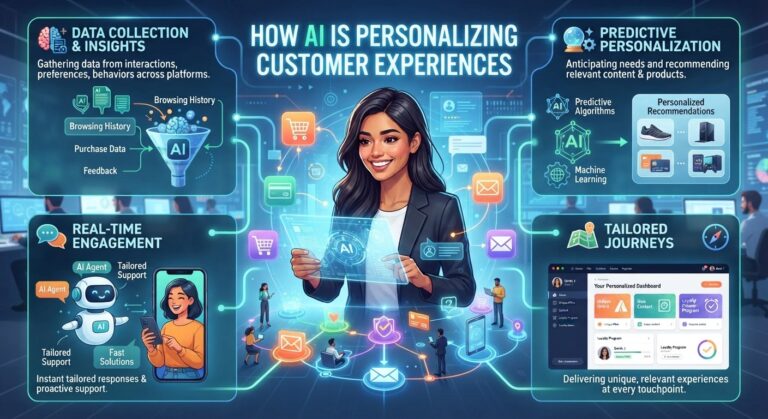
Customer expectations are changing rapidly. People want businesses to understand their needs, remember their preferences, provide relevant recommendations, and deliver helpful support without making every interaction feel repetitive. Generic messages and one-size-fits-all service are becoming less effective as customers increasingly expect experiences that feel relevant to their individual interests.
This is where artificial intelligence is transforming modern business.
Understanding how AI is personalizing customer experiences helps businesses discover new ways to connect with customers, improve engagement, and build lasting relationships. AI-powered systems can analyze customer interactions, identify patterns, recommend relevant products, personalize communication, and help businesses respond to individual needs more efficiently.
Unlike traditional personalization methods that rely heavily on manual customer segmentation, AI can process large amounts of information and adapt recommendations or interactions as new information becomes available.
For example, an online store can recommend products based on browsing behavior, a customer service platform can use previous conversations to provide more relevant assistance, and a marketing system can tailor messages according to customer interests.
However, successful personalization requires more than advanced technology. Businesses must also respect customer privacy, use reliable data, maintain transparency, and ensure that automated interactions remain helpful rather than intrusive.
In this guide, we explore how AI is personalizing customer experiences, the technologies behind this transformation, its business benefits, practical applications, implementation strategies, and the future of AI-driven customer engagement.
AI-powered customer personalization is the use of artificial intelligence to tailor products, services, recommendations, messages, and interactions to individual customer needs and preferences.
Traditional personalization often relies on basic information, such as a customer’s name, location, age group, or previous purchase. While these details can be useful, they do not always explain what a customer needs at a particular moment.
AI can combine multiple relevant signals to identify patterns and support more contextual experiences.
These signals may include:
When businesses have appropriate permission to use this information, AI systems can help create experiences that are more relevant to each customer.
For example, a customer who frequently purchases running equipment might receive recommendations for compatible accessories rather than unrelated products. A returning customer contacting support might receive assistance that takes an earlier unresolved issue into account.
The objective is simple: make each interaction more useful to the person receiving it.
Customers interact with businesses across websites, mobile applications, social media, email, messaging platforms, and customer support channels. Maintaining a consistent experience across these touchpoints is increasingly important.
AI helps businesses manage this complexity by identifying relevant information and assisting with personalized communication.
Customers are more likely to pay attention to information that reflects their interests or immediate needs. AI can help businesses organize content, recommendations, and offers around relevant customer signals.
Many companies offer similar products and services. A useful, personalized experience can help differentiate a business beyond price alone.
Customers rarely follow a perfectly linear buying journey. They may discover a product on social media, compare options on a website, ask questions through chat, and complete a purchase later.
AI can help businesses understand these connected interactions and provide more consistent support.
Marketing teams cannot manually create unique messages and recommendations for every customer at scale. AI can assist with segmentation, content variation, and recommendation generation while allowing employees to oversee quality.
Relevant support, timely communication, and useful recommendations can improve the customer experience. When customers consistently receive value, businesses have more opportunities to build loyalty and encourage repeat purchases.
AI personalization can influence nearly every stage of the customer journey.
Recommendation systems are among the most familiar applications of AI personalization.
They analyze patterns in customer behavior and product information to suggest items that may be relevant to a particular customer.
For example, an e-commerce platform might recommend products based on:
A customer who purchases a camera might see compatible lenses, memory cards, or camera bags.
These recommendations can help customers discover useful products without searching through an entire catalog.
Business benefit: More relevant product discovery and potential improvements in conversion rates and average order value.
AI can help marketers adapt campaigns to different customer interests, preferences, and stages of the buying journey.
Instead of sending the same message to every subscriber, businesses can develop targeted communication based on appropriate customer data.
Examples include:
AI can also assist with subject lines, message variations, content selection, and campaign analysis.
Human review remains important to ensure that marketing messages are accurate, appropriate, and consistent with the brand.
Customer support becomes more effective when businesses understand the context of a customer’s question.
AI-powered support systems can use authorized conversation history, knowledge bases, and customer records to help provide more relevant answers.
For example, a returning customer who asks about a delayed delivery should not have to repeat information that is already available in the support conversation.
AI can help support teams:
The result can be a smoother support experience with less unnecessary repetition.
AI can help websites adapt their content to visitors’ interests and current needs.
Depending on the business and the information available, a website might personalize:
For example, a visitor researching business automation may benefit from seeing guides about workflow tools, productivity, and AI implementation rather than unrelated content.
Personalization should remain transparent and useful. Businesses should avoid creating experiences that hide important information or manipulate visitors into unwanted decisions.
AI can help businesses understand where customers are in their journey and determine which information might be useful next.
A customer discovering a product for the first time may need educational content. Someone comparing alternatives may need feature comparisons. A recent buyer may need setup instructions or after-sales support.
AI can help identify these different needs and coordinate relevant interactions.
Customer Journey Stage | Personalization Example | Goal |
Awareness | Recommend relevant educational content | Build awareness |
Consideration | Share comparisons and product information | Help customers evaluate options |
Purchase | Provide clear answers and relevant offers | Reduce buying friction |
Onboarding | Deliver tailored setup guidance | Help customers get started |
Retention | Share useful tips and relevant updates | Maintain engagement |
Loyalty | Recognize preferences and reward participation | Strengthen relationships |
The goal is not to send more messages. It is to provide the right assistance at the right stage.
AI can analyze historical patterns to estimate what customers may need next.
Depending on the quality of the available data, predictive models can help businesses identify:
Predictions are not guarantees. Businesses should test model performance and avoid treating predictions as certain facts about individuals.
Search is an important part of customer discovery.
AI can help search systems understand intent, recognize related terms, and return results that better match what a customer is trying to find.
For example, someone searching for “comfortable shoes for long walks” may benefit from results organized around walking comfort rather than products that merely contain the word “shoes.”
Personalized search can also incorporate relevant filters and previously stated preferences, provided the system respects privacy and gives users reasonable control over the experience.
AI-powered email systems can help businesses select content according to customer interests and engagement patterns.
A software company might send beginner tutorials to new users, advanced guides to experienced customers, and troubleshooting resources to people who request support.
Personalized email can also help with:
Businesses should respect consent, unsubscribe preferences, and applicable marketing laws. Personalization is most effective when communication is genuinely useful.
The first interaction with a product or service can shape the entire customer relationship.
AI can help businesses adapt onboarding instructions to a customer’s goals, experience level, and progress.
For example, a beginner using an online productivity tool may need a simple guided introduction. An experienced user may prefer advanced configuration instructions.
AI-assisted onboarding can provide:
This helps customers reach value faster without forcing everyone through the same learning process.
AI can help businesses understand which rewards and benefits may be relevant to different customer groups.
For example, a retail business might offer product education to customers exploring a new category, while frequent purchasers may value early access to new products.
A thoughtful loyalty program can use personalization to make benefits more relevant instead of sending every customer identical promotions.
Businesses should avoid using sensitive personal information or unfairly excluding customers from important opportunities.
Several technologies work together to support personalized experiences.
Machine Learning
Machine learning identifies patterns in data and helps systems make predictions or recommendations.
It can support product suggestions, customer segmentation, demand forecasting, and other personalization tasks.
Natural Language Processing
Natural language processing helps AI systems interpret written or spoken language.
It can support customer support, conversational search, intent detection, and personalized responses.
Generative AI
Generative AI can create or adapt content, including email drafts, support responses, product descriptions, and educational materials.
Generated content should be reviewed when accuracy, tone, or customer impact matters.
Recommendation Engines
Recommendation engines rank or suggest products, services, or content based on relevant signals.
They can use product similarities, customer interactions, preferences, and other appropriate information.
Predictive Analytics
Predictive analytics uses historical and current data to estimate potential outcomes. It can help businesses anticipate customer needs and identify opportunities for proactive service.
Customer Data Platforms and CRM Systems
Customer relationship management systems and customer data platforms can organize relevant customer information. When properly integrated with AI tools, they can help businesses maintain context across interactions.
Integration should follow data minimization, access-control, and privacy requirements.
Both approaches can improve customer experiences, but they differ in how they use information and adapt to changing behavior.
Feature | Traditional Personalization | AI-Powered Personalization |
Customer segmentation | Often based on predefined groups | Can identify more complex patterns |
Recommendations | Frequently rule-based | Can use learned behavioral patterns |
Content adaptation | Often manually configured | Can assist with dynamic variations |
Customer insights | Often based on fixed reports | Can identify patterns across large datasets |
Real-time responses | Depends on configured systems | Possible when systems support real-time processing |
Scalability | May require substantial manual work | Can support personalization across many interactions |
Human oversight | Needed | Still needed, especially for sensitive decisions |
AI does not automatically outperform traditional methods. A simple rule-based system may be cheaper, more predictable, and more effective for a straightforward use case.
Businesses should choose the approach that best meets the customer’s needs and the organization’s operational requirements.
Improved Customer Satisfaction
Customers can receive more relevant recommendations, quicker assistance, and communication that reflects their actual needs.
Higher Customer Engagement
Relevant messages and content may encourage customers to interact more meaningfully with a business.
More Efficient Marketing
AI can help marketing teams organize audiences, generate content variations, and identify which campaigns deserve further attention.
Better Customer Retention
Personalized onboarding, useful follow-ups, and responsive support can help businesses maintain stronger relationships with existing customers.
More Relevant Product Discovery
AI-powered recommendations can help customers discover products and services that match their interests.
Greater Operational Efficiency
Automation can reduce repetitive work associated with segmentation, content preparation, support routing, and customer analysis.
Better Decision Support
AI can help teams recognize patterns in customer behavior and identify areas where the customer experience may need improvement.
These benefits depend on implementation quality, data accuracy, customer trust, and ongoing measurement. AI personalization is not a guaranteed path to higher sales or customer loyalty.
AI personalization looks different across industries.
E-Commerce
An online store recommends complementary products, improves product search, and provides personalized shopping assistance.
Education
An educational platform can suggest learning materials based on a student’s progress, stated goals, and performance, while keeping educators involved in important decisions.
Banking and Financial Services
A financial service provider may personalize educational content, product information, and support guidance. Sensitive financial decisions require appropriate safeguards and regulatory compliance.
Healthcare Services
A healthcare organization may use technology to improve appointment reminders, navigation, and administrative communication. Health-related personalization requires especially strong privacy protections and appropriate clinical oversight.
Travel and Hospitality
A travel platform may suggest destinations, itineraries, or accommodation options based on customers’ stated preferences and trip requirements.
Software and SaaS
A software company can tailor onboarding, recommend relevant features, and provide contextual help based on how customers use the product.
Across these industries, the guiding principle is the same: use appropriate information to make experiences more relevant without compromising privacy, fairness, or customer control.
Businesses do not need to personalize every customer interaction immediately. A focused rollout can help teams test the value of AI before expanding it.
Step 1: Define Your Business Goal
Identify the customer experience problem you want to solve.
Examples include reducing repetitive support questions, improving product discovery, increasing onboarding completion, or making email communication more relevant.
Choose a measurable objective rather than adopting AI simply because it is available.
Step 2: Understand Your Customers
Use appropriate customer feedback, support records, surveys, and interaction data to understand common needs.
Avoid collecting information that is unnecessary for the intended purpose.
Step 3: Review Your Data Quality
Check whether customer records are accurate, up to date, and consistent across systems.
Duplicate profiles, outdated preferences, and missing information can lead to irrelevant recommendations.
Step 4: Choose the Right AI Tools
Evaluate tools based on their actual capabilities, integration options, security, privacy practices, cost, and ease of use.
Consider whether your business needs recommendation software, AI customer support, marketing automation, predictive analytics, or a combination of tools.
Step 5: Start With One Use Case
Choose a manageable project, such as personalized product recommendations or AI-assisted customer support.
Test it with a limited audience before expanding.
Step 6: Keep Human Oversight
Set clear boundaries for automated decisions and establish escalation paths for complex or sensitive interactions.
Review generated content and recommendations when errors could materially affect customers.
Step 7: Measure Performance
Compare results against a baseline.
Monitor customer satisfaction, conversion rates, response times, retention, complaint rates, and other metrics relevant to your goal.
Step 8: Improve Continuously
Gather feedback, review errors, and update workflows as customer needs change.
Personalization should be an ongoing improvement process rather than a one-time technology project.
A successful AI personalization strategy should produce measurable improvements for both customers and the business.
KPI | What It Measures |
Customer Satisfaction (CSAT) | How customers rate their experience |
Customer Effort Score (CES) | How easy customers find it to complete a task |
Conversion Rate | How often visitors complete a desired action |
Repeat Purchase Rate | How frequently customers return to buy |
Customer Retention | How well the business retains customers |
Support Resolution Time | How quickly customer issues are resolved |
Email Engagement | How customers interact with relevant email campaigns |
Recommendation Click-Through Rate | How often customers interact with recommended items |
Complaint Rate | Whether personalization causes confusion or frustration |
Opt-Out Rate | Whether customers are declining personalized communication |
Do not rely on one metric alone. For example, more clicks do not necessarily mean a better customer experience if customers later complain or return the recommended products.
Where practical, controlled experiments or A/B tests can help determine whether personalization actually improves outcomes compared with a suitable alternative.
Collecting Too Much Customer Data
More data is not always better. Collect only what is reasonably necessary, and handle it according to applicable privacy requirements.
Making Personalization Feel Intrusive
Customers may feel uncomfortable when businesses reveal unexpected knowledge about their behavior.
Use customer information transparently and avoid messaging that makes unsupported assumptions about an individual’s personal life.
Ignoring Data Quality
Outdated or inaccurate records can produce irrelevant recommendations and frustrating interactions.
Over-Automating Customer Communication
Automated responses should not prevent customers from reaching a human when they need one.
Using the Same Personalization Strategy Everywhere
Different industries, customer groups, and business goals require different approaches.
Ignoring Bias and Fairness
AI systems may reproduce patterns or biases present in their data. Review outcomes to identify unfair treatment or unintended exclusions.
Failing to Explain Data Practices
Customers should have clear information about relevant data collection and personalization practices, along with meaningful choices where applicable.
Measuring Only Revenue
Sales are important, but customer trust, satisfaction, service quality, and long-term retention also matter.
Trust is essential to sustainable customer personalization.
AI systems may process information that customers consider private, so businesses need clear rules about how data is collected, used, retained, and shared.
Good practices include:
Businesses should also avoid assuming that a customer’s past behavior always reflects their current needs. Preferences can change, and customers should be able to correct information or adjust recommendations when appropriate.
Responsible personalization balances relevance with respect.
AI personalization is likely to become more contextual, conversational, and integrated with everyday business systems.
More Natural AI Conversations
AI assistants may become better at maintaining context across customer conversations and helping customers complete multi-step tasks.
Businesses will still need safeguards against incorrect answers and clear pathways to human assistance.
Real-Time Personalization
Systems may increasingly adapt content and recommendations as customers interact with websites, applications, and support channels.
Real-time personalization requires careful controls so that fast decisions remain accurate, appropriate, and privacy-conscious.
More Connected Customer Journeys
AI systems may help coordinate customer interactions across marketing, sales, onboarding, and customer service.
Better integration could reduce the need for customers to repeat information across departments.
Proactive Customer Assistance
Businesses may use predictive insights to identify potential problems and offer useful assistance before a customer needs to request it.
Such systems should avoid excessive notifications and unsupported assumptions about customer intentions.
AI Agents for Customer Experience
AI agents may help perform multi-step tasks, such as retrieving information, preparing recommendations, updating records, or coordinating service requests.
Sensitive actions should remain subject to appropriate permissions, monitoring, and human approval.
Greater Emphasis on Trust
As personalization becomes more sophisticated, customers and regulators will continue to care about privacy, fairness, transparency, and accountability.
The businesses that succeed will be those that use AI to make customer interactions genuinely better rather than simply increasing the amount of automated communication.
Small businesses do not need enterprise-level technology to begin improving customer experiences.
They can start with practical, manageable applications:
The best starting point is a process that creates a clear problem for customers or consumes too much employee time.
Choose one use case, establish a baseline, test the solution, and expand only when the results justify the effort.
Customer personalization can support growth by improving how businesses attract, serve, and retain customers.
When customers can find relevant information more easily, they may be more confident in their decisions. When support teams have useful context, they may resolve issues more efficiently. When marketing communication reflects real customer interests, it may become more valuable to its audience.
These improvements can contribute to business outcomes such as:
However, growth depends on the complete customer experience, including product quality, pricing, service, reliability, and trust. AI personalization supports these fundamentals; it does not replace them.
AI personalizes customer experiences by analyzing appropriate customer data, identifying patterns, recommending relevant products or content, adapting communication, and helping businesses provide more contextual support.
The main benefits can include more relevant recommendations, improved customer engagement, faster support, more efficient marketing, smoother onboarding, and better customer retention.
Yes. Small businesses can use accessible AI tools to personalize email campaigns, recommend products, support customers, organize customer data, and provide tailored onboarding experiences.
Businesses may use AI-powered CRM platforms, recommendation engines, marketing automation software, customer data platforms, conversational AI tools, and predictive analytics systems. The right choice depends on business goals and technical requirements.
It can contribute to customer loyalty when it makes interactions more useful, consistent, and convenient. Loyalty also depends on product quality, pricing, trust, and the overall customer experience.
AI can help segment audiences, suggest relevant content, generate message variations, recommend campaign timing, and analyze engagement patterns. Businesses should review the results and respect customers’ communication preferences.
It can be implemented responsibly, but safety depends on data protection, access controls, transparency, fairness, vendor practices, and compliance with applicable laws.
Personalization generally involves a business adapting an experience based on relevant information or inferred preferences. Customization typically allows customers to choose their own settings, preferences, or experience features.
Businesses can track customer satisfaction, conversion rates, repeat purchases, retention, support resolution time, recommendation engagement, complaints, and opt-out rates. Controlled testing can help determine whether personalization is responsible for improvements.
The future is likely to include more contextual recommendations, conversational assistance, connected customer journeys, real-time adaptation, and AI agents that can help complete multi-step tasks under appropriate controls.
AI is changing the way businesses understand, engage, and support their customers. From personalized product recommendations and targeted marketing to contextual customer support and adaptive onboarding, artificial intelligence creates new opportunities to make customer experiences more relevant and efficient.
The greatest value comes from using AI to solve real customer problems. Businesses should begin with clear objectives, reliable data, suitable tools, and measurable outcomes. They should also protect customer privacy, maintain transparency, monitor performance, and preserve access to human assistance.
As AI capabilities continue to develop, customer personalization will become an increasingly important part of digital business strategy. Organizations that combine intelligent technology with genuine customer understanding will be better positioned to deliver useful experiences and build stronger relationships over time.
AI personalization works best when customers feel understood, not monitored. That principle should guide every business decision involving personalized customer experiences.
To deliver innovative, scalable, AI, and human-centered technology solutions that empower businesses to thrive in a digital-first economy
1129 Northern Blvd., Suite 404, Manhasset, New York 11030
Privacy Policy | Team of Use | Cache © 2026 All rights reserved