
Marketing has evolved far beyond manually sending emails, posting on social media, and tracking leads in spreadsheets. In today’s digital landscape, businesses can use automation and artificial intelligence (AI) to create a fully automated marketing system that attracts prospects, nurtures leads, converts customers, and measures results with minimal manual intervention.
Whether you’re a startup, a growing small business, or a large enterprise, marketing automation can help you save time, improve customer engagement, and increase revenue. Instead of spending hours on repetitive tasks, your team can focus on strategy, creativity, and building meaningful customer relationships.
In this guide, you’ll learn how to build a fully automated marketing system, the essential components, best practices, and common mistakes to avoid.
A fully automated marketing system is a collection of integrated tools and workflows that automate every stage of the customer journey—from attracting visitors to converting them into loyal customers.
These systems use technologies such as:
When configured correctly, the system works around the clock, ensuring prospects receive the right message at the right time.
Businesses that invest in marketing automation enjoy numerous advantages.
Save Time
Automation handles repetitive tasks such as email campaigns, lead follow-ups, and social media scheduling.
Generate More Qualified Leads
Lead scoring and automated nurturing help identify prospects who are ready to purchase.
Improve Customer Experience
Customers receive personalized content based on their interests and behavior.
Increase Marketing ROI
Automation reduces wasted effort and improves campaign performance.
Scale Without Hiring Large Teams
Businesses can manage larger audiences without significantly increasing staff.
Every automated system begins with attracting potential customers.
Common lead generation channels include:
The objective is to encourage visitors to provide their contact information.
A CRM platform stores and organizes customer information.
A good CRM helps you:
A centralized database ensures every department works with the same customer information.
Email remains one of the highest-performing digital marketing channels.
Automated email workflows may include:
These workflows run automatically based on user behavior.
Modern chatbots provide instant support while collecting valuable customer information.
Chatbots can:
Providing immediate assistance improves customer satisfaction and conversion rates.
Managing multiple social platforms manually consumes valuable time.
Automation tools can:
Consistent posting improves brand visibility and audience engagement.
Automation is only valuable if performance can be measured.
Track important metrics such as:
Metric | Why It Matters |
Website Traffic | Measures visitor growth |
Conversion Rate | Evaluates campaign effectiveness |
Email Open Rate | Indicates audience engagement |
Click-Through Rate (CTR) | Measures content performance |
Customer Acquisition Cost (CAC) | Calculates marketing efficiency |
Customer Lifetime Value (CLV) | Estimates long-term profitability |
Return on Investment (ROI) | Measures overall marketing success |
Real-time dashboards help businesses make faster, data-driven decisions.
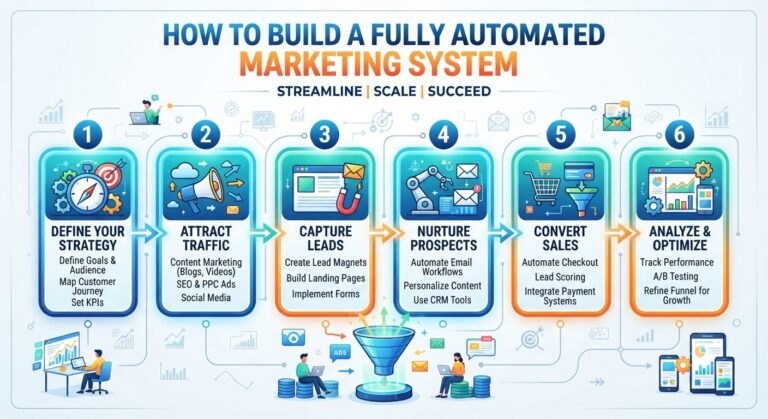
Step 1: Define Your Marketing Goals
Begin with clear objectives.
Examples include:
Well-defined goals provide direction for your automation strategy.
Step 2: Map the Customer Journey
Understand every stage your customers experience.
Typical stages include:
Identify automation opportunities within each stage.
Step 3: Create High-Quality Content
Automation performs best when supported by valuable content.
Examples include:
Quality content builds trust and nurtures prospects.
Step 4: Build Automated Workflows
Design workflows that trigger specific actions based on customer behavior.
Examples:
These automated workflows ensure consistent communication.
Step 5: Use AI for Personalization
Artificial intelligence can personalize marketing by analyzing customer behavior.
AI can recommend:
Personalization increases engagement and conversions.
Step 6: Monitor and Optimize
Marketing automation requires ongoing improvement.
Review:
Small improvements over time lead to significant long-term gains.
Many businesses fail to maximize automation because they:
Avoiding these mistakes helps maintain an effective marketing system.
To maximize your automation investment:
Consistency and continuous improvement are the keys to success.
Marketing automation is becoming increasingly intelligent.
Future trends include:
Businesses that embrace these innovations will be better positioned to compete in an increasingly digital marketplace.
Building a fully automated marketing system is one of the smartest investments a business can make. By combining AI, CRM software, email automation, analytics, chatbots, and workflow automation, companies can streamline operations, improve customer experiences, and generate more consistent results.
Rather than replacing marketers, automation empowers them to focus on strategic planning, creativity, and business growth. Whether you’re just beginning your automation journey or refining an existing system, implementing these best practices will help create a scalable marketing engine that supports long-term success.
To deliver innovative, scalable, AI, and human-centered technology solutions that empower businesses to thrive in a digital-first economy
1129 Northern Blvd., Suite 404, Manhasset, New York 11030
Privacy Policy | Team of Use | Cache © 2026 All rights reserved