
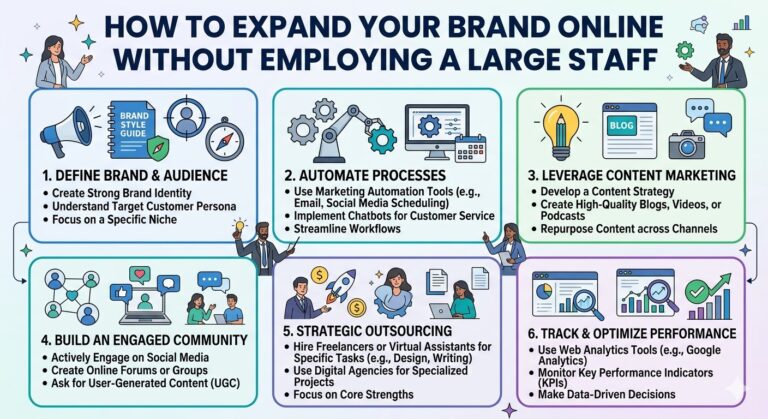
Building a successful internet brand, according to many entrepreneurs and small business owners, necessitates a sizable marketing staff, pricey agencies, and substantial resources. Modern technology has altered the game, even though large corporations frequently have specialized teams for content development, social media management, SEO, advertising, and consumer engagement.
By utilizing clever digital tools, automation, and intelligent marketing techniques, organizations can effectively expand their online presence in 2026. By concentrating on high-impact initiatives and utilizing AI-powered solutions, even lone proprietors and tiny teams can successfully compete.
Customers’ perception of your company on digital media is known as your online brand.
A strong brand helps you:
The good news is that brand growth depends more on consistency and strategy than the size of your team.
Before investing time in marketing, define your brand identity.
Ask yourself:
A clear brand identity ensures consistency across your website, content, social media, and marketing campaigns.
Your website serves as the foundation of your online presence.
A strong website should include:
Your website often serves as the first impression for potential customers, making it one of the most important brand-building assets.
Search Engine Optimization (SEO) helps people discover your business through search engines.
Key SEO strategies include:
Unlike paid advertising, SEO continues generating traffic over time, making it ideal for small teams with limited budgets.
Content marketing allows businesses to demonstrate expertise and attract potential customers organically.
Content ideas include:
Consistently publishing valuable content helps establish your brand as a trusted resource in your industry.
AI-powered tools can dramatically reduce the workload of small teams.
AI can help with:
By automating repetitive tasks, business owners can focus on strategy, customer relationships, and growth.
You do not need to be active on every social platform.
Instead:
A focused social media strategy often performs better than trying to manage numerous platforms simultaneously.
Email marketing remains one of the highest-ROI digital marketing channels.
Benefits include:
Offer valuable resources, newsletters, or exclusive updates to encourage email signups.
Marketing automation allows small teams to operate more efficiently.
Tasks that can be automated include:
Automation helps maintain consistency while reducing manual effort.
Growing a brand online requires continuous optimization.
Track important metrics such as:
Data-driven decisions help you focus on strategies that deliver the best results.
Many businesses fail because they try to do too much at once.
Instead of publishing content daily on every platform, focus on maintaining a consistent schedule you can sustain long-term.
For example:
Consistency builds trust and brand recognition over time.
When growing a brand with a small team, avoid these mistakes:
A focused strategy often produces better results than spreading resources too thin.
AI is helping small businesses compete with larger organizations by providing access to powerful marketing capabilities without requiring large staffs.
AI can assist with:
This allows entrepreneurs and lean teams to accomplish more in less time.
Growing your brand online does not require a large marketing department or a massive budget. With the right combination of SEO, content marketing, automation, social media strategy, and AI-powered tools, small businesses can build strong digital brands and compete effectively in their industries.
Success comes from consistency, strategic planning, and smart use of technology. By focusing on high-impact activities and leveraging modern digital tools, entrepreneurs can achieve sustainable brand growth without hiring a big team.
In 2026, the businesses that grow fastest are not always the ones with the largest teams—they are the ones that work the smartest.
To deliver innovative, scalable, AI, and human-centered technology solutions that empower businesses to thrive in a digital-first economy
1129 Northern Blvd., Suite 404, Manhasset, New York 11030
Privacy Policy | Team of Use | Cache © 2026 All rights reserved