
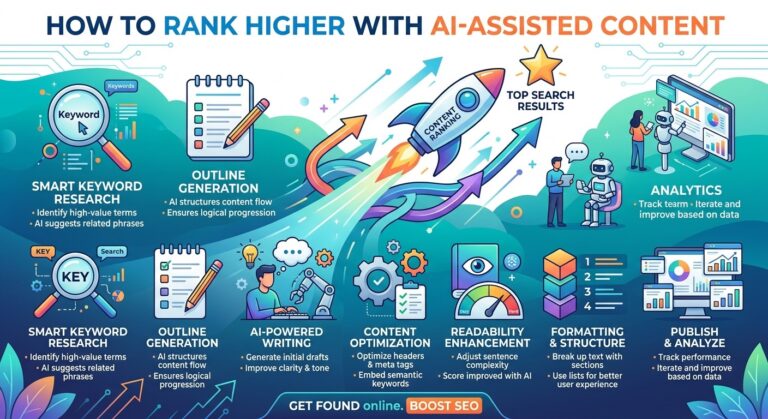
Creating content that ranks well in search engines has become more challenging. Competition is increasing, search behavior is changing, and businesses are expected to publish useful information across multiple topics and platforms.
Artificial intelligence can help.
AI-assisted content allows marketers and content creators to accelerate research, identify search opportunities, develop outlines, improve existing content, and optimize SEO workflows.
However, simply asking AI to write an article and publishing the result isn’t a reliable SEO strategy.
The strongest approach is to use AI as a content assistant while humans remain responsible for expertise, accuracy, originality, and strategic decisions.
In 2026, businesses that combine AI efficiency with high-quality content practices can create a scalable SEO strategy capable of competing in an increasingly crowded search environment.
AI-assisted content is content created or improved with the help of artificial intelligence.
AI may assist with:
The key word is assisted.
AI doesn’t have to create the entire article.
Instead, marketers can use AI throughout the content creation process while adding human expertise and editorial judgment.
Yes, AI-assisted content can perform well in search when it provides genuine value and follows sound SEO practices.
The use of AI itself isn’t the objective.
What matters is the quality of the final content.
A strong AI-assisted article should:
AI can make the process more efficient, but it doesn’t replace the need for quality.
Before creating content, understand why someone is searching.
Search intent generally falls into several categories:
Informational
The user wants to learn something.
Example:
“What is AI SEO?”
Commercial Investigation
The user is comparing options.
Example:
“Best AI SEO tools for small businesses”
Transactional
The user is ready to take action.
Example:
“Buy SEO software”
Navigational
The user is looking for a specific website or resource.
Example:
“Google Search Console login”
AI can help classify keywords and identify the likely intent behind them.
Your content should then match that intent.
Keyword research is one of the most useful applications of AI.
Instead of focusing only on popular keywords, ask AI to help identify:
For example, the broad keyword:
“AI marketing”
could lead to more specific opportunities such as:
Specific searches can reveal highly relevant content opportunities.
Before generating a draft, create a detailed content brief.
An AI-assisted content brief can include:
This gives the writer a strategic framework before the article is created.
A strong brief also reduces the risk of producing content that is unfocused or repetitive.
Don’t try to rank by writing the shortest possible article.
Instead, aim to answer the important questions surrounding the topic.
For example, an article about AI SEO might cover:
Comprehensive coverage helps readers find the information they need in one place.
This is one of the most important steps.
AI can produce general information, but human expertise can make the content distinctive.
Add:
For example, instead of simply explaining that AI can improve SEO, provide a practical workflow showing exactly how your team uses AI to research, create, optimize, and update content.
That’s the type of information that can differentiate an article from generic AI-generated material.
AI systems can sometimes produce inaccurate information.
Before publishing, verify:
This is especially important for content involving rapidly changing technology.
AI should accelerate research, not eliminate verification.
Good structure improves both readability and usability.
Use:
For example:
H1: How to Rank Higher With AI-Assisted Content
H2: What Is AI-Assisted Content?
H2: How AI Can Improve SEO
H2: AI Content Strategies That Work
H2: Common Mistakes
This makes the page easier to scan.
AI can help identify keyword opportunities, but avoid keyword stuffing.
Instead of repeating the exact keyword throughout every paragraph, use natural variations.
For a topic about AI-assisted content, related terms might include:
The goal is to communicate the topic naturally rather than manipulate keyword frequency.
Creating new content isn’t the only way to grow organic traffic.
AI can help analyze existing pages and identify improvement opportunities.
Look for:
Updating valuable existing pages can often be more efficient than constantly creating new ones.
Internal links connect related pages on your website.
AI can analyze your content and suggest relevant connections.
For example, an article about AI-assisted content could link to articles about:
This creates a stronger content ecosystem and helps users discover related information.
Your title and meta description influence how users perceive your page in search results.
AI can help generate variations.
For example:
Basic title:
AI Content
Improved title:
How to Rank Higher With AI-Assisted Content in 2026
The improved version communicates the topic and benefit more clearly.
However, your title and description should accurately reflect the page.
AI can help identify content that may be difficult to read.
Ask AI to review:
Then edit the content for clarity.
Simple writing doesn’t mean simplistic writing.
The goal is to make valuable information easier to understand.
Long-tail searches can be valuable because they often reveal specific user needs.
For example:
Broad:
AI SEO
Long-tail:
How can a small business use AI to improve SEO?
The second query provides more context and can inspire a highly focused article.
AI can help identify hundreds of related questions and organize them into useful content themes.
Ranking isn’t the only objective.
Create content that other websites, professionals, and creators would want to reference.
You can accomplish this by publishing:
Original value can help your website stand out in a crowded search environment.
Search is increasingly becoming conversational.
Users may ask detailed questions and receive synthesized answers.
Businesses should therefore make important information easy to identify.
Use:
The goal isn’t to manipulate AI-powered search.
The goal is to make your content genuinely useful and understandable.
AI can help you understand what competing pages are covering.
Analyze:
Then look for opportunities to provide something better.
Don’t simply copy competing pages.
Instead ask:
What can our page provide that users aren’t getting elsewhere?
Text isn’t the only way to provide value.
Consider adding:
Multimedia can make complex subjects easier to understand and improve the overall user experience.
Don’t assume that publishing AI-assisted content means SEO is improving.
Monitor:
A successful SEO strategy should ultimately contribute to meaningful business outcomes.
AI-Assisted Content Workflow
A practical workflow might look like this:
Step 1: Research
Use AI to identify keywords, questions, trends, and customer needs.
Step 2: Analyze Search Intent
Determine what users expect when searching for the topic.
Step 3: Create a Content Brief
Develop the article structure and information requirements.
Step 4: Draft
Use AI to accelerate research and initial writing.
Step 5: Add Expertise
Insert original insights, examples, experience, and supporting evidence.
Step 6: Fact-Check
Verify important claims and information.
Step 7: Optimize
Improve headings, keywords, internal links, metadata, and readability.
Step 8: Publish
Ensure the final page is useful and technically accessible.
Step 9: Measure
Track organic performance and conversions.
Step 10: Update
Improve the article as search behavior and information change.
Publishing AI Content Without Editing
AI-generated drafts should be reviewed and improved before publication.
Creating Generic Articles
If your content says the same things as hundreds of competing pages, it may struggle to stand out.
Overusing Keywords
Write naturally instead of trying to hit an arbitrary keyword density.
Ignoring Search Intent
The best keywords won’t help if the content doesn’t satisfy what users want.
Publishing Too Much Low-Value Content
Quality should take priority over volume.
Forgetting Existing Content
Some of your biggest SEO opportunities may already exist on your website.
AI will continue to become more capable at assisting marketers throughout the SEO process.
Future workflows may involve AI systems that can:
However, human expertise will remain critical.
The most successful content strategies will likely combine AI efficiency with human originality, experience, judgment, and creativity.
Learning how to rank higher with AI-assisted content isn’t about asking AI to generate as many articles as possible.
It’s about using artificial intelligence intelligently throughout the SEO process.
AI can help businesses discover keywords, understand search intent, create content briefs, improve existing pages, optimize internal links, analyze competitors, and monitor performance.
But the final content needs something more: real value.
Add expertise. Provide original examples. Verify information. Answer real questions. Make the content easy to understand. Keep improving it after publication.
When AI is used as a strategic assistant rather than a content factory, businesses can create a more efficient and sustainable SEO process.
The future of SEO isn’t about choosing between humans and AI.
It’s about combining the strengths of both.
Can AI-assisted content rank on Google?
Yes. AI can assist with content creation, but ranking depends on many factors, including relevance, quality, search intent, technical SEO, authority, and the overall usefulness of the page.
Is AI-generated content good for SEO?
AI-generated content can be useful when it is accurate, relevant, original, and properly edited. Publishing large amounts of generic content simply because AI makes it easy is not a reliable SEO strategy.
How can AI help improve SEO?
AI can assist with keyword research, search-intent analysis, content planning, optimization, internal linking, competitor research, technical analysis, and content updates.
Should humans edit AI-generated content?
Yes. Human review can improve accuracy, originality, expertise, brand voice, and usefulness.
Can AI replace SEO writers?
AI can automate parts of the writing process, but skilled writers remain valuable for strategy, research, expertise, storytelling, editing, and creating original perspectives.
What is the best AI SEO strategy?
The strongest strategy is to use AI for research and efficiency while focusing human effort on search intent, expertise, originality, quality, and user experience.
To deliver innovative, scalable, AI, and human-centered technology solutions that empower businesses to thrive in a digital-first economy
1129 Northern Blvd., Suite 404, Manhasset, New York 11030
Privacy Policy | Team of Use | Cache © 2026 All rights reserved