
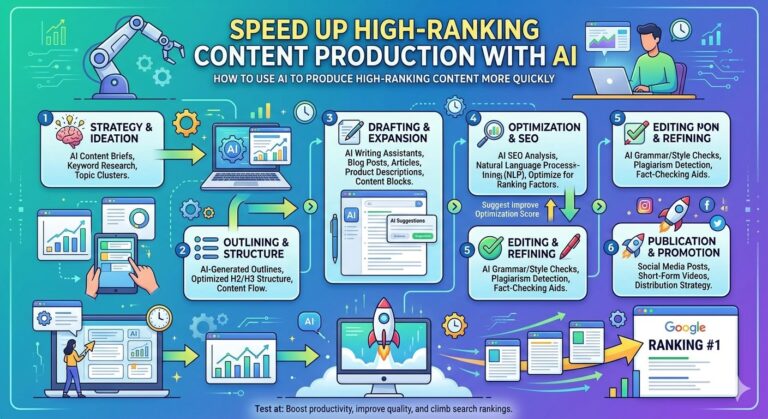
One of the best strategies to increase organic traffic is to provide high-quality content that performs well in search results. However, marketers, bloggers, and company owners may find it time-consuming to regularly produce SEO-optimized material.
In 2026, artificial intelligence (AI) has developed into a potent instrument for quickening the production of content. AI-powered technologies assist authors with topic research, idea generation, keyword optimization, and effective article construction.
This article discusses how to use AI to produce high-ranking content more quickly while preserving search engine optimization, quality, and relevancy.
Research, authoring, optimization, and analysis are all necessary for content marketing. By evaluating vast volumes of data and offering useful insights, AI systems streamline these processes.
Benefits of using AI for content creation include:
With AI assistance, marketers can produce high-quality content in a fraction of the time.
Choosing the right topic is the first step to creating content that ranks well on search engines.
AI tools can help identify:
By focusing on topics that people are actively searching for, you increase the chances of ranking higher in search results.
Keywords are essential for SEO success. AI-powered keyword research tools analyze search trends and suggest valuable keywords to target.
These tools help marketers:
Using the right keywords ensures your content reaches the right audience.
A well-structured article improves both readability and SEO performance. AI tools can quickly generate outlines based on top-ranking pages and keyword analysis.
AI-generated outlines may include:
This saves time during the planning phase and ensures your content covers important information.
AI writing tools help accelerate the drafting process by generating text suggestions, improving sentence structure, and expanding ideas.
Writers can use AI to:
While AI assists with writing, human editing ensures the content remains accurate, engaging, and aligned with brand voice.
Creating content is only part of the process—optimizing it for search engines is equally important.
AI SEO tools help optimize content by:
These optimizations improve the chances of ranking higher on search engine results pages.
AI tools can analyze content quality and provide suggestions for improvement. They evaluate factors such as readability, grammar, structure, and keyword usage.
Content improvement tools may suggest:
This helps ensure the final content meets both SEO standards and reader expectations.
Creating multiple types of content from a single article can maximize its value.
AI tools can help repurpose content into:
Repurposing content expands your reach and increases content efficiency.
To maximize the benefits of AI content tools, follow these best practices:
Combining AI efficiency with human creativity produces the best results.
When using AI for content creation, avoid these common mistakes:
Search engines prioritize high-quality, useful content, so human oversight remains essential.
AI technology will continue to evolve and play a larger role in content marketing. Future AI tools will provide deeper insights into audience behavior, predictive SEO strategies, and advanced content optimization features.
Businesses that adopt AI-assisted content strategies early will gain a strong advantage in the competitive digital landscape.
AI is revolutionizing the way marketers create content. By using AI tools for topic research, keyword analysis, content structuring, and SEO optimization, businesses can produce high-ranking content faster and more efficiently.
However, the best results come from combining AI capabilities with human creativity and strategic thinking.
In 2026 and beyond, AI-powered content creation will be a key factor in building successful digital marketing strategies and achieving sustainable online growth.
To deliver innovative, scalable, AI, and human-centered technology solutions that empower businesses to thrive in a digital-first economy
1129 Northern Blvd., Suite 404, Manhasset, New York 11030
Privacy Policy | Team of Use | Cache © 2026 All rights reserved