
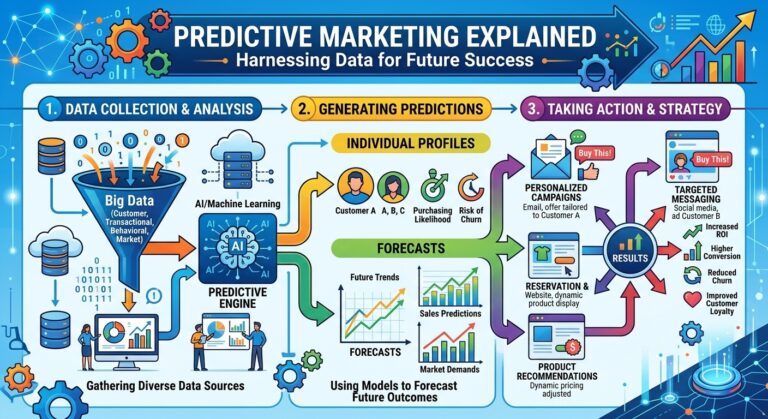
Marketing has traditionally relied on historical results, customer research, and the experience of marketing professionals to determine which campaigns are likely to succeed. Businesses analyze past sales, monitor website traffic, test advertisements, and adjust their strategies based on the results. Although these methods remain valuable, they can make it difficult to identify opportunities before they become obvious.
This is where predictive marketing comes in.
Predictive marketing uses historical data, statistical analysis, and machine learning to estimate what customers may do next. Instead of simply reviewing what happened in a previous campaign, businesses can use predictive insights to identify potential buyers, recognize customers who may stop purchasing, anticipate product demand, and determine which marketing actions deserve attention.
For example, an online store might identify customers who are likely to purchase a particular product. A software company might identify trial users who are more likely to become paying subscribers. An email marketing team might estimate which customers are most likely to respond to a particular offer.
These predictions help businesses make more informed decisions about their marketing activities.
However, predictive marketing is not about knowing the future with certainty. Its purpose is to reduce guesswork, identify patterns, and improve decisions using available evidence.
In this guide, we explain what predictive marketing is, how predictive analytics works, its most important benefits, practical applications, and how businesses can start using it to build smarter marketing strategies.
Predictive marketing is a data-driven marketing approach that uses statistical models, machine learning, and artificial intelligence to forecast likely customer behaviors and marketing outcomes.
It examines patterns in available data to estimate the probability of future actions, such as purchasing a product, clicking an advertisement, responding to an email, or canceling a subscription.
According to Salesforce’s overview of predictive marketing, businesses can use historical customer information and predictive analytics to anticipate behavior and improve the relevance of marketing activities.
Unlike traditional marketing analysis, which often focuses on past performance, predictive marketing helps marketers make forward-looking decisions.
How Predictive Marketing Differs From Traditional Marketing
Traditional marketing often asks questions such as:
Predictive marketing builds on these insights by asking:
The distinction is important because historical performance does not always reveal what will happen next. Predictive analytics uses historical patterns and current information to estimate possible outcomes, while recognizing that predictions can be wrong.
Predictive marketing combines customer data, analytical methods, predictive models, and marketing actions.
The process usually involves several stages.
Step 1: Collect Relevant Marketing Data
Predictive marketing begins with data. Depending on the business and its goals, useful information may include:
Businesses should collect only data that is appropriate for their purposes and handled according to applicable privacy requirements.
The objective is not to gather as much information as possible. It is to obtain reliable information that helps answer a specific marketing question.
Step 2: Organize and Prepare the Data
Data from different systems may contain duplicate records, missing values, inconsistent formats, or outdated information.
Before building a predictive model, businesses need to review data quality and determine whether the available information is suitable for the intended task.
For example, a company predicting subscription cancellations needs accurate subscription dates, renewal records, and cancellation outcomes. If these records are incomplete, the resulting predictions may be unreliable.
Step 3: Identify Patterns and Relationships
Analytical tools examine historical examples to identify patterns associated with particular outcomes.
An ecommerce business might discover that repeat purchases are more common among customers who buy complementary products. A software company might find that users who complete onboarding and use certain features are more likely to subscribe.
These relationships can help identify useful predictors, although correlation alone does not prove that one behavior causes another.
Step 4: Build or Use a Predictive Model
A predictive model uses selected data to estimate a particular outcome.
Depending on the goal, a model might estimate:
Some marketing platforms provide ready-made predictive models, while others allow businesses to build customized models using their own data.
Step 5: Apply the Predictions to Marketing Decisions
Predictions become useful when they guide appropriate actions.
For example, a marketing team might prioritize high-intent leads for follow-up, send a relevant product recommendation to an interested customer, or offer assistance to a subscriber who appears likely to disengage.
The action should match the business objective and the customer’s needs. A high probability score should guide a decision, not automatically determine every interaction.
Step 6: Measure Results and Improve
After implementing a predictive marketing strategy, businesses should compare predicted outcomes with actual results.
They can measure conversion rates, campaign costs, customer retention, revenue, and other relevant indicators.
Over time, the team can evaluate whether the model remains accurate and whether the resulting marketing actions create measurable improvements.
Artificial intelligence makes predictive marketing more scalable by helping businesses analyze large amounts of information and identify patterns that may be difficult to detect manually.
AI-powered marketing platforms can generate customer propensity scores, identify likely churn, support audience segmentation, and help marketers personalize customer experiences.
Adobe’s documentation on Customer AI, for example, describes the use of customer-level predictions for outcomes such as conversion and churn, along with information about factors influencing those predictions.
AI-Powered Customer Segmentation
Traditional segmentation may group customers by age range, location, industry, or purchase history.
Predictive segmentation can add another dimension by grouping people according to their estimated likelihood of taking an action.
For example, an online store might distinguish between:
These segments can help businesses create more relevant campaigns instead of sending the same message to every customer.
Predictive Lead Scoring
Lead scoring assigns values to potential customers based on selected characteristics and behaviors.
Predictive lead scoring can use historical conversion outcomes to estimate which leads are more likely to become customers.
Sales teams can then prioritize follow-up, while marketing teams can provide additional information to leads who are not yet ready to buy.
A reliable system should be evaluated against actual conversion outcomes and updated when customer behavior changes.
Predictive Personalization
AI can help businesses estimate which products, messages, or content categories are likely to interest different customers.
For example, a returning visitor to an educational website might receive recommendations for related tutorials based on their previous activity, where appropriate data and permissions are available.
The purpose is to make the experience more relevant without becoming intrusive or making assumptions that customers cannot easily correct.
Marketing Automation
Predictive analytics can work alongside marketing automation to trigger actions when certain conditions are met.
A model might identify a subscriber at risk of becoming inactive. An automation workflow could then send a helpful reminder or offer relevant content, subject to the subscriber’s preferences and communication permissions.
Predictive models estimate what might happen; automation carries out predefined actions based on those estimates.
Predictive marketing can help businesses make better use of their data and marketing budgets. Its value depends on the quality of the data, the relevance of the predictions, and the actions taken afterward.
Predictive marketing can help identify audiences who are more likely to respond to a particular offer or campaign.
Rather than targeting everyone who matches a broad demographic description, marketers can consider relevant behavioral signals and estimated purchase intent.
This can help reduce wasted effort and focus resources on more promising opportunities.
Marketing budgets are limited, and not every campaign produces the same results.
Predictive insights can help teams prioritize campaigns, channels, and customer segments that are more likely to contribute to business goals.
However, a prediction does not automatically increase return on investment. Marketers still need to compare costs, incremental results, revenue, and profit to determine whether a strategy is worthwhile.
Predictive marketing can help businesses select content, products, and messages that better match customer interests.
For example, a customer who frequently purchases beginner-level educational resources might receive recommendations for related learning materials rather than unrelated products.
Useful personalization should feel relevant and helpful, not as though the business is monitoring every activity unnecessarily.
Sales teams often spend considerable time following up with leads who are not ready to buy.
Predictive lead scoring can help prioritize leads based on patterns associated with previous conversions.
This allows teams to allocate attention more effectively while continuing to nurture leads who may become valuable customers later.
Acquiring a new customer is not the only path to growth. Businesses also need to maintain relationships with existing customers.
Predictive churn models can identify customers who may be at risk of leaving. Companies can use those insights to investigate possible problems and offer appropriate support.
For example, a subscription business might contact customers who have stopped using important features or provide onboarding assistance to users who appear to be struggling.
The goal should be to solve the customer’s problem, not simply to send another promotional message.
Predictive analysis can help marketers evaluate potential campaign outcomes before committing substantial resources.
Teams can use forecasts to plan budgets, prioritize experiments, estimate demand, and identify opportunities that deserve further investigation.
Forecasts should be treated as estimates with uncertainty rather than guaranteed results.
Predictive marketing can be applied across industries, from ecommerce and software to education and professional services.
Example 1: Predictive Marketing for Ecommerce
An online store wants to increase repeat purchases.
It reviews its transaction history and identifies customers who frequently purchase complementary products. A predictive model estimates which existing customers are most likely to be interested in a related item.
The marketing team can then test personalized recommendations or follow-up emails with an appropriate audience.
To determine whether the strategy works, the store compares the results with a suitable control group rather than assuming every recommended purchase was caused by the campaign.
Example 2: Predictive Marketing for SaaS Businesses
A software company offers a free trial of its product.
The company analyzes historical trial behavior to identify patterns associated with paid subscriptions. It finds that users who complete onboarding and explore important features are more likely to convert.
The marketing team can use these insights to improve onboarding messages and offer helpful tutorials to users who have not completed key steps.
The objective is to help users experience the product’s value, not to pressure every trial user into purchasing.
Example 3: Predictive Marketing for Email Campaigns
A business sends educational newsletters to subscribers.
Instead of sending every message at the same time and in the same format, it analyzes engagement patterns to identify which topics and campaign formats are more likely to interest different audience segments.
It tests personalized subject lines, relevant content recommendations, and different delivery schedules.
The team then evaluates engagement and conversion outcomes while respecting unsubscribe requests and communication preferences.
Example 4: Predictive Marketing for B2B Lead Generation
A business-to-business company receives leads through its website, webinars, and content downloads.
Its predictive lead-scoring model estimates which leads are most likely to become qualified sales opportunities.
Sales representatives can prioritize promising leads, while marketing automation provides useful resources to other prospects.
The company should regularly check whether the scoring model performs fairly and accurately across different lead sources and customer groups.
Example 5: Predictive Marketing for Content Planning
A content marketing team wants to identify future opportunities for articles and guides.
It reviews historical organic traffic, search queries, seasonal demand, audience questions, and engagement trends. Analytical tools help identify topics that may deserve attention.
The team then validates those opportunities through keyword research, audience needs, competition, and editorial judgment.
Predictive insights can inform content planning, but they cannot guarantee that a topic will rank or attract traffic.
Businesses do not need to implement every predictive marketing technique at once. Starting with a clear objective helps make the process manageable.
Strategy 1: Predict Purchase Intent
Use relevant behavioral and transaction data to estimate which visitors or customers are more likely to purchase.
Apply the findings to product recommendations, helpful follow-up messages, or audience segmentation.
Measure actual incremental conversions to determine whether the strategy improves performance.
Strategy 2: Predict Customer Churn
Identify patterns associated with subscription cancellations, reduced engagement, or declining purchase frequency.
Use the findings to develop retention strategies that address customer needs, such as improving onboarding, offering support, or explaining useful product features.
Avoid relying solely on discounts. Sometimes the best response is to resolve a product or service problem.
Strategy 3: Optimize Marketing Campaigns
Use past campaign data to estimate which audiences and messages are more likely to achieve a particular objective.
Run controlled experiments to test the predictions. Monitor conversion rates, acquisition costs, and revenue rather than focusing only on clicks or impressions.
Strategy 4: Forecast Product Demand
Historical sales, seasonal patterns, customer interest, and market signals can help estimate future demand.
These forecasts can inform promotional calendars, inventory planning, and content campaigns.
Businesses should also account for factors that historical data may not capture, such as competitor activity, sudden market changes, or product availability.
Strategy 5: Improve Customer Lifetime Value Estimates
Customer lifetime value (CLV) estimates the value a customer may generate over a defined relationship period.
Predictive models can help estimate future purchasing, retention, and revenue patterns. Marketers can use these estimates to inform acquisition and retention decisions.
CLV predictions should be interpreted carefully because future customer behavior, costs, and market conditions can change.
Strategy 6: Identify Content Opportunities
Predictive analysis can help content teams prioritize topics based on historical performance, seasonal demand, and observed audience interests.
For SEO, combine these insights with search intent, keyword research, content quality, and competitive analysis.
The goal is to make better editorial decisions, not to publish content simply because a model predicts potential traffic.
Businesses can use several types of tools to support predictive marketing, depending on their size, data maturity, and objectives.
Customer Relationship Management Platforms
CRM platforms organize customer and sales information. Some include predictive lead scoring, forecasting, segmentation, or AI-powered recommendations.
These features can help sales and marketing teams work from a more consistent view of customer activity.
Marketing Automation Platforms
Marketing automation tools manage email sequences, audience segmentation, campaign triggers, and customer journeys.
When predictive features are available, teams can use estimated behavior to inform when and how they communicate with customers.
Web and Marketing Analytics
Analytics platforms help businesses understand traffic sources, user interactions, conversions, and campaign performance.
Predictive or advanced analytics features may help identify patterns, detect anomalies, and estimate future outcomes.
AI-Powered Customer Data Platforms
Customer data platforms can combine eligible information from multiple sources to support audience creation and personalization.
Their usefulness depends on data integration, identity resolution, governance, and the quality of the information being analyzed.
Custom Predictive Analytics Solutions
Businesses with specialized needs may build custom models using statistical software, machine-learning frameworks, or cloud analytics services.
This approach can provide flexibility but usually requires more technical expertise, ongoing evaluation, and governance.
How should a business choose a predictive marketing tool?
Start with the business problem rather than the software. Compare data compatibility, ease of use, integration options, reporting, model transparency, privacy controls, and total cost.
A complex platform is not necessarily better than a simpler tool that solves the problem reliably.
Predictive marketing may sound like an enterprise-level strategy, but small businesses can begin with focused projects and existing data.
Step 1: Choose One Measurable Goal
Start with a specific question, such as:
Avoid attempting to predict every customer behavior at once.
Step 2: Review Your Available Data
Determine what information you already collect through your website, CRM, ecommerce platform, email service, or sales records.
Check whether the information is accurate, relevant, current, and collected appropriately.
If the data is incomplete, improving tracking and record quality may be more valuable than immediately adopting an advanced predictive model.
Step 3: Establish a Baseline
Measure current performance before introducing predictive marketing.
For example, record the existing lead-to-customer conversion rate, customer churn rate, or cost per qualified lead.
Without a baseline, it is difficult to determine whether the new strategy creates an improvement.
Step 4: Select a Suitable Tool
Choose a tool that fits your current workflow and technical capabilities.
A small business may be able to begin with built-in analytics or CRM scoring features before investing in a custom machine-learning solution.
Step 5: Test One Use Case
Apply the prediction to a limited campaign or audience.
For instance, test whether leads with higher predicted conversion likelihood respond better to a particular follow-up process.
Where feasible, compare the results against a control group to understand whether the action caused an improvement.
Step 6: Monitor and Refine
Review the model’s accuracy and the business outcomes it supports.
If customer behavior changes, the model may need new data, recalibration, or replacement.
Scale the strategy only when it demonstrates reliable value and can be operated responsibly.
Predictive marketing and prescriptive marketing are related, but they serve different purposes.
Feature | Predictive Marketing | Prescriptive Marketing |
Main question | What is likely to happen? | What action should we consider? |
Primary output | Forecast or probability | Recommended action or decision |
Example | A lead has a high estimated likelihood of conversion | Prioritize a relevant follow-up for that lead |
Main purpose | Anticipate outcomes | Help choose actions that may improve outcomes |
Predictive analytics estimates possible outcomes using data and models. Prescriptive analytics goes further by evaluating possible actions and recommending options that may improve a desired result.
In practice, businesses may use both approaches together. A prediction can identify an opportunity, while a recommendation system helps determine what to do next.
Neither guarantees a particular business outcome. Human judgment, operational constraints, and ongoing measurement remain important.
Predictive marketing can improve decision-making, but it also introduces risks that businesses must manage.
Poor Data Quality
Incomplete, inaccurate, or outdated information can produce unreliable predictions.
Businesses should establish data-quality checks and correct important issues before relying on model outputs.
Limited or Unrepresentative Data
A model trained on a narrow set of customers or historical conditions may not perform well for new audiences or changing market circumstances.
Teams should evaluate how well predictions generalize and avoid assuming that past patterns will continue indefinitely.
Privacy and Customer Trust
Predictive marketing often involves analyzing customer information, so privacy should be a central consideration.
Businesses should provide appropriate transparency, respect communication preferences, restrict access to sensitive information, and follow relevant data-protection requirements.
The FTC’s guidance on information quality emphasizes accuracy, reliability, objectivity, and transparency where appropriate. These principles are useful reminders when evaluating the information and analytical outputs used in marketing decisions.
Bias and Unfair Outcomes
Historical data may reflect existing inequalities or inconsistent business practices. Predictive models can reproduce or amplify those patterns if they are not evaluated carefully.
Review model performance across relevant groups, consider which variables are appropriate, and investigate outcomes that may create unfair treatment.
False Confidence in Predictions
A model produces an estimate, not a guarantee.
A customer with a high predicted likelihood of purchasing may never buy, while someone with a low score may become a valuable customer.
Marketers should use predictions alongside other evidence and avoid making important decisions based on a single score.
Integration and Maintenance Costs
Predictive marketing may require data integration, staff training, software subscriptions, technical support, and ongoing model monitoring.
Businesses should compare these costs with measurable benefits before expanding the project.
Predictive marketing should be evaluated using metrics connected to business objectives.
Conversion Rate
Measures the proportion of relevant visitors or leads who complete a desired action.
Customer Acquisition Cost
Measures the cost of acquiring a customer. Businesses should compare acquisition costs with customer value and retention.
Return on Marketing Investment
Evaluates the financial return associated with marketing expenditure. Use consistent cost and revenue definitions when comparing campaigns.
Customer Retention and Churn
Tracks how many customers remain active and how many stop purchasing or cancel subscriptions during a defined period.
Lead Quality
Measures how effectively marketing generates leads that progress toward qualified opportunities or actual sales.
Prediction Quality
Evaluate the model itself using suitable metrics, such as precision, recall, calibration, or error measures, depending on the type of prediction.
A model that predicts behavior accurately is not necessarily profitable. Likewise, a campaign can improve business results even if its model is not perfect. Businesses need to assess both prediction quality and the impact of the actions based on those predictions.
Incremental Results
Where possible, use controlled experiments to determine whether predictive marketing produces better outcomes than the existing approach.
This helps distinguish genuine improvements from results that would have occurred anyway.
Predictive marketing is likely to continue evolving as businesses improve their data infrastructure and integrate more AI-powered capabilities into their marketing workflows.
More Real-Time Decision Support
Marketing systems may increasingly update predictions as new interactions occur. This can help businesses respond to changes in customer behavior more quickly, provided the underlying data and models are reliable.
Greater Personalization
Predictive insights may support more relevant product recommendations, content selection, and customer journeys.
Businesses will need to balance personalization with privacy, transparency, and user control.
Integration With Generative AI
Predictive and generative AI can serve complementary purposes.
Predictive models estimate likely outcomes, such as conversion or churn. Generative AI can help produce draft messages, summaries, and content variations. Marketing teams can combine these capabilities while reviewing outputs for accuracy, relevance, and brand consistency.
Generating more content does not automatically make a campaign more effective. The content still needs to serve a clear customer need.
Smarter Marketing Automation
Predictive insights can inform automation workflows that respond to relevant customer signals.
For example, a business may use an estimated churn risk to trigger a support review or educational email. Responsible automation should include safeguards, clear business rules, and human oversight for sensitive decisions.
More Focus on Measurement and Governance
As predictive marketing becomes more accessible, businesses will need better methods for evaluating model accuracy, monitoring changing behavior, documenting decisions, and managing data responsibly.
The strongest strategies will combine analytical capabilities with sound marketing judgment.
Predictive marketing helps businesses move beyond simply analyzing past performance and begin estimating what customers may do next. By combining historical data, statistical modeling, machine learning, and marketing automation, organizations can identify promising leads, anticipate customer needs, improve segmentation, and make more informed campaign decisions.
However, predictive marketing is not a guaranteed path to higher revenue. Its effectiveness depends on data quality, appropriate modeling, relevant actions, privacy safeguards, and consistent measurement.
Businesses do not need to begin with complicated AI systems. A focused project—such as improving lead scoring, identifying churn risk, or forecasting product demand—can provide a practical starting point.
By defining a clear goal, using reliable data, testing predictions, and measuring real business outcomes, organizations can build a more thoughtful and effective marketing strategy.
Ultimately, predictive marketing is not about knowing exactly what every customer will do. It is about using evidence to make better decisions, respond more intelligently, and create marketing experiences that are more relevant to the people they serve.
Predictive marketing uses data and analytical models to estimate what customers are likely to do in the future. Businesses use these estimates to guide campaigns, prioritize leads, personalize experiences, and improve marketing decisions.
It collects relevant customer and campaign data, identifies patterns, applies a predictive model, and uses the resulting estimates to guide marketing actions. Businesses then compare predictions with actual outcomes to evaluate performance.
An online store may use previous purchases and product interactions to estimate which customers are likely to buy a complementary product. It can test personalized recommendations and measure whether they generate additional sales.
No. Predictive marketing is one application of data analytics and AI in marketing. AI marketing is a broader category that can also include content generation, conversational assistants, automation, and other applications.
Yes. Small businesses can start with built-in analytics, CRM scoring, customer segmentation, or basic sales forecasting. A focused, measurable project is often more practical than building a complex custom model immediately.
Depending on the objective, useful data may include transaction history, website interactions, campaign engagement, CRM records, customer support activity, and subscription information. Data should be relevant, reliable, appropriately collected, and handled responsibly.
Potential benefits include better targeting, improved lead prioritization, more relevant personalization, stronger retention efforts, more efficient campaign planning, and better-informed budget decisions.
Common risks include poor data quality, inaccurate predictions, bias, privacy problems, excessive personalization, integration costs, and overreliance on automated decisions.
Predictive marketing estimates what may happen. Prescriptive marketing recommends actions that may improve the outcome. Businesses can combine both to identify opportunities and determine how to respond.
No. Predictive marketing can help businesses make better-informed decisions, but results depend on the model’s reliability, campaign execution, costs, customer response, and market conditions. Testing and measurement are necessary to determine its actual value.
To deliver innovative, scalable, AI, and human-centered technology solutions that empower businesses to thrive in a digital-first economy
1129 Northern Blvd., Suite 404, Manhasset, New York 11030
Privacy Policy | Team of Use | Cache © 2026 All rights reserved