
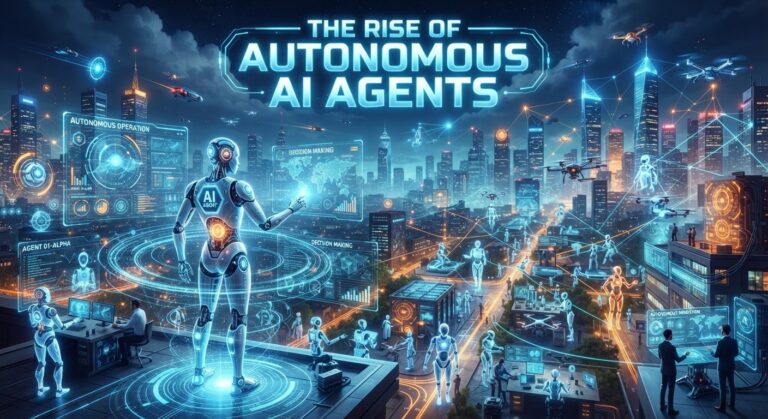
Artificial intelligence is entering a new stage.
For years, businesses primarily used AI as a tool that responded to individual requests. A person entered a prompt, asked a question, generated content, analyzed information, or requested a recommendation, and the AI provided an answer.
The next evolution is more action-oriented.
Autonomous AI agents are designed to do more than simply generate responses. They can interpret goals, plan multiple steps, interact with software, use available tools, evaluate information, and complete parts of a workflow with less continuous human direction.
This shift is helping move AI from a question-and-answer technology toward a more active participant in digital work.
For businesses, the implications are significant.
AI agents can potentially help manage customer requests, research information, coordinate workflows, analyze data, support sales teams, assist employees, monitor processes, and perform repetitive digital tasks.
However, autonomy does not mean that every business process should be handed over to AI.
The most practical approach is to combine autonomous capabilities with clear permissions, human oversight, security controls, and measurable objectives.
An autonomous AI agent is an AI system designed to pursue a goal by taking multiple steps rather than simply producing a single response.
A traditional AI interaction might look like:
User → Prompt → AI → Answer
An AI agent workflow may look more like:
Goal → Planning → Tool use → Action → Evaluation → Additional action → Completion
For example, instead of asking an AI:
“Give me a summary of these customer reviews.”
A business might give an agent a broader task:
“Analyze this week’s customer feedback, identify the most common complaints, categorize them, prepare a summary, and notify the appropriate team.”
The agent may then perform several connected actions depending on its available tools and permissions.
The difference is primarily about how much initiative and multi-step task execution the system can handle.
Traditional AI | Autonomous AI Agents |
Responds to individual prompts | Can pursue multi-step goals |
Primarily generates information | Can generate information and take actions |
Usually requires frequent user direction | Can operate through multiple workflow steps |
Often produces one response | Can coordinate multiple actions |
Limited tool interaction | Can use connected tools when authorized |
User-driven | Goal-driven |
This does not mean autonomous agents operate without limits.
Their capabilities depend on the software, tools, permissions, data, and instructions provided by the organization.
Businesses already use automation for repetitive tasks.
The limitation is that traditional automation generally depends on clearly defined rules.
For example:
If a form is submitted → send an email.
This works well when the process is predictable.
But real-world business activities often involve ambiguity.
A customer may write an unusual question.
A sales prospect may provide incomplete information.
A document may contain unexpected details.
A research task may require information from multiple sources.
AI agents can potentially handle more of this complexity by interpreting information and determining what steps to take next.
This creates a bridge between automation and intelligent decision support.
One of the defining characteristics of AI agents is their ability to work through multiple steps.
Consider a market research task.
A traditional AI interaction might require the user to ask:
An agent-oriented system can potentially coordinate these steps as one broader task, depending on its available tools.
This can reduce the amount of manual coordination required from employees.
Research is another area where autonomous AI agents can be useful.
An agent can potentially help:
For businesses, this could support activities such as:
Human review remains important when decisions depend on the accuracy and interpretation of the research.
Customer service is one of the areas where agentic AI could have a major impact.
A traditional chatbot may answer a customer’s question.
An AI agent could potentially handle a broader workflow.
For example:
Customer reports a problem
↓
Agent identifies the issue
↓
Checks available account or product information
↓
Determines possible solution
↓
Provides instructions or performs an authorized action
↓
Records the interaction
↓
Escalates if necessary
This moves customer service from simply answering questions toward completing tasks.
Sales professionals often spend considerable time on administrative work.
An AI agent could potentially assist with:
For example, an agent could research a prospect before a sales meeting and prepare a concise briefing for the salesperson.
The salesperson can then review the information and use it during the conversation.
This illustrates an important principle:
AI agents can handle preparation while humans remain responsible for relationships and important decisions.
Marketing contains many multi-step workflows.
AI agents can potentially assist with:
For example, a marketing agent could monitor a defined set of industry topics, identify emerging themes, organize research, and prepare content opportunities for a marketer to review.
This could make marketing teams more responsive without requiring employees to manually monitor every information source.
Modern businesses operate through many digital platforms.
Employees may move between:
AI agents can potentially act as an intelligent layer connecting these systems.
For example:
New customer → CRM update → welcome workflow → internal notification → task creation → follow-up reminder
Instead of requiring employees to manually coordinate each step, an agent can potentially orchestrate authorized actions.
Autonomous AI agents do not have to be customer-facing.
They can also operate as internal assistants.
An employee might ask an agent to:
“Prepare a summary of this week’s sales performance and highlight unusual changes.”
The agent could potentially retrieve permitted information, analyze it, and produce a report.
Other examples include:
This can reduce information overload.
Traditional automation usually waits for a trigger.
Agentic systems can potentially monitor information continuously or on a schedule.
For example, an agent could monitor:
When a predefined condition occurs, the system can notify an employee or initiate an authorized workflow.
This creates a more proactive form of automation.
AI automation and AI agents are related but not identical.
Traditional automation
Trigger → Rule → Action
AI-powered automation
Trigger → AI analysis → Action
Autonomous agent
Goal → Plan → Analyze → Use tools → Act → Evaluate → Continue or escalate
The third approach can potentially handle more complex workflows.
However, it also introduces additional risks because the system may have more freedom to determine what happens next.
That makes governance especially important.
A capable AI agent typically depends on several components.
The model provides language understanding, reasoning, classification, or generation capabilities.
The agent needs clear objectives, rules, and constraints.
Tools allow the agent to interact with external systems.
These might include:
Depending on the architecture, an agent may need relevant information from previous steps or interactions.
Multi-step tasks require the system to determine what actions should happen next.
The system may need to check whether an action produced the intended result.
Agents should only have access to the systems and actions they actually need.
Department | Potential AI Agent Applications |
Sales | Lead research, preparation, CRM assistance |
Marketing | Research, campaign analysis, content workflows |
Customer Service | Issue classification, support workflows |
Finance | Document analysis, reporting assistance |
HR | Employee information workflows |
Operations | Process monitoring and coordination |
IT | Ticket analysis and troubleshooting assistance |
Management | Business summaries and monitoring |
These applications vary significantly in complexity and risk.
Small businesses may benefit from AI agents because employees often perform several roles simultaneously.
An owner may be responsible for:
AI agents could potentially help coordinate some repetitive digital workflows.
For example:
New website lead
→ Agent analyzes the request
→ Adds lead information to CRM
→ Creates a follow-up task
→ Prepares a personalized response
→ Alerts the business owner
The human still controls the important customer relationship while the agent handles administrative preparation.
The productivity potential of autonomous AI agents comes from reducing the amount of manual coordination required.
Employees often spend time not only doing tasks but also deciding:
An AI agent can potentially coordinate some of these steps.
This can shift employees from managing workflows manually toward supervising intelligent workflows.
The concept of an AI “digital worker” is becoming increasingly common.
Unlike a traditional software feature, a digital worker is intended to perform a broader set of related tasks.
For example, an AI sales assistant might:
The important distinction is that such systems are designed around a role or objective, rather than a single isolated function.
Businesses should still define exactly what the agent is allowed to do.
The rise of autonomous AI agents also creates new challenges.
Accuracy
AI systems can generate incorrect information or make inappropriate assumptions.
Security
An agent with access to business systems can potentially create security risks if permissions are poorly designed.
Privacy
Agents may interact with customer, employee, or business information.
Unintended Actions
More autonomy means more potential for unexpected behavior.
Oversight
Organizations need ways to monitor agent activity and intervene when necessary.
Cost
Complex agent systems may require infrastructure, integrations, monitoring, and ongoing maintenance.
These challenges do not eliminate the value of AI agents, but they make responsible implementation important.
Autonomous does not mean unrestricted.
Businesses should define boundaries.
For example, an AI agent might be allowed to:
But require human approval before:
This creates a human-in-the-loop model.
For some workflows, businesses may use human-on-the-loop monitoring, where the system operates independently within defined limits while humans monitor performance and intervene when necessary.
Companies do not need to begin with highly complex systems.
A practical approach is to start with one well-defined workflow.
Step 1: Choose a Repetitive Process
Look for a process that happens frequently.
Step 2: Define the Goal
State exactly what the agent should accomplish.
Step 3: Define the Boundaries
Specify what the agent can and cannot do.
Step 4: Limit Permissions
Give the agent only the access it needs.
Step 5: Add Human Approval
Require approval for important or high-risk actions.
Step 6: Monitor Performance
Track accuracy, completion rates, errors, and unexpected behavior.
Step 7: Improve Gradually
Expand the agent’s capabilities only after the initial workflow performs reliably.
Businesses adopting agentic AI should consider the following principles:
Start Small
Begin with a clearly defined use case.
Keep Permissions Limited
An agent should not have unrestricted access to every company system.
Maintain Audit Logs
Businesses should be able to understand what actions an agent took.
Build Escalation Paths
The agent should know when to stop and involve a human.
Test Before Deployment
Use controlled environments to evaluate behavior.
Monitor Continuously
Performance can change as systems, data, and workflows change.
Protect Sensitive Information
Apply appropriate security and privacy controls.
Measure Business Outcomes
Focus on useful metrics such as time saved, response time, accuracy, customer satisfaction, and workflow completion.
The rise of AI agents may change how people interact with software.
Instead of opening multiple applications and manually completing each step, employees may increasingly describe an objective and allow an AI system to coordinate the underlying workflow.
The interaction could shift from:
“Which application should I open?”
to:
“What outcome do I need?”
The software then becomes an execution layer behind the user’s goal.
This does not mean traditional applications will disappear. Instead, AI may increasingly become an interface through which people interact with multiple digital systems.
It is important to distinguish between potential automation and complete autonomy.
Some tasks are highly predictable and suitable for automation.
Others involve:
These activities may continue to require substantial human involvement.
The future is therefore more likely to involve combinations of people, traditional software, automation, and AI agents rather than one technology replacing everything else.
For growing companies, the biggest opportunity may be workflow scalability.
Imagine a business where:
AI agents handle routine information processing
Automation moves information between systems
Employees supervise important decisions
Managers focus on strategy
This structure can potentially reduce administrative friction and allow businesses to handle larger volumes of work.
The objective is not simply to make AI more autonomous.
The objective is to make businesses more capable.
AI Chatbots | Autonomous AI Agents |
Primarily communicate | Communicate and potentially act |
Answer questions | Can pursue defined objectives |
Usually conversation-focused | Workflow-focused |
Limited actions | Can use multiple authorized tools |
Often reactive | Can be proactive within defined rules |
Typically one interaction at a time | Can coordinate multi-step tasks |
A chatbot can therefore be considered one possible interface for AI, while an agent is more focused on completing objectives.
The development of AI agents is likely to continue toward more capable systems that can coordinate multiple tools and workflows.
Potential developments include:
However, increased capability also makes governance more important.
The organizations that adopt AI agents effectively will need to balance autonomy with control.
The rise of autonomous AI agents represents an important shift in how businesses can use artificial intelligence.
Traditional AI primarily responds to requests.
Automation follows predefined processes.
Autonomous AI agents can potentially combine reasoning, planning, tool use, and workflow execution to pursue broader goals.
For businesses, this creates opportunities across sales, marketing, customer service, operations, research, administration, and productivity.
But autonomy should not mean unlimited access or unrestricted decision-making.
Successful implementation requires clear objectives, limited permissions, human oversight, security controls, monitoring, and measurable outcomes.
The future of AI in business may therefore not be about simply asking an AI for an answer.
It may increasingly be about giving AI a well-defined goal and allowing it to help coordinate the work required to achieve it.
What are autonomous AI agents?
Autonomous AI agents are AI systems designed to pursue defined goals through multiple steps, potentially including planning, information analysis, tool use, and workflow execution.
What is the difference between AI and an AI agent?
Traditional AI often responds to individual requests, while an AI agent can be designed to complete multi-step objectives using authorized tools and workflows.
How can businesses use autonomous AI agents?
Businesses can use AI agents for research, customer service, sales assistance, marketing workflows, data processing, reporting, process monitoring, and other structured digital tasks.
Are autonomous AI agents completely independent?
Not necessarily. Their autonomy depends on their design, permissions, tools, instructions, and operating environment. Businesses can require human approval for important actions.
Can small businesses use AI agents?
Yes. Small businesses can start with focused applications such as lead management, customer support, research, scheduling, reporting, and administrative workflows.
Are AI agents replacing employees?
AI agents can automate or assist with certain tasks, but many business activities continue to require human judgment, creativity, communication, accountability, and relationship-building.
What are the biggest risks of AI agents?
Important risks include inaccurate outputs, unintended actions, security vulnerabilities, privacy issues, excessive permissions, and inadequate human oversight.
How should a business start with AI agents?
Start with one well-defined, measurable workflow. Set clear objectives, restrict permissions, include appropriate human review, monitor performance, and expand gradually.
To deliver innovative, scalable, AI, and human-centered technology solutions that empower businesses to thrive in a digital-first economy
1129 Northern Blvd., Suite 404, Manhasset, New York 11030
Privacy Policy | Team of Use | Cache © 2026 All rights reserved