
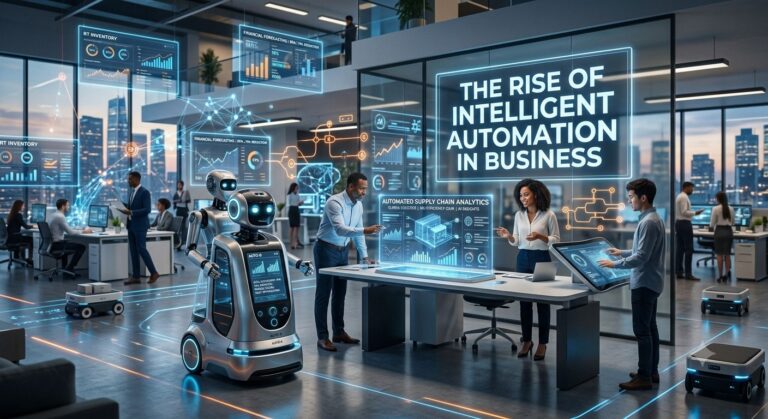
Businesses today face growing pressure to operate faster, reduce costs, and deliver exceptional customer experiences. At the same time, customers expect personalized services, quick responses, and seamless interactions across multiple digital channels. Meeting these expectations with manual processes alone has become increasingly difficult.
This is why intelligent automation has become one of the most important business trends in 2026. By combining Artificial Intelligence (AI), machine learning, robotic process automation (RPA), and data analytics, intelligent automation enables businesses to streamline operations, improve decision-making, and increase productivity.
From startups to global enterprises, organizations are embracing AI-powered automation to eliminate repetitive tasks, enhance employee efficiency, and support long-term growth.
This article explores the rise of intelligent automation in business, its benefits, practical applications, and why it is becoming essential for companies that want to stay competitive.
Intelligent automation is the integration of artificial intelligence with automation technologies to perform business processes more efficiently.
Unlike traditional automation, which follows fixed rules, intelligent automation can:
This makes it a valuable solution for businesses seeking greater flexibility and efficiency.
Several factors are driving the adoption of intelligent automation across industries:
Businesses are realizing that automation is no longer just about saving time—it is about creating smarter and more scalable operations.
Artificial intelligence is transforming automation from simple task execution into intelligent decision-making.
Modern AI automation tools can:
Instead of simply following instructions, AI-powered systems continuously improve based on data and experience.
One of the biggest advantages of intelligent automation is increased productivity.
Businesses can automate repetitive tasks such as:
Employees spend less time on routine work and more time focusing on strategic, creative, and customer-focused activities.
Customers expect fast and accurate support.
AI-powered customer service helps businesses provide:
AI chatbots and virtual assistants improve customer satisfaction while reducing support costs.
Marketing has become more data-driven than ever before.
Marketing automation tools powered by AI can:
Automation enables marketers to deliver more relevant messages while improving efficiency.
Business decisions are stronger when backed by accurate data.
Intelligent automation uses analytics to help businesses:
These insights allow organizations to make informed decisions faster.
As businesses grow, manual processes often become difficult to manage.
Automation allows companies to:
This scalability makes intelligent automation especially valuable for startups and small businesses planning long-term growth.
One of the biggest benefits of intelligent automation is cost efficiency.
Automation reduces expenses by:
Businesses can achieve better results while controlling operating costs.
Intelligent automation is transforming many sectors, including:
Digital Marketing
E-commerce
Healthcare
Finance
Human Resources
The flexibility of intelligent automation makes it valuable across nearly every industry.
Increased Productivity
Automation eliminates repetitive tasks, allowing employees to focus on high-value work.
Improved Accuracy
AI systems reduce human error and improve process consistency.
Faster Business Operations
Workflows become more efficient, leading to quicker results.
Better Customer Experiences
Personalized communication and faster support improve customer satisfaction.
Greater Business Agility
Organizations can respond more quickly to changing market conditions.
Although intelligent automation offers many advantages, successful implementation requires planning.
Common challenges include:
Businesses should view automation as a tool that enhances human capabilities rather than replacing them entirely.
Businesses can begin by following these steps:
A strategic implementation approach delivers the best long-term results.
The future of intelligent automation will include even more advanced capabilities such as:
As AI technology continues to evolve, intelligent automation will become a standard part of business operations across industries.
The rise of intelligent automation is transforming the way businesses operate. By combining artificial intelligence, automation, and analytics, companies can improve productivity, reduce costs, enhance customer experiences, and build scalable operations.
Organizations that embrace AI-powered automation today will be better prepared to compete in an increasingly digital and data-driven economy.
Rather than replacing human talent, intelligent automation empowers teams to focus on innovation, strategy, and meaningful customer relationships. As technology continues to advance, businesses that adopt intelligent automation will be well-positioned for sustainable growth and long-term success.
To deliver innovative, scalable, AI, and human-centered technology solutions that empower businesses to thrive in a digital-first economy
1129 Northern Blvd., Suite 404, Manhasset, New York 11030
Privacy Policy | Team of Use | Cache © 2026 All rights reserved