
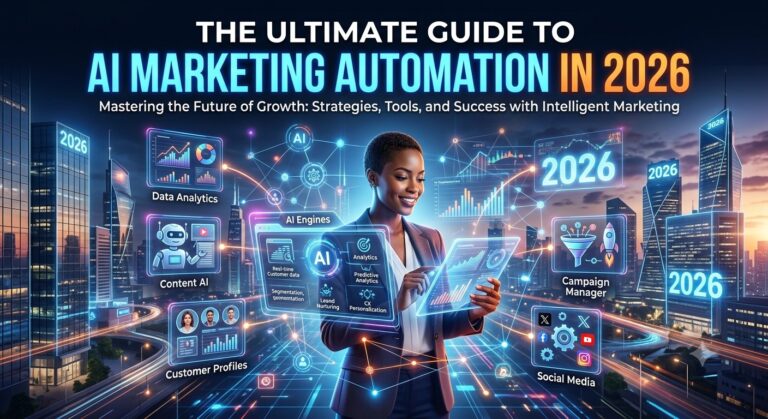
Artificial intelligence has transformed digital marketing from a manual, time-consuming process into an intelligent, data-driven strategy. In 2026, AI marketing automation is no longer just a competitive advantage—it’s becoming a necessity for businesses that want to grow efficiently, improve customer experiences, and maximize their marketing return on investment (ROI).
From creating personalized email campaigns to optimizing advertising budgets in real time, AI-powered automation is helping businesses accomplish more with fewer resources. Whether you’re a startup, small business owner, or enterprise marketer, understanding AI marketing automation can help you stay ahead in an increasingly competitive digital landscape.
This guide explores what AI marketing automation is, why it matters, its key benefits, practical applications, and how to implement it successfully.
AI marketing automation combines artificial intelligence with traditional marketing automation to create smarter, more adaptive campaigns. Unlike conventional automation, which relies on predefined rules, AI systems analyze data, recognize patterns, predict customer behavior, and continuously optimize marketing activities.
AI marketing automation can perform tasks such as:
By reducing manual work, businesses can focus on strategic planning and creative decision-making.
Modern consumers expect fast responses, personalized experiences, and relevant recommendations. Meeting these expectations manually is increasingly difficult as businesses scale.
AI marketing automation addresses these challenges by helping companies:
Organizations that embrace AI automation are better positioned to compete in today’s digital marketplace.
AI automates repetitive marketing tasks, allowing teams to focus on strategy, creativity, and customer relationships.
Examples include:
AI analyzes customer preferences, browsing behavior, and purchase history to deliver highly personalized experiences.
Personalization includes:
This helps improve engagement and conversion rates.
AI identifies potential customers by analyzing behavior patterns and engagement data.
Businesses can automatically:
This enables sales teams to focus on high-quality opportunities.
Managing advertising campaigns manually can be both expensive and time-consuming.
AI marketing automation helps by:
These capabilities improve advertising efficiency while reducing wasted spending.
AI processes massive amounts of marketing data much faster than humans.
It can analyze:
These insights enable marketers to make informed decisions and continuously improve performance.
Email Marketing
AI optimizes email campaigns by determining the best send times, personalizing subject lines, and recommending relevant content for each subscriber.
Benefits include:
AI helps marketers create and optimize content more efficiently.
Common uses include:
AI accelerates production while allowing human editors to refine and enhance quality.
AI automation strengthens SEO efforts through:
Businesses can improve their search rankings while saving valuable time.
AI simplifies social media management by:
This enables consistent brand visibility across multiple platforms.
AI-powered chatbots and virtual assistants provide instant support by:
This improves customer satisfaction while reducing support costs.
To maximize results, businesses should follow these best practices:
Set Clear Objectives
Define measurable goals before implementing AI automation.
Examples include:
Use High-Quality Data
AI performs best when trained on accurate, organized, and relevant data.
Regularly update customer databases and remove outdated information.
Combine AI With Human Expertise
AI excels at automation and analysis, but human creativity remains essential for:
The most successful marketing teams combine AI efficiency with human insight.
Monitor Performance Regularly
Track key performance indicators (KPIs) such as:
Continuous monitoring helps refine AI-driven strategies over time.
While AI offers significant advantages, businesses should be aware of potential challenges:
Addressing these challenges requires responsible AI governance and ongoing human oversight.
AI marketing automation is evolving rapidly. Future advancements are expected to include:
As AI technology becomes more sophisticated, businesses that invest early in automation will be better equipped to adapt to changing consumer expectations and market dynamics.
AI marketing automation is reshaping how businesses connect with customers, manage campaigns, and achieve measurable growth. By automating repetitive tasks, delivering personalized experiences, and providing actionable insights, AI empowers marketing teams to work smarter and achieve better results.
Whether you’re just beginning your automation journey or looking to enhance existing strategies, adopting AI marketing automation can help your business remain competitive in 2026 and beyond.
The future of marketing belongs to organizations that combine intelligent automation with human creativity, delivering exceptional experiences that build lasting customer relationships.
To deliver innovative, scalable, AI, and human-centered technology solutions that empower businesses to thrive in a digital-first economy
1129 Northern Blvd., Suite 404, Manhasset, New York 11030
Privacy Policy | Team of Use | Cache © 2026 All rights reserved