
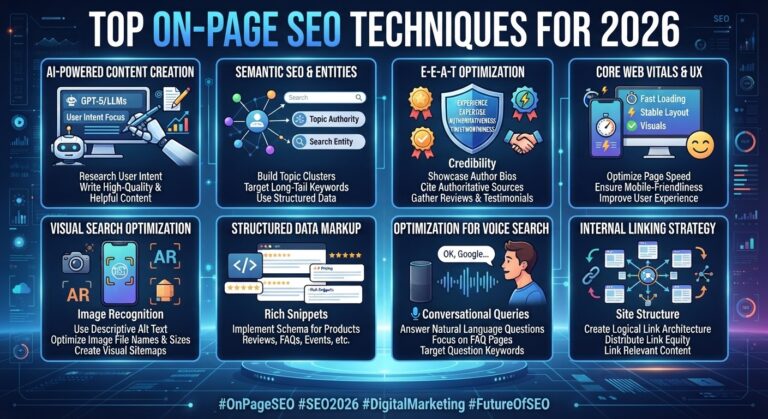
Search engine optimization continues to change, but on-page SEO remains one of the most important foundations of a successful website.
In 2026, optimizing a page is no longer simply about placing a keyword in the title and repeating it throughout an article. Search engines have become increasingly sophisticated at understanding topics, context, relationships, user intent, and content quality.
At the same time, AI-powered search experiences are changing how people discover information online.
This means modern on-page SEO needs to accomplish several things at once:
The good news is that many of the fundamentals remain straightforward.
By applying the right on-page SEO techniques for 2026, website owners and content creators can build pages that are more useful to readers and easier for search systems to understand.
On-page SEO is the process of optimizing elements within a webpage to improve its relevance, usability, and ability to perform in search results.
It can include:
On-page SEO is different from off-page SEO.
On-page SEO focuses primarily on what you control on your website.
Off-page SEO focuses on external signals such as backlinks, mentions, and other references to your website.
Both matter, but strong on-page optimization provides the foundation.
Search has become much more complex.
Users may discover information through traditional search results, AI-generated answers, featured results, videos, social platforms, forums, maps, and other search experiences.
This creates a broader challenge for website owners.
Your content needs to be:
Relevant enough to rank.
Useful enough to satisfy visitors.
Structured enough to be understood.
Trustworthy enough to be referenced.
On-page SEO helps support all four goals.
One of the most important SEO techniques in 2026 is understanding search intent.
Search intent refers to what users are actually trying to accomplish with a query.
For example:
“What is on-page SEO?”
This indicates informational intent.
The user wants an explanation.
Meanwhile:
“Best SEO tools for bloggers”
has commercial investigation intent.
The user is researching potential tools.
And:
“Buy SEO software”
has transactional intent.
The user may be ready to make a purchase.
Before creating a page, ask:
What does the searcher actually want to accomplish?
Then create content that directly satisfies that need.
Keyword optimization cannot compensate for weak content.
Your page needs to provide genuine value.
Strong SEO content should:
One of the biggest opportunities for content creators is to go beyond what competing pages already say.
Instead of asking:
“How can I make my article longer?”
ask:
“What useful information can I provide that other pages don’t?”
That mindset leads to better content.
The title tag remains an important on-page SEO element.
Your title should clearly communicate the page’s subject.
For example:
Weak:
SEO Tips
Better:
Top On-Page SEO Techniques for 2026
The second title provides much more context.
Good SEO titles should generally be:
Avoid stuffing multiple keywords into the title.
A meta description provides a short summary of a webpage.
Although the meta description itself is not a guaranteed direct ranking factor, it can influence whether users choose your result.
A strong description should:
For example:
Discover the top on-page SEO techniques for 2026, including content optimization, search intent, internal linking, structured data, and AI search strategies.
The description tells users exactly what they can expect.
Keywords still matter, but modern SEO is not about repeating the same phrase as many times as possible.
Instead, use keywords naturally throughout the content.
Include the primary topic where appropriate in:
Also use related terminology.
For example, an article about on-page SEO might naturally discuss:
This creates a richer topical context.
A common SEO mistake is treating every keyword as a separate target.
Modern content strategies increasingly benefit from organizing related searches into broader topics.
For example:
Main Topic
On-Page SEO
Related Topics
One comprehensive guide can cover many closely related concepts naturally.
This is often more useful than creating dozens of thin pages targeting tiny keyword variations.
Every important page should have a clear primary heading.
The H1 should tell visitors and search engines what the page is about.
For example:
Top On-Page SEO Techniques for 2026
is clearer than:
SEO Tips You Need to Know
Your H1 doesn’t have to exactly match the title tag, but both should accurately represent the page.
Headings make content easier to scan.
A well-structured article might look like:
H1: Top On-Page SEO Techniques for 2026
H2: What Is On-Page SEO?
H2: Why On-Page SEO Matters
H2: Top On-Page SEO Techniques
H3: Match Search Intent
H3: Optimize Page Titles
H3: Improve Internal Linking
This hierarchy helps readers navigate the article.
It also provides useful structural context for search systems.
SEO content should be easy to consume.
Avoid turning every section into a wall of text.
Instead:
Good readability isn’t about making every article extremely simple.
It’s about making information easy to understand.
Internal links connect pages within your website.
They can help visitors discover related content while helping search engines understand relationships between pages.
For example, an article about on-page SEO might link to:
Use descriptive anchor text when appropriate.
Instead of:
Click here
consider:
learn how AI improves keyword research
The second option gives users and search engines more context.
Internal linking becomes even more powerful when combined with topic clusters.
For example:
Pillar Page
Complete Guide to SEO
Supporting Pages
Connect related pages naturally.
This helps create a logical website structure.
Your URLs should be simple and descriptive.
For example:
/top-on-page-seo-techniques-2026
is easier to understand than:
/page?id=93847&cat=seo
Good URLs should generally:
Don’t make URLs unnecessarily complicated.
Images can improve content, but poorly optimized images can hurt page performance.
Use:
For example, instead of:
IMG_93847.jpg
use something descriptive when appropriate:
on-page-seo-checklist.jpg
Alt text should describe the image when the image conveys meaningful information.
Don’t use alt text as a place to stuff keywords.
A technically slow website can frustrate visitors.
Important page experience considerations include:
Optimize:
A fast and usable website provides a better experience for both visitors and search crawlers.
A large portion of web activity happens on mobile devices.
Your website should work properly across different screen sizes.
Check:
A page that looks excellent on desktop but is difficult to use on a phone is not properly optimized.
Structured data helps communicate specific information about a page in a machine-readable format.
Depending on the page, relevant structured data may describe things such as:
Structured data should accurately represent visible or relevant page information.
It should not be used to manipulate search engines with misleading information.
Some searches can produce enhanced results such as featured snippets or other prominent answer formats.
To improve the likelihood that your content can be understood for these formats:
For example, if your article answers:
What is on-page SEO?
you could provide a concise definition before expanding on the topic.
This helps both users and automated systems quickly understand the answer.
One of the biggest developments affecting SEO in 2026 is the growth of AI-powered search experiences.
Content creators increasingly need to think beyond traditional rankings.
AI systems need to understand:
To make content easier to understand:
Don’t create content solely for AI systems.
Create excellent content for people that is also easy for machines to interpret.
Generic information is easy to produce.
First-hand experience is harder to replicate.
Whenever appropriate, add:
For example, instead of simply explaining that an SEO tool can analyze keywords, explain how it was used to identify a particular content opportunity.
This adds depth and credibility.
Outdated information can make otherwise good content less useful.
Review important pages regularly.
Update:
Don’t change the publication date simply to make an old article appear new.
Actually improve the content.
One of the simplest on-page SEO techniques is also one of the most important:
Write for humans first.
Imagine someone arriving on your page.
Can they immediately understand:
If the answer is yes, you’re already moving in the right direction.
SEO traffic has little value if visitors don’t know what to do next.
Depending on the page, your CTA might encourage visitors to:
The CTA should naturally follow the user’s intent.
Examples make complex SEO concepts easier to understand.
Instead of saying:
Use descriptive internal links.
Show the difference:
Weak anchor:
Click here
Descriptive anchor:
Learn how AI improves keyword research
Examples make educational content more practical and useful.
FAQ sections can address questions that readers commonly have after reading an article.
For an on-page SEO guide, questions might include:
FAQs can improve the usefulness of a page when they provide genuinely relevant answers.
Creating new content isn’t the only way to improve SEO.
Your existing pages may already contain valuable opportunities.
Audit older content for:
Sometimes improving an existing high-potential page is more valuable than publishing another new article.
Before publishing a page, review this checklist:
Keyword and Intent
Content
Page Elements
Internal SEO
Images
Technical Experience
AI Search
Keyword Stuffing
Repeating keywords unnaturally can make content difficult to read.
Writing for Search Engines Instead of People
A perfectly optimized page is useless if visitors don’t find it helpful.
Ignoring Search Intent
A page can target the right keyword but still fail if it doesn’t satisfy what searchers expect.
Creating Thin Content
Don’t create pages simply to target additional keyword variations.
Overusing AI-Generated Content
AI can assist with content creation, but unedited, generic content may fail to provide unique value.
Ignoring Internal Links
Every useful page should fit into the broader structure of your website.
Forgetting Existing Content
Older pages can contain valuable SEO opportunities.
Neglecting Mobile Experience
Always check how your content looks and functions on smaller screens.
AI can make on-page SEO more efficient.
Content creators can use AI tools to assist with:
However, AI recommendations should be reviewed by humans.
An AI system may recommend a keyword that doesn’t make sense for your audience.
It may also suggest adding unnecessary information simply because competitors mention it.
Use AI as an assistant rather than an unquestioned authority.
On-page SEO is moving toward a more comprehensive understanding of content.
The future is likely to involve a combination of:
This means successful SEO strategies will increasingly focus on information quality and usefulness rather than mechanical keyword optimization.
The websites that consistently answer important questions better than their competitors will have a stronger foundation for long-term visibility.
What are the most important on-page SEO techniques for 2026?
Some of the most important techniques include matching search intent, creating useful content, optimizing titles and headings, improving internal linking, using related topics naturally, optimizing images, improving page experience, and making content easy for search systems and AI-powered search to understand.
Is keyword density still important in 2026?
Keyword density should not be treated as a primary SEO target. Use keywords naturally while focusing on relevance, search intent, topical coverage, and content quality.
How important are title tags for SEO?
Title tags remain an important way to communicate the subject of a webpage and can influence how users understand and choose search results.
Does internal linking help SEO?
Yes. Internal links can help users navigate your website and help search engines understand relationships between pages.
Should I use AI to create SEO content?
AI can assist with research, brainstorming, outlining, and drafting. However, human review, fact checking, originality, and expertise are important for producing genuinely useful content.
How can I optimize content for AI search?
Use clear structure, direct answers, accurate information, descriptive headings, relevant context, and credible supporting sources where appropriate. Focus on making content genuinely useful rather than trying to manipulate AI systems.
How often should I update SEO content?
There is no universal update schedule. Review content when information changes, rankings decline, competitors provide substantially better information, or the page becomes outdated.
Is on-page SEO enough to rank a website?
On-page SEO is an important foundation, but rankings can also depend on factors such as website authority, backlinks, technical accessibility, competition, content quality, and overall search relevance.
The top on-page SEO techniques for 2026 are built around a simple principle:
Create the most useful and understandable page for the searcher’s needs.
Keyword optimization still matters, but successful SEO now requires much more.
Content creators need to understand search intent, create original and helpful information, structure pages clearly, improve internal linking, optimize images, maintain strong page experiences, and make content easy for both traditional search systems and AI-powered search experiences to understand.
The strongest SEO strategy isn’t about trying to manipulate every ranking signal.
It is about building a website where every important page has a clear purpose and provides genuine value.
When you combine smart keyword research, strong content, thoughtful on-page optimization, excellent user experience, and continuous improvement, your website has a much stronger foundation for sustainable organic visibility in 2026 and beyond.
To deliver innovative, scalable, AI, and human-centered technology solutions that empower businesses to thrive in a digital-first economy
1129 Northern Blvd., Suite 404, Manhasset, New York 11030
Privacy Policy | Team of Use | Cache © 2026 All rights reserved