
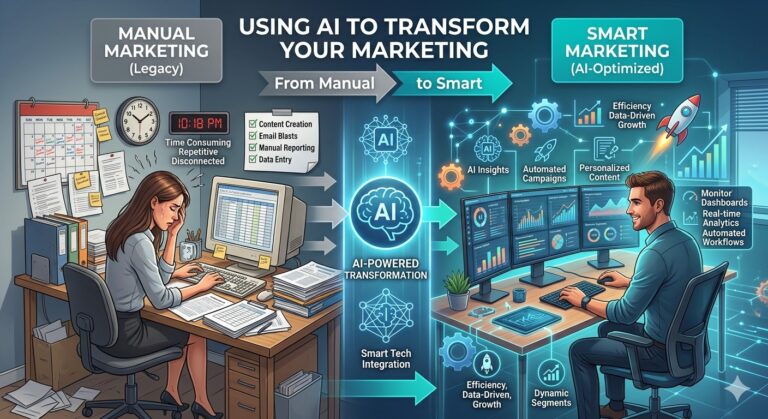
Over the past ten years, marketing has undergone significant change. Conventional marketing techniques mostly focused on manual procedures, such as writing emails by hand, publishing on social media, examining spreadsheets, and running campaigns by hand. Although these techniques were effective in the past, they are no longer effective in the fast-paced digital environment of today.
Businesses are moving away from manual marketing and toward intelligent AI-powered marketing in 2026. Businesses can automate tedious operations, analyze massive amounts of data, and provide highly customized client experiences thanks to artificial intelligence (AI).
Significant time, effort, and human resources are needed for manual marketing. Marketers frequently work for hours on monotonous procedures that may be automated.
Common challenges of manual marketing include:
As businesses grow, relying solely on manual marketing becomes increasingly inefficient.
Smart marketing uses AI technologies and automation tools to manage and optimize marketing activities. Instead of manually executing every step, AI systems analyze data and make intelligent decisions to improve marketing performance.
Examples of smart marketing capabilities include:
Smart marketing allows businesses to operate more efficiently while delivering better results.
The first step in upgrading your marketing strategy is identifying tasks that consume the most time.
AI tools can automate tasks such as:
Automation reduces manual workload and improves productivity.
Modern marketing generates large amounts of data. Analyzing this data manually can be overwhelming and inefficient.
AI-powered analytics tools can process data quickly and provide insights such as:
With these insights, marketers can make smarter and faster decisions.
Personalization is one of the most powerful advantages of AI marketing. Customers today expect brands to understand their preferences and deliver relevant content.
AI helps businesses personalize marketing by:
Personalized marketing improves engagement and increases conversion rates.
AI-powered marketing platforms can monitor campaigns in real time and make automatic adjustments.
These systems can:
This ensures marketing resources are used efficiently and improves return on investment.
Content marketing remains a key component of digital marketing. However, producing high-quality content consistently can be challenging.
AI tools assist marketers by helping them:
AI does not replace creativity—it enhances it by speeding up the content production process.
Smart marketing systems integrate multiple marketing channels into a single workflow. Instead of managing separate tools, businesses can coordinate campaigns across platforms.
Integration allows marketers to manage:
A unified marketing system improves efficiency and simplifies management.
Transitioning from manual marketing to AI-driven marketing offers several advantages.
Increased Productivity
Automation reduces repetitive tasks, allowing marketers to focus on strategic work.
Improved Marketing Performance
AI tools optimize campaigns and improve targeting accuracy.
Better Customer Experiences
Personalized marketing enhances engagement and customer satisfaction.
Scalability for Business Growth
AI systems allow businesses to handle larger marketing operations without dramatically increasing workload.
Cost Efficiency
Automation reduces operational costs by minimizing manual processes.
Some businesses hesitate to adopt AI due to concerns about complexity or cost. However, modern AI tools are becoming increasingly accessible and user-friendly.
To successfully adopt AI marketing:
This balanced approach ensures a smooth transition.
AI technology will continue to advance, offering even more powerful marketing capabilities. Future innovations may include deeper predictive analytics, advanced personalization, and fully automated marketing ecosystems.
Businesses that upgrade their marketing strategies today will be better positioned to compete in the future digital economy.
The transition from manual marketing to smart AI-driven marketing is transforming the way businesses operate. By automating repetitive tasks, analyzing data intelligently, and delivering personalized customer experiences, AI enables businesses to market more efficiently and effectively.
Upgrading your marketing with AI is not just about adopting new technology—it’s about building a smarter, scalable marketing system that supports long-term business growth.
In today’s competitive digital landscape, businesses that embrace AI-powered marketing will lead the future.
To deliver innovative, scalable, AI, and human-centered technology solutions that empower businesses to thrive in a digital-first economy
1129 Northern Blvd., Suite 404, Manhasset, New York 11030
Privacy Policy | Team of Use | Cache © 2026 All rights reserved