
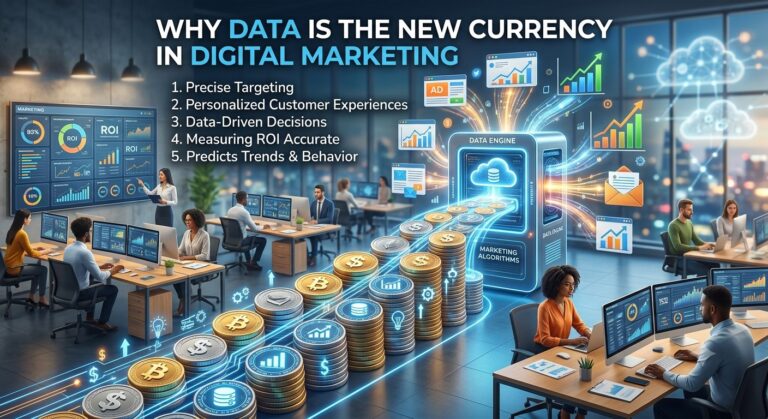
In the digital economy, information has become one of the most valuable resources businesses can have. While money has always powered business growth, today’s most successful companies are gaining an advantage through something equally powerful: data.
In 2026, businesses rely on customer data, analytics, and artificial intelligence to understand audiences, improve marketing strategies, and create better customer experiences.
Data helps brands discover what customers want, when they want it, and how to communicate with them effectively. This is why many experts consider data the new currency in digital marketing.
This article explores why data has become essential for modern marketing and how businesses can use data-driven marketing strategies to achieve sustainable growth.
The phrase “data is the new currency” means that information has become a valuable asset in the digital world.
Just as financial currency helps businesses make investments, customer data helps companies:
Businesses that effectively collect and use data gain deeper insights into their customers and can make smarter marketing decisions.
Traditional marketing often relied on assumptions, broad targeting, and limited customer insights.
Modern digital marketing uses data to understand:
With the help of digital marketing analytics, businesses can create strategies based on real customer behavior instead of guesswork.
Customer understanding is the foundation of successful marketing.
Data provides insights into:
By analyzing this information, businesses can create more relevant campaigns and connect with customers more effectively.
Customers expect personalized experiences from brands.
Data allows businesses to deliver:
Data-driven marketing helps companies create messages that match individual customer needs.
Personalization improves engagement, builds trust, and increases customer loyalty.
Marketing decisions become more effective when supported by accurate information.
Data helps businesses answer questions like:
Using marketing analytics tools, companies can measure results and continuously improve their strategies.
Artificial Intelligence depends on high-quality data.
AI systems use data to:
The combination of AI marketing tools and customer data allows businesses to create smarter marketing systems.
A great customer experience is one of the biggest advantages in modern business.
Data helps companies:
When businesses understand customers better, they can create experiences that keep people coming back.
Digital advertising has become more precise because of data.
Instead of showing ads to everyone, businesses can target specific audiences based on:
Data-powered advertising helps businesses reduce wasted spending and improve campaign performance.
One of the biggest developments in digital marketing is predictive technology.
Using customer data, businesses can forecast:
Predictive marketing helps brands take action before customers make decisions.
Search Engine Optimization also depends heavily on data.
SEO data helps businesses understand:
With AI SEO tools, marketers can analyze information faster and create content that better matches user intent.
Previously, large companies had an advantage because they had more resources and research capabilities.
Today, data tools have changed the landscape.
Small businesses can use:
These technologies allow smaller companies to make smarter decisions and compete with larger brands.
Businesses use different types of data, including:
Customer Data
Information about customers, preferences, and interactions.
Behavioral Data
Data showing how users interact with websites, apps, and content.
Marketing Performance Data
Information about campaign results and conversions.
Sales Data
Insights about purchases, revenue, and customer value.
Combining these data sources creates a complete view of customer behavior.
Better Customer Targeting
Businesses can reach the right audience with more accurate messaging.
Higher Conversion Rates
Relevant campaigns encourage more customer actions.
Improved ROI
Data helps businesses spend marketing budgets more effectively.
Faster Growth
Insights allow companies to identify new opportunities.
Stronger Customer Relationships
Personalized experiences improve trust and loyalty.
Although data provides many benefits, businesses must manage it responsibly.
Common challenges include:
Successful businesses balance innovation with responsible data management.
The future of marketing will become even more dependent on intelligent data usage.
Future trends include:
Businesses that understand and use data effectively will have a major advantage.
Data has become one of the most valuable resources in modern digital marketing. It allows businesses to understand customers, personalize experiences, improve campaigns, and make smarter decisions.
In 2026 and beyond, companies that treat data as a strategic asset will be better prepared for the future of online growth.
The future of marketing is not only about reaching more people—it is about understanding them better.
To deliver innovative, scalable, AI, and human-centered technology solutions that empower businesses to thrive in a digital-first economy
1129 Northern Blvd., Suite 404, Manhasset, New York 11030
Privacy Policy | Team of Use | Cache © 2026 All rights reserved